


Geopolitical tensions are often seen as a source of inflation. But this is only part of the story. This column shows that geopolitical shocks transmitted through energy markets raise prices while depressing economic activity. But geopolitical shocks unrelated to energy markets reduce inflation instead. These two shocks can be identified based on oil prices and geopolitical risk dynamics around major geopolitical events.
Russia’s invasion of Ukraine brought geopolitics back to the centre of the inflation debate. The conflict spillovers threatened energy supplies, oil and gas prices rose sharply, and higher energy costs subsequently fed into consumer prices and firms’ production costs (Bachmann et al. 2022). But not every geopolitical event looks like February 2022 (or March 2026).
After the September 2001 terrorist attacks, for example, geopolitical risk increased dramatically while oil prices fell. Other episodes display yet another combination of movements in geopolitical risk, commodity prices and economic activity. Treating all increases in geopolitical risk as the same economic shock can therefore obscure rather than clarify their effects on inflation.
Figure 1 Geopolitical risk and oil prices do not always move together
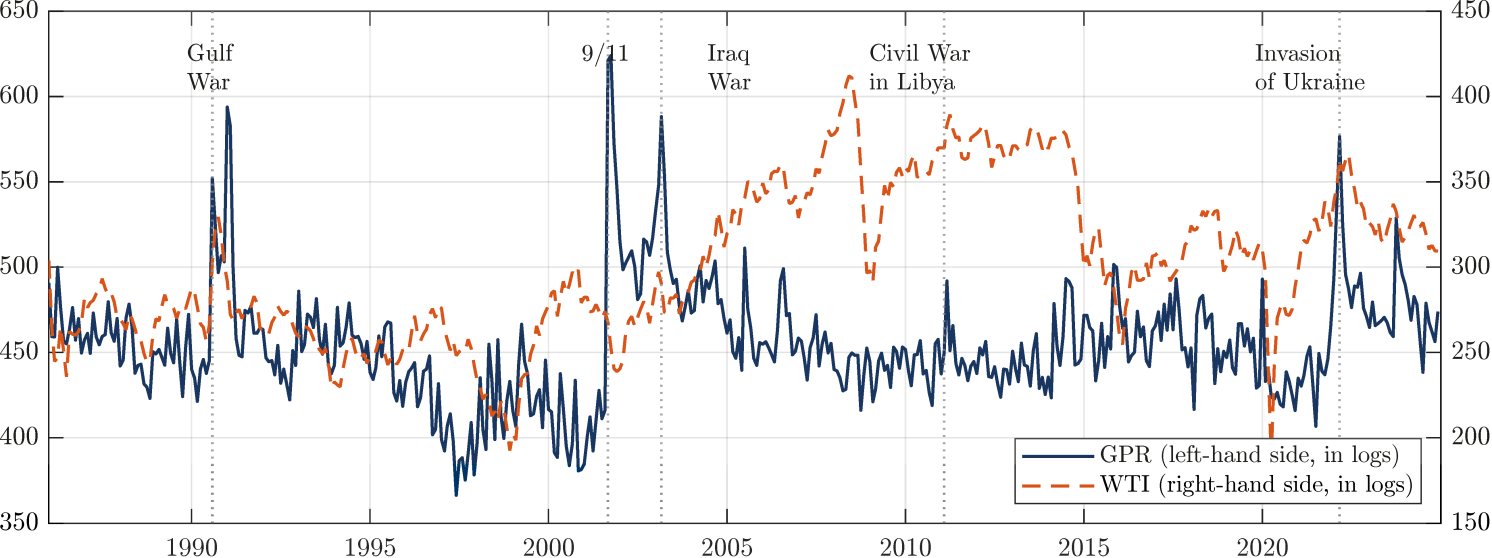
Note: GPR = Geopolitical Risk Index of Caldara and Iacoviello (2022). WTI is the West Texas Intermediate oil price, deflated by the US consumer price index.
This distinction matters because geopolitical events can affect the economy through very different channels. A conflict in an important energy-producing region may threaten the supply of oil or gas. Another event may primarily raise uncertainty, weaken confidence, and reduce expected global demand. Both increase geopolitical risk, but their implications for inflation can be almost the opposite.
Reading geopolitical shocks through energy markets
In a recent paper (Pinchetti 2026), I use the behaviour of energy markets around major geopolitical events to separate these two forces. The starting point is the Geopolitical Risk Index developed by Caldara and Iacoviello (2022), which measures the intensity of geopolitical tensions using newspaper coverage. I combine movements in this index with movements in oil prices around major geopolitical episodes since 1986.
The intuition is simple. Consider an event that unexpectedly raises geopolitical risk. If oil prices rise at the same time, financial markets are signalling concerns about energy supply. I label the resulting shock a geopolitical energy shock. If instead oil prices fall as geopolitical risk rises, the event is more consistent with a deterioration in expected economic conditions that reduces energy demand. I label this a geopolitical macro shock.
To make this distinction empirically, I measure surprises in geopolitical risk and oil prices over a three-day window around major events. I then use these high-frequency comovements to identify shocks in a structural VAR, following the logic of the high-frequency sign restrictions introduced by Jarociński and Karadi (2018, 2020).
The exercise does not assume that an historical episode consists of one and only one type of shock. Wars, terrorist attacks, and international crises are complex events. Rather, the short-window movements in geopolitical risk and oil prices provide information that helps identify the economic forces underlying the broader monthly fluctuations observed in the data.
The distinction maps naturally into several well-known episodes. The Gulf War and Russia’s invasion of Ukraine feature the combination of heightened geopolitical risk and pressure on energy prices characteristic of geopolitical energy shocks. The September 2001 attacks, by contrast, were accompanied by a sharp deterioration in the economic outlook and falling oil prices.
Different shocks, different paths for inflation
The macroeconomic consequences of the two shocks are intrinsically different. Both types of geopolitical shock reduce economic activity. This common contractionary effect helps explain why increases in geopolitical risk are often associated with weaker growth, irrespective of their origin. Their effects on prices, however, go in opposite directions.
Geopolitical energy shocks raise oil prices and consumer prices while reducing industrial production. In this respect, they resemble adverse supply shocks: firms face higher input costs at the same time as aggregate activity weakens. In the estimates, consumer prices increase by around 0.2% at their peak following such a shock.
Geopolitical macro shocks are also contractionary, but they lower oil prices and consumer prices. Their dominant effect resembles a negative demand or uncertainty shock rather than an adverse energy-supply shock. The estimated decline in consumer prices ranges from roughly 0.1% to 0.4%, depending on the horizon.
Figure 2 Macroeconomic effects of geopolitical macro and geopolitical energy shocks
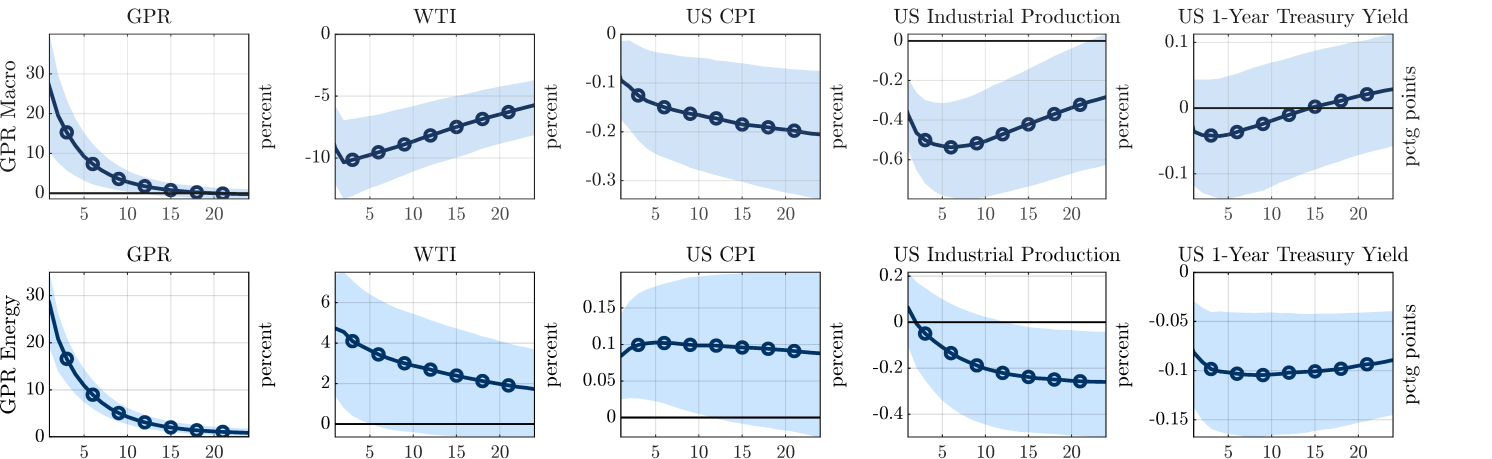
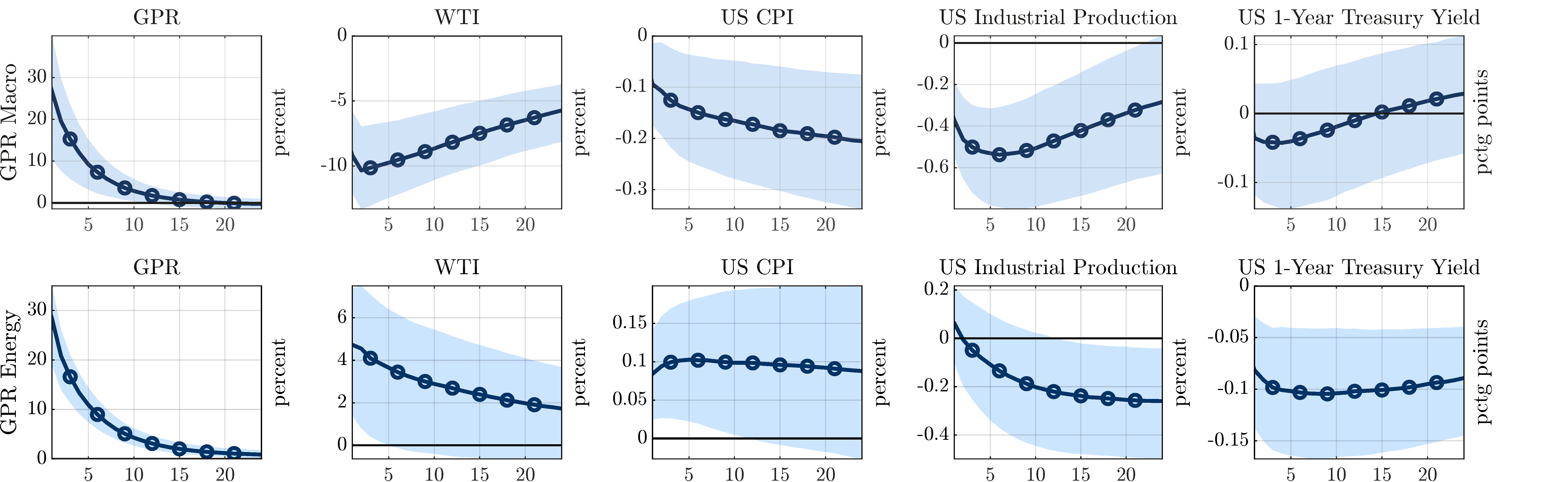
Note: Estimated responses to one-standard-deviation geopolitical macro and geopolitical energy shocks. Shaded areas denote 68% credible sets.
This helps reconcile apparently conflicting views of the relationship between geopolitics and inflation. Recent evidence shows that geopolitical risk can be inflationary on average. But an average effect may combine shocks operating through quite different mechanisms. The relevant question is therefore not simply whether geopolitical risk has increased, but why it has increased and through which markets it is being transmitted.
Is energy really the mechanism?
Calling the first disturbance a geopolitical energy shock requires more than observing that oil prices rise after it. A stronger test is whether the shock disproportionately affects the parts of the economy that use more energy.
I therefore turn to sectoral evidence. The idea is straightforward. If energy markets are genuinely responsible for the inflationary effects identified in the aggregate data, sectors whose production processes are more energy intensive should experience larger cost pressures following a geopolitical energy shock.
That is what the data show. Across manufacturing sectors, higher energy intensity is associated with substantially stronger increases in producer prices and larger falls in output after geopolitical energy shocks. By contrast, this relationship is absent, or much weaker, following geopolitical macro shocks.
This cross-sectional evidence is useful because it provides an independent test of the interpretation imposed by the high-frequency identification. The shock identified from the joint increase in geopolitical risk and oil prices behaves in the sectoral data as an energy-cost shock should: the industries most exposed to energy inputs are also those most affected.
The result also suggests why aggregate inflation responses to geopolitical events may differ substantially across countries. Economies differ in their energy mix, import dependence and production structure. The same international geopolitical event can therefore generate different domestic price pressures depending on how exposed firms and households are to energy costs.
Policy implications
Asking whether “geopolitical risk raises inflation” is somewhat like asking whether “oil prices affect output” without distinguishing between supply and demand shocks. The answer depends on the shock that lies behind the observed movement. Geopolitical events are not exclusively energy disruptions events – they can disrupt trade, alter government spending, financial conditions, and change firms’ investment decisions. Whether geopolitical disturbances operate through energy markets or predominantly through broader macroeconomic conditions matters for short- and medium-run transmission.
The practical lesson is correspondingly simple. A spike in geopolitical risk should not automatically be interpreted as an inflationary signal. When geopolitical tensions rise, what happens in energy markets can tell us a great deal about what happens next. For policymakers observing a sudden geopolitical escalation, movements in energy markets can therefore provide valuable information to evaluate the consequences of the underlying shock for inflation dynamics.
Source : VOXeu