

Official Russian statistics report a mild recession in 2022 following the full-scale of Ukraine but suggest that Russia has since fully recovered. This column argues that data on nighttime lights emitted by Russian cities suggest otherwise. The authors find evidence of a significant economic slowdown due to the war, and substantial redistribution of economic activity across Russia’s regions. The costs appear to have been concentrated where it matters: in the economic and political core of Russia.
On 24 February 2022, Russia launched its full-scale invasion of Ukraine. The West responded by imposing waves of sanctions on Russia, freezing its assets abroad, and excluding it from international payment systems. At the same time, the invasion required significant funds and manpower, which were diverted from more productive uses. How has all this affected the Russian economy?
Giving an answer to this question is not straightforward. Russia has stopped releasing some national and regional statistics (SITE 2024). Moreover, the figures that it still does release are not necessarily reliable: the regime has strong incentives to manipulate them. Inflated figures help maintain domestic political support for waging war on Ukraine, and might convince Ukraine and the West that Russia has the ability, and resources, to continue the conflict as long as it deems necessary.
Indeed, while the official Russian statistics report a mild recession (-1.2%) in 2022, they suggest that Russia has since fully recovered, showing healthy growth in 2023 and 2024 (3.6 and 4.1%., respectively) and only a moderate slowdown (1% growth) in 2025. These figures would suggest that the war, sanctions, and isolation have had little real impact on the Russian economy and Russians’ wellbeing.
If the official statistics are not trustworthy, can we obtain alternative figures? Yes!
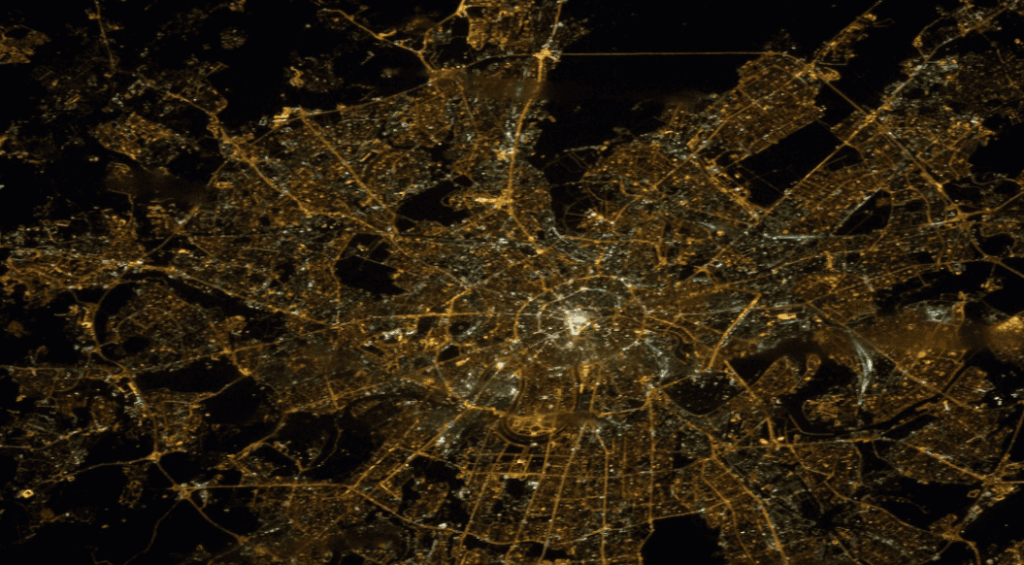
In a new paper, we use satellite imagery capturing nighttime lights emitted by Russian cities (Barbakadze et al. 2026). Human activity generates light at night and this can be observed from afar, even from space. In fact, the amount of light a place emits at night can serve as a proxy for its economic dynamism. Importantly, authoritarian or secretive governments are unable to manipulate such figures: the imagery is collected by NASA satellites and evaluated by independent researchers. For these reasons, nighttime lights have been used to assess the state of and changes to economic activity in places where official statistics are either unavailable or unreliable, including to assess the damage wreaked by internal conflict in Somalia (Shortland et al. 2013), to evaluate the economic impact of domestic conflict during the Arab Spring (Ceylan and Tumen 2021), to gauge the extent to which dictatorial regimes inflate their official GDP statistics (by as much as 35%, Martinez 2022), and to document the economic damage wreaked by Ukrainian UAV strikes on Russian refineries (Mikula and Sabatini 2026).
We collect satellite data on nighttime lights for Russia from January 2012 to January 2025, omitting summer months when nights are not completely dark in northern regions (the source is the NASA Black Marble Project). We combine this with geographical data on 1,058 Russian cities (see the Russian Cities Spatial Dataset). We treat the full-scale invasion of Ukraine as a discontinuity in time, allowing us to compare the nighttime lights before and after. In contrast to the official statistics, our figures suggest a significant slowdown in economic activity (proxied by year-to-year growth rate of nighttime lights) following the invasion. Figure 1 illustrates that this is a persistent rather than a temporary decline.
Figure 1 Invasion impact nationwide


Note: Year-on-year average growth rates of nighttime lights for Russian municipalities on a monthly basis, omitting summer months due to bright nights.
The full-scale invasion is likely to have had significant distributional implications for Russian cities too. Those located in Western (European) Russia used to trade disproportionately with European countries. Such trade flows have now been disrupted or stopped by the war and the Western sanctions. The sanctions, on the other hand, created an incentive for indirect trade through countries that did not impose sanctions on Russia. These are neighbouring countries in the Caucasus, Central Asia, and China. Our analysis captures this. Figures 2-4 show the relative gains (in green) versus losses (in red) at the levels of cities, subjects of the Russian Federation, and federal districts. They all indicate the same pattern: declines in Western Russia and gains in the South and East. When we categorise Russian oblasts according to the nearest foreign country’s border, we see statistically significant declines in those close to Ukraine, Belarus, Poland, Estonia, and especially Finland, and statistically significant gains close to China and especially Georgia (the remaining neighbours are not associated with statistically significant estimates).
Figure 2 Invasion impact: Cities


Note: Impact of the full-scale invasion on individual Russian cities.
Figure 3 Invasion impact: Federal regions


Note: City-level impact of the full-scale invasion, averaged at the level of federal regions.
Figure 4 Invasion impact: Federal districts


Note: City-level impact of the full-scale invasion, averaged at the level of federal districts.
Hence, while the invasion was, on average, bad for the economy, at the regional level it engendered winners and losers. Ironically, we obtain insignificant (zero impact) estimates for ethnic-minority regions that bore a disproportionate burden of mobilisation and casualties (Bessudnov 2023). This perhaps reflects the opposing effects of an individual’s enlistment on the home city or region. On the one hand, a soldier departing for the front means the removal of one economically active person from the local labour force. In case of an injury or death, this effect is permanent. However, the soldiers and their families benefit from the enlistment bonuses, soldiers’ salaries, and ultimately from compensation for their injury or death (Solanko 2024). These payments can more than offset the immediate economic impact of removing one economically active person from the local economy. Sadly, once the war is over, such payments will stop but the fallen soldiers will not come back to rejoin their families or the local labour force.
How do nighttime lights compare to the official statistics? We considered five officially reported measures of economic activity which remain available (albeit fragmented and incomplete) even after the full-scale invasion: the number of building permits, investment in fixed capital, number of profitable firms, number of employees, and financial results of profitable firms. For the first two, we obtain positive and statistically significant estimates: the post-invasion period seems to be marked by an improvement rather than by a contraction (the remaining three estimates do not produce significant estimates). Hence, if you trust the Russian official statistics, the war seems to have stimulated the economy rather than inflict costs on it. Nighttime lights say otherwise.
In summary, our analysis reveals both evidence of a significant economic slowdown due to the war, and substantial redistribution of economic activity across Russia’s regions. At the local level, there are winners and losers from the war. The winners are predominantly in Southern and Eastern Russia. These regions benefited from increased sanction-busting trade with countries that failed to join the West in imposing sanctions. They are also likely to have benefited from increased output of weapons, munitions, and other supplies for the war effort (this is only a speculation, as our data do not contain this information). The losers are mainly in Western Russia, close to the conflict and also close to the countries that imposed sanctions in the wake of the invasion. The war was thus costly, and those costs are concentrated where it matters: in the economic and political core of Russia. Time will show how long Russia and its citizens will be prepared to bear this cost.
Source : VOXeu