



Access to jobs is influenced by where people live and the conditions that surround them. Spatial factors such as infrastructure, safety, and exposure to natural hazards play an important role in shaping employment opportunities. Yet, these factors are often difficult to capture through traditional labor market analyses. Geospatial analysis helps address this gap. Policymakers and researchers can combine labor market data with geographic information to better understand spatial inequalities, identify location-specific constraints, and design more targeted employment interventions.
In this context, the World Bank Group has introduced GeoE3, the Geospatial Enabling Environments for Employment Spatial Tool, a QGIS plugin designed to strengthen the analysis of employment dynamics through a spatial lens. GeoE3 supports the World Bank Group’s Jobs Agenda, which focuses on improving employment outcomes and understanding the drivers of job creation, by offering a practical framework to explore how local conditions are associated with employment and business opportunities.
An important feature of GeoE3 is its capacity to incorporate a gender lens into spatial analysis. This is achieved through the integration of factors related to mobility of care, safety, and exposure to conflict and environmental-related risks, which are particularly relevant for women’s access to employment.
How does GeoE3 work?
GeoE3 structures its analysis around three dimensions: contextual, accessibility, and place characterization.
The contextual dimension focuses on the legal and institutional environment that shapes labor markets. A recent publication in the European Journal of Geography, based on a gender focused application of GeoE3 in Albania, Bulgaria, and Türkiye, found important differences across countries. In Türkiye, gaps were identified in laws related to equal pay, parental leave, and women’s ability to run businesses. In Albania, limitations were mainly observed in parental leave provisions. In contrast, Bulgaria had legal protections in place across all of these domain.
The accessibility dimension examines how easily people can reach essential services, using measures of travel time and distance. In Lubango, Angola, this dimension was used to complement a broader spatial vulnerability assessment. Pedestrian access to healthcare, education, public transport, financial services, and markets was analyzed as part of a broader assessment to identify bairros, or neighborhoods, with higher concentrations of low-income populations. Limited access to these services often signals areas where residents face greater constraints in meeting basic needs, which can act as barriers to securing and maintaining employment. This analysis was subsequently replicated in the Benguela-Lobito area, where reliable transit network data was not available, making this type of analysis difficult to apply. Instead, the assessment used proximity to essential services as a practical alternative. Although less technically detailed, this approach still provides a useful indication of how easily residents can access key services and is therefore suitable for the vulnerability assessment.1
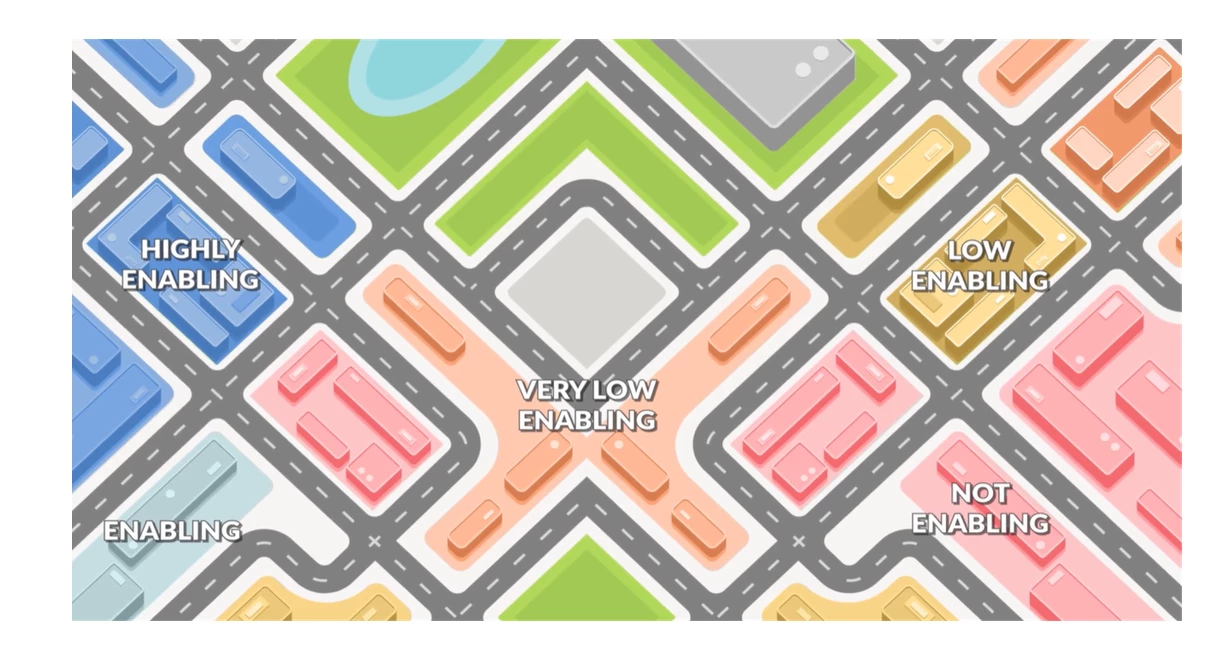
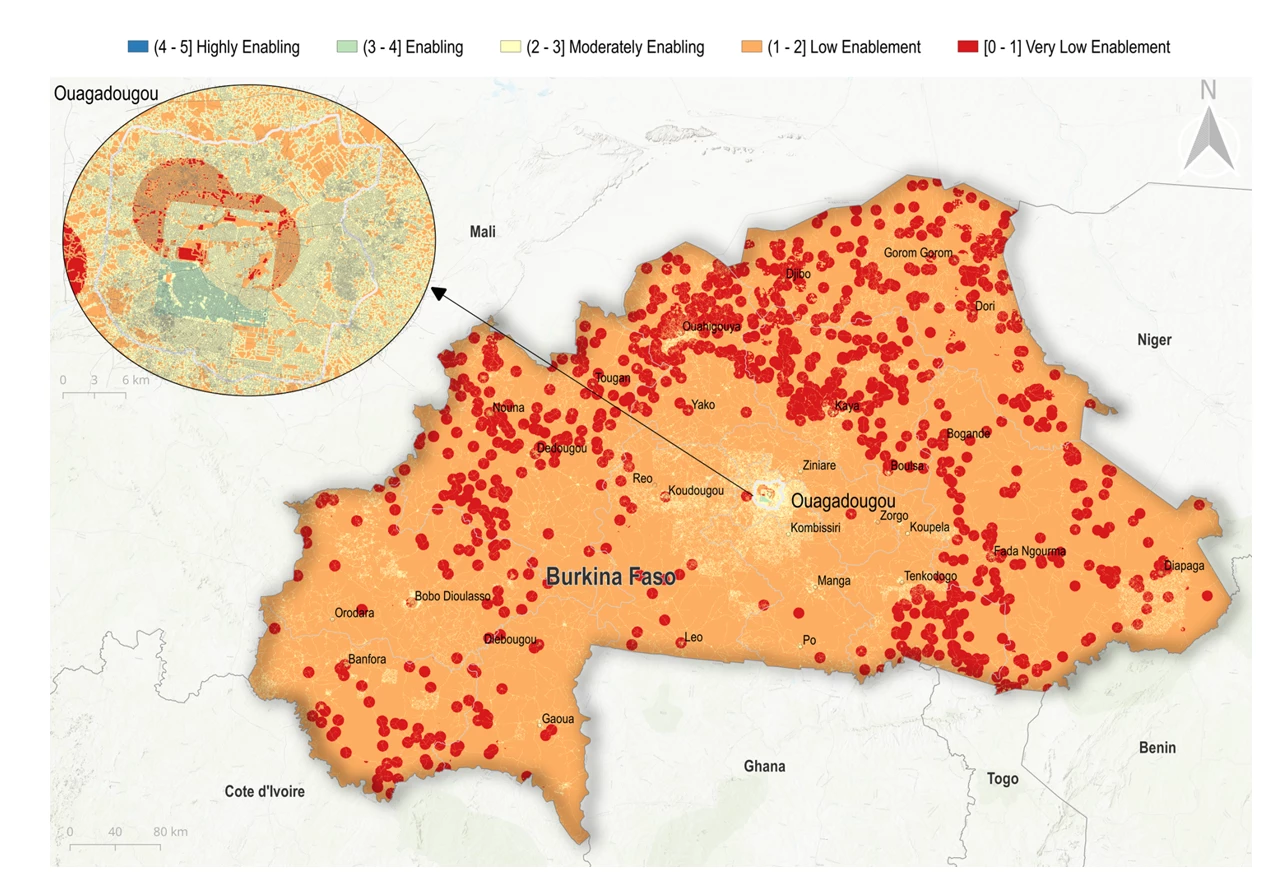
The place-characterization dimension focuses on the physical and functional attributes of locations. This includes elements such as active transport infrastructure, access to water and sanitation, digital connectivity, and exposure to risks related to fragility, conflict, and violence. In Burkina Faso, GeoE3 was used to examine spatial barriers affecting women’s participation in the informal sector. The analysis highlighted how conflict, limited access to electricity, and weak infrastructure outside major urban centers constrain women’s access to economic opportunities. Limited digital connectivity further restricts access to information and markets, reinforcing these challenges across both formal and informal sectors.
What does GeoE3 reveal about access to jobs?
GeoE3 moves beyond describing labor market outcomes and helps identify the underlying conditions influencing who can access opportunities and where constraints are most severe. Policymakers and practitioners can use these insights to design more targeted and place-sensitive employment interventions.
In doing so, GeoE3 directly supports the first pillar of the World Bank Jobs Agenda by strengthening the evidence base needed to design more targeted, place-sensitive employment policies. If you would like to learn more about how geography shapes access to jobs, particularly for women, we invite you to take the online course Geographic Considerations of Women’s Employment Opportunities, launching on June 16.
Source : World Bank