



How far can minimum wages rise without damaging jobs and output? This column uses evidence from France to show that firms respond not only by employing fewer workers, but also by increasing training and flattening management hierarchies. A quantitative model suggests that this reorganisation cushions the impact of moderate increases. Higher revenue productivity, however, is not a free efficiency gain, and the adjustment becomes less effective as wage floors rise.
The debate over higher minimum wages is increasingly about how far to go. In July 2026, the UK’s Low Pay Commission examined raising the National Living Wage target beyond two-thirds of median earnings, stressing the trade-offs and uncertainty surrounding more ambitious increases (Low Pay Commission 2026). The question is not just whether higher wage floors reduce employment, but how firms adapt before and alongside any job cuts.
Existing research points to several responses. Evidence from Hungary shows that consumers can bear much of the cost through higher prices (Harasztosi and Lindner 2019). On VoxEU, Vom Berge et al. (2021) document German workers moving towards more productive establishments, while Kondo (2020) distinguishes productivity improvements within firms from changes in which firms survive.
Less visible is adjustment inside firms: who performs which tasks, how much workers learn, and how many layers of management are needed. Our research on France (Lawson et al. 2026) finds that higher minimum wages induce smaller, flatter organisations with more training and higher revenue per worker. This helps explain why output effects can be limited – without implying that employment or efficiency costs disappear.
A French policy experiment
France’s transition to the 35-hour workweek created an unusual opportunity to study these changes. To protect minimum-wage workers’ monthly earnings, the reforms introduced five temporary wage guarantees, depending on when firms adopted shorter hours. Their subsequent reunification generated different increases in minimum labour costs among firms operating under the same legal workweek. Between 2003 and 2006, real changes ranged from a 7.9% increase to a 1.6% decline, taking payroll-tax changes into account.
We link these policy differences to administrative data on employment, occupations, training and firm accounts. Because firms chose when to adopt shorter hours, exposure was not random. We therefore also compare firms within the same wage-guarantee group according to their initial share of low-paid workers. The paper reports the identification strategy and robustness checks.
Fewer production jobs, more training, flatter firms
Consider the intermediate reform that raised the real total labour cost of a minimum-wage job by 3.7%. For a firm with average initial exposure, our estimates imply about 0.9% fewer jobs overall and 1.8% fewer production-layer jobs. Revenue per job rose by approximately 1.1% (Figure 1). These are firm-level responses, not estimates of aggregate employment changes.
The organisational changes were concentrated at the bottom. More exposed firms became less likely to add a managerial layer and more likely to remove one. Changes in managerial headcounts were smaller and generally imprecisely estimated: flatter hierarchies should not be read as evidence of large, precisely measured cuts in management employment.
Training, by contrast, increased. Among relatively simple firms, participation in employer-financed training among production workers rose by roughly two percentage points. At the same time, wage growth above the production layer was compressed, suggesting that firms partly absorbed higher labour costs by narrowing internal wage differentials. A related within-firm adjustment is documented by Adamopoulou et al. (2026): in their VoxEU column, they show that Italian wage floors shift part of the burden of adverse productivity shocks towards higher-paid workers.
The estimates show no statistically significant declines in sales or value added despite lower employment and hours. Revenue per hour rose by about 0.9%. Revenue-based measures of total factor productivity, which also account for capital inputs, increased by roughly 0.3%. Changes in capital and investment per worker were too small to explain the main productivity response.
Figure 1 Estimated firm responses to a 3.7% rise in minimum labour costs
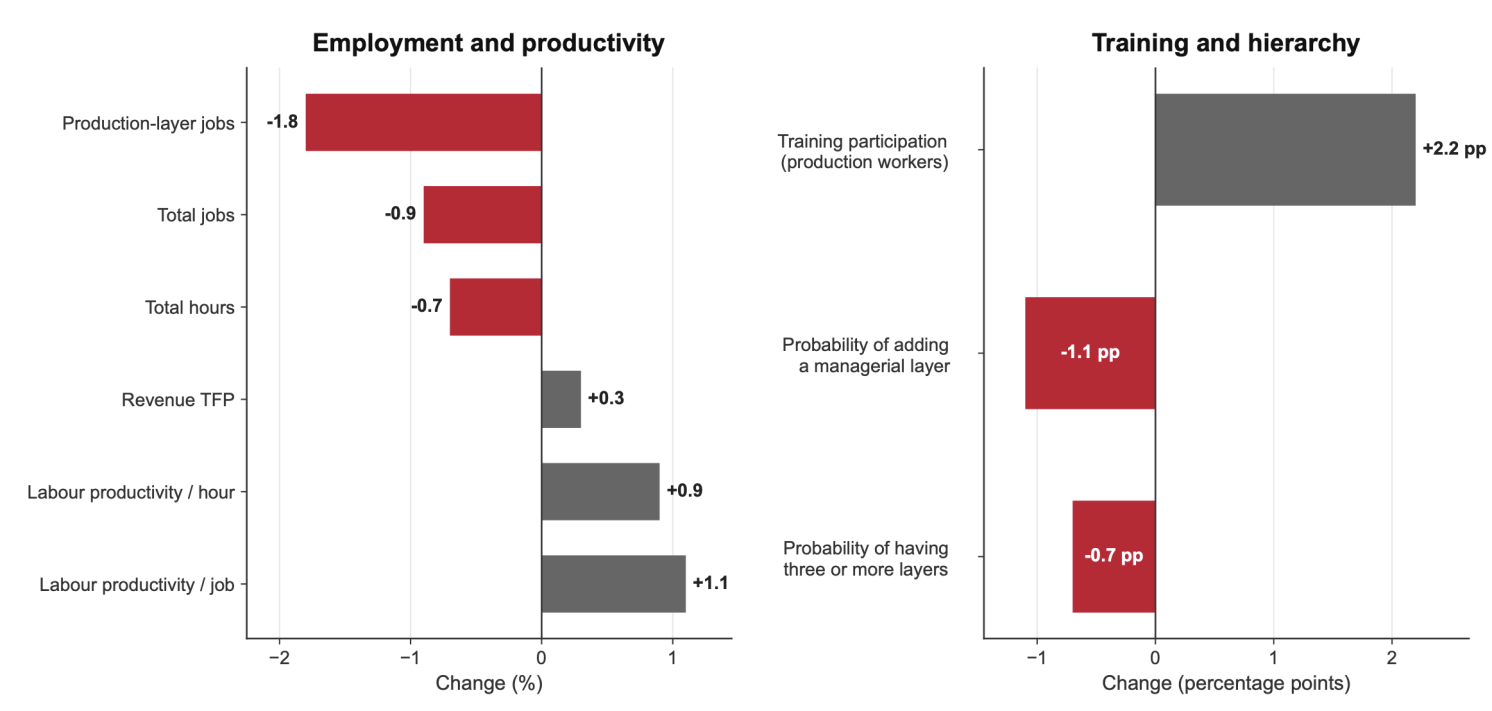
Note: Point estimates at average initial exposure to the GMR2 wage-guarantee group. Left panel: percentage changes. Right panel: percentage-point changes (pp). Revenue TFP is revenue-based total factor productivity, not physical productivity. The training estimate concerns production workers in relatively simple firms. Confidence intervals are not shown. |
Source: Lawson et al. (2026), Tables 2-4.
Why higher wage floors lead to internal reorganisation
The mechanism builds on Garicano (2000) and Caliendo and Rossi-Hansberg (2012). Production workers solve routine problems and pass difficult ones to managers. Additional managerial layers cost money, but allow a large workforce to specialise without every worker having to master every problem.
A higher wage floor changes this trade-off. Once even a basic job must pay a higher wage, investing in skills becomes relatively more attractive. Better-trained workers solve more problems independently, reducing the need for supervision. Firms can then save on managerial layers while employing fewer, more skilled production workers.
This also clarifies why higher revenue productivity need not mean greater technical efficiency. Revenue per worker can increase because firms change their workforce, organisation and prices. It is not a direct measure of how much physical output a given bundle of resources can produce – nor is it evidence of a welfare gain.
In the aggregate: Adaptation cushions moderate minimum wage increases
To assess economy-wide implications, we calibrate a model of these organisational choices to French firms in 2006. The calibration does not target the estimated responses to minimum-wage changes. Nevertheless, it reproduces their broad direction and magnitude: for an increase of around 4%, average firm size falls by roughly 1% and revenue per worker rises by a similar amount.
In the model, reorganising firms substantially cushions the output cost of moderate minimum wages. Most of the revenue-productivity gain comes from changes within surviving firms, rather than the exit of weak performers. When skills can adjust but hierarchical organisation cannot, the simulated output cost is roughly four times larger.
Figure 2 also shows the limits. At a wage floor 24% above the calibrated French baseline, modelled output is about 19% below a hypothetical economy with no minimum wage. This is not a forecast for a 24% increase today: it illustrates the limits of adaptation as the floor comes to bind a large share of the wage distribution.
Even for moderate increases, adjustment uses real resources. More effort goes into training rather than current production, profits deteriorate, and the model’s quantity-based productivity measure falls. Higher revenue per worker should therefore not be interpreted as evidence that the policy creates resources at no cost.
Figure 2 Aggregate simulations under increasingly stringent minimum wages
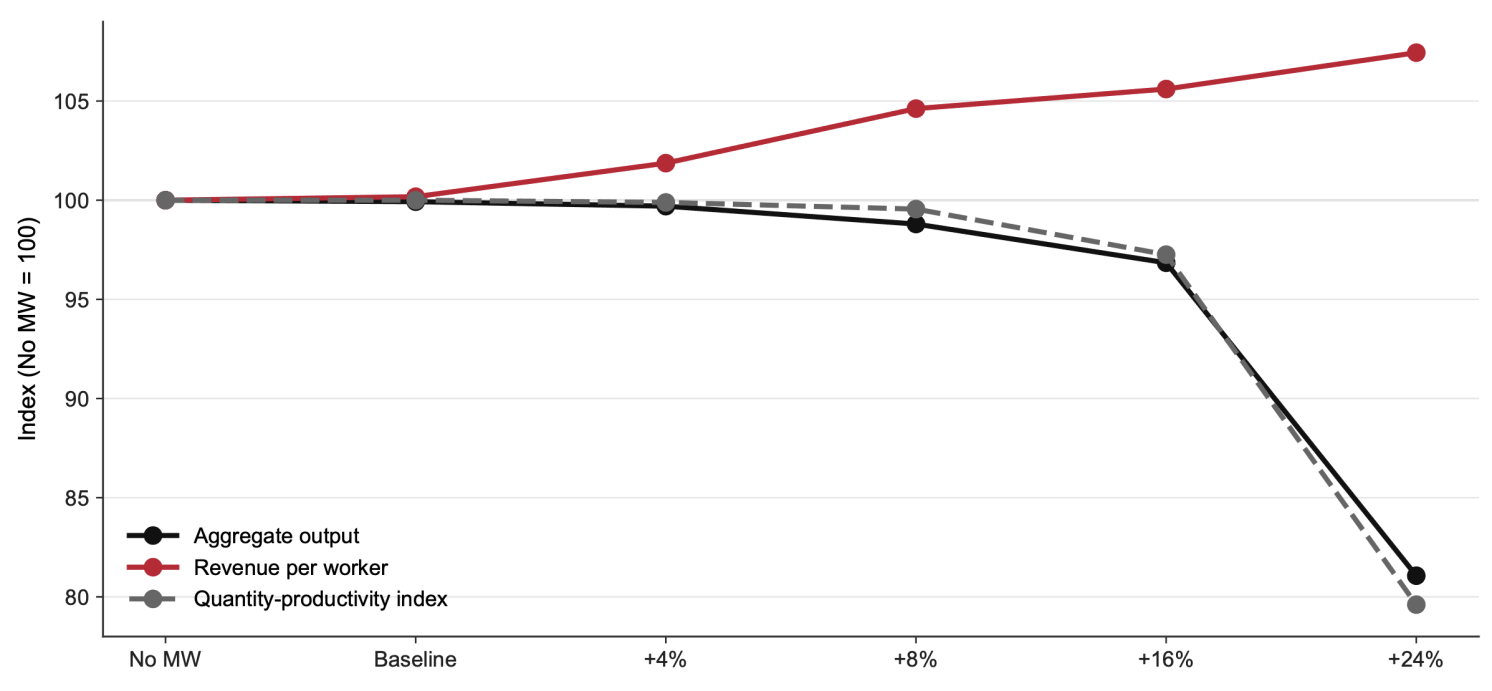
Note: Model simulations, not empirical estimates. Each series is indexed to 100 in the economy without a minimum wage (No MW). Baseline denotes the calibrated French economy; +4% to +24% are increases relative to that baseline.
Source: Lawson et al. (2026), Table 6 and Section 5.2.
What this means for policy
The first lesson is that a wage floor does more than change pay. It changes the design of jobs, the demand for training, the span of managerial control, and the distribution of employment across layers. Analyses that hold organisation fixed can substantially overstate the aggregate output cost of moderate minimum wages.
The second lesson is that higher revenue productivity is not synonymous with a welfare gain. A firm may report more revenue per worker because it employs fewer production workers, trains the remainder, changes prices and removes managers, even while technical efficiency and profits decline. Distinguishing revenue measures from physical productivity is essential.
The third lesson is that the magnitude of the policy matters. The French episode involved moderate changes and an initial exposure of about 13.6% of workers. The model’s favourable adjustment mechanism weakens when the minimum wage approaches the wages of most workers. Results from moderate reforms should not be mechanically applied to very large increases.
Finally, institutions shape the available response. France’s relatively strong employment protection may encourage firms to upgrade incumbent workers rather than replace them through hiring and layoffs. Training systems, organisational flexibility and technology will therefore influence how well the mechanism travels to other countries.
The broader point is simple: the firm is not a black box. When the wage floor changes, firms change what workers know, which problems they solve, and how many people supervise them. Ignoring those responses misses an important reason why moderate minimum-wage increases can have limited output effects – and why the costs may rise sharply once organisational adaptation is exhausted.
Source : VOXeu