


High public debt in several euro-area countries has renewed the debate over a central question: can fiscal pressures in one member state affect inflation expectations elsewhere by constraining the ECB? This column uses a randomised information experiment with German firms to show that the answer depends on trust in the central bank. Pessimistic debt projections for France, Italy, and Spain raise the three-year inflation expectations of firms that distrust the ECB, while high-trust firms do not react. By contrast, a €500 billion German debt package leaves inflation expectations unchanged.
Public debt is high in several large euro area economies, and markets and governments are concerned about its sustainability. This has renewed the debate on whether fiscal pressures could lead the ECB to tolerate higher inflation. Since Sargent and Wallace (1981), economists have understood that a central bank’s control over inflation depends on fiscal backing. If the public believes that the central bank will limit interest rate increases to protect government finances, expectations of higher inflation can become self-fulfilling. This situation is known as fiscal dominance.
Large public debts do not necessarily lead to fiscal dominance (Mengus et al. 2021), but the risk depends on the beliefs of firms and households. Recent work has found evidence that euro-area firms’ longer-term inflation expectations have become more sensitive to their short-term expectations, indicating a possible unanchoring (Baumann et al. 2025). Households adjust their expectations when confronted with news about future debt (Coibion et al. 2021), and people who perceive higher inflation also report lower trust in the ECB (van der Cruijsen et al. 2023).
In a recent paper (Bianchi et al. 2026), we study firms’ inflation expectations in response to debt news. We test whether bad news about public debt in other member states of the monetary union changes the inflation that German firms expect in Germany. We find that such news raises the inflation expectations of firms that do not trust the ECB and leaves those of firms that trust the ECB unchanged.
Half of German firms expect the ECB to hold back
The Bundesbank Online Panel of Firms surveys around 7,000 German firms each quarter and is representative by sector, size, and region. Almost 90% of respondents are owners, managing directors, or board members, who typically decide on prices. In early 2024, we asked these firms how likely it was that within five years the ECB would fail to raise rates enough to return inflation to 2% because of concerns about some euro-area governments’ finances. About half of the firms rated this scenario as likely or very likely.
This belief is closely tied to trust in the ECB to deliver on its price-stability mandate. In mid-2023, the same panel had asked firms how much they trust the ECB to deliver price stability. Among the least-trusting firms, about 70% expect the ECB to hold back, and among the most-trusting, fewer than 40% do (Figure 1). Each additional point of trust lowers the share by about 3.6 percentage points conditional on controls for firm size, sector, and region.
Figure 1 Firms that distrust the ECB are far more likely to expect it to accommodate fiscal pressure
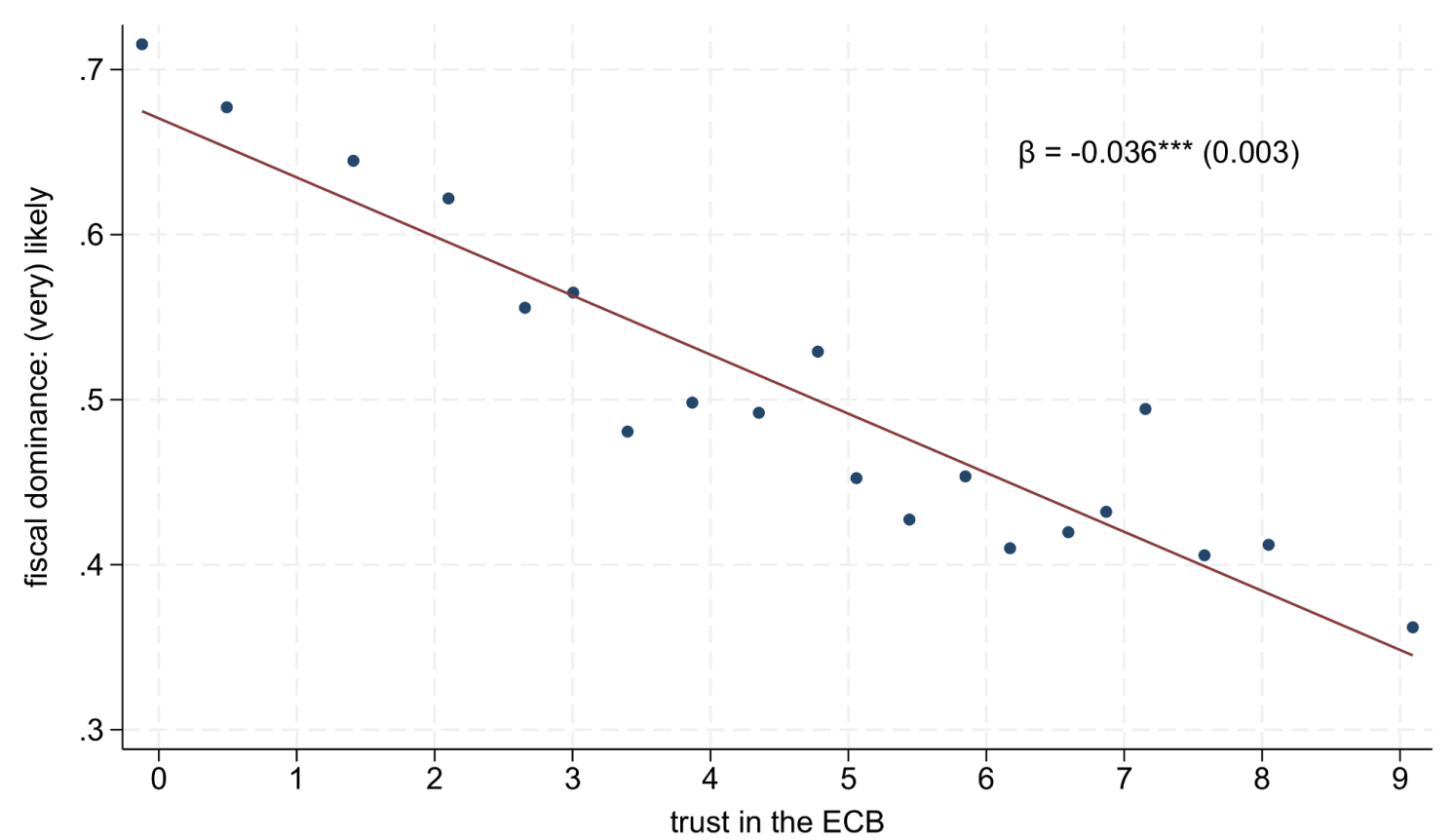
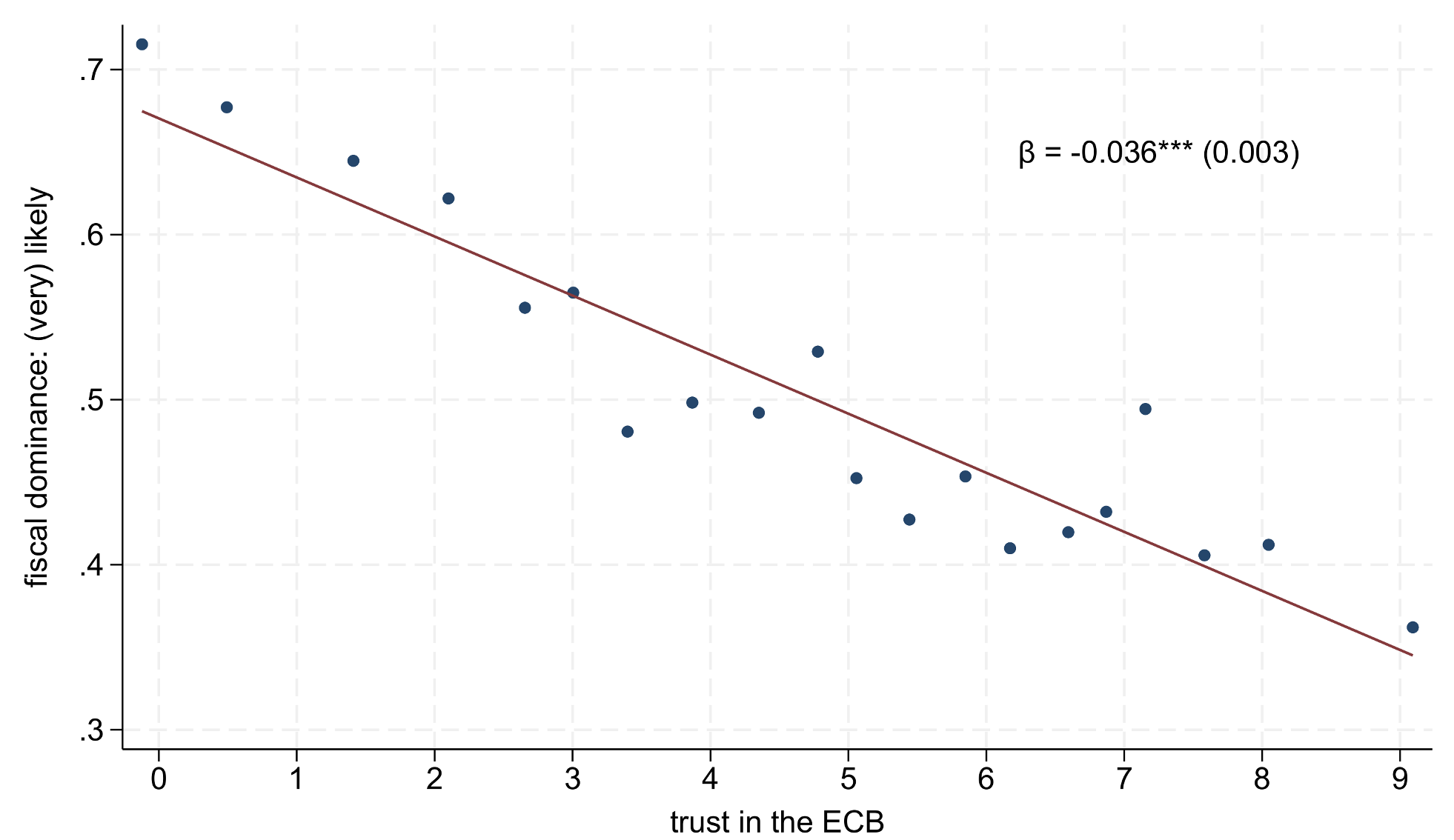
Notes: Binned scatter plot of the share of German firms that consider it likely or very likely that the ECB will not raise rates enough to return inflation to 2% because of concerns about public finances in some euro-area countries (vertical axis), against trust in the ECB to deliver price stability on a 0–10 scale (horizontal axis), controlling for firm size, sector, and region. The line shows the linear fit. Trust was elicited in Q2 2023, the fiscal-dominance question in Q1 2024.
Source: Bianchi et al. (2026).
A randomised experiment with foreign debt news
In the first quarter of 2024, we showed every firm a European Commission projection for the average debt-to-GDP ratio of France, Italy, and Spain over the next five years. Firms were randomly assigned to one of three groups. One group saw the optimistic scenario, in which debt falls from 123% to 105% of GDP. The other two saw the pessimistic scenario, in which it rises to 140%, one of them with a sentence of context on pensions and pandemic debt. Because every firm received a projection, differences between the groups reflect the content of the news, not the act of receiving information.
Firms shown the pessimistic scenario expected the three countries’ debt ratio to be almost 17 percentage points higher than firms shown the optimistic scenario. We then asked all firms again for their expectations of German inflation one, three, and five years ahead.
Distrustful firms raise their medium-term inflation expectations
On average, the pessimistic debt projection raised expected inflation by 0.17 percentage points one year ahead and 0.42 percentage points three years ahead, against pre-treatment averages of 3.8% and 3.4%, respectively. Five-year expectations did not move. The fact that the effect is larger at three years than at one year suggests that firms expect the inflationary consequences of fiscal stress to persist beyond the short run, but not permanently.
More importantly, the effects of foreign debt news on inflation expectations are entirely driven by firms with below-median trust in the ECB (Figure 2). For these firms, the debt news raises expected inflation by about 0.5 percentage points one year ahead and 1.4 percentage points three years ahead. Firms with above-median trust barely react. Neither group revises its five-year expectations.
Figure 2 Only low-trust firms raise their medium-term inflation expectations after bad foreign debt news
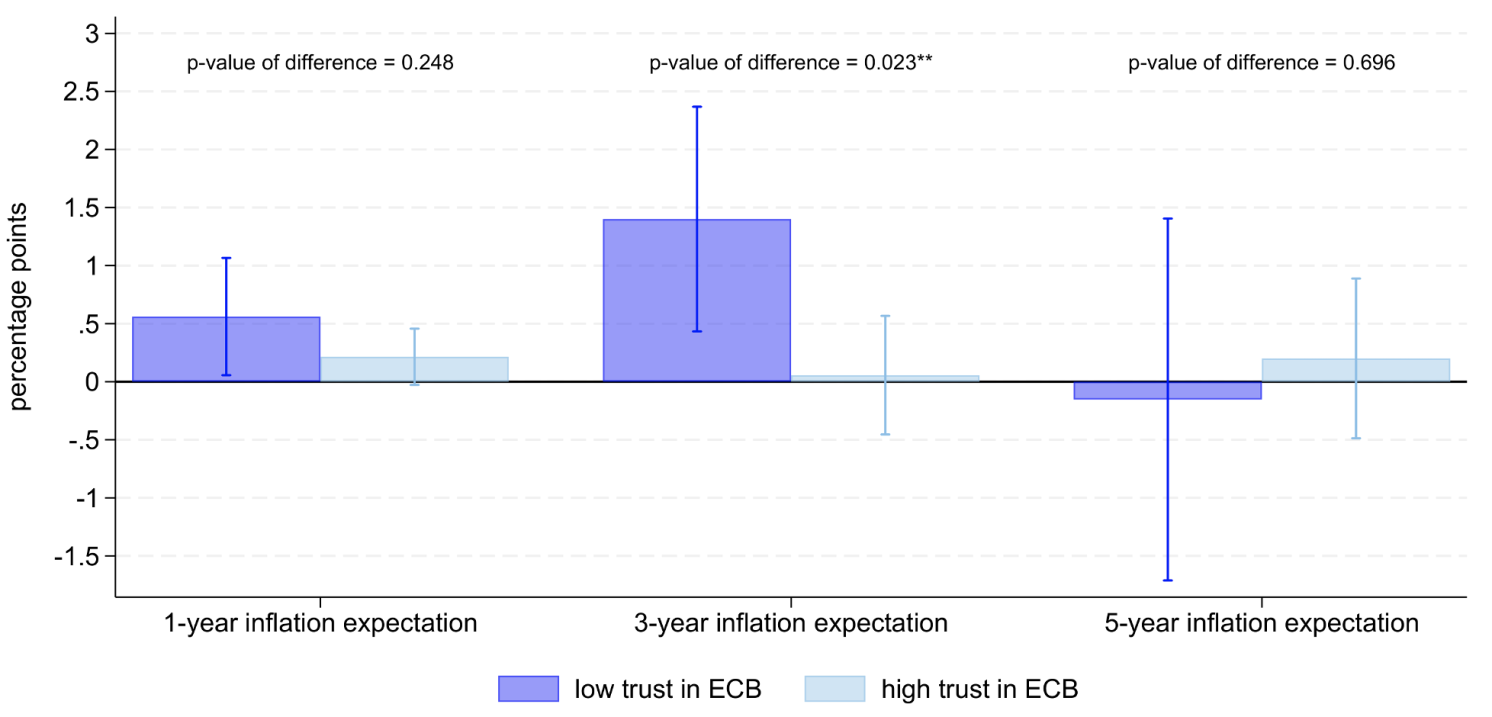
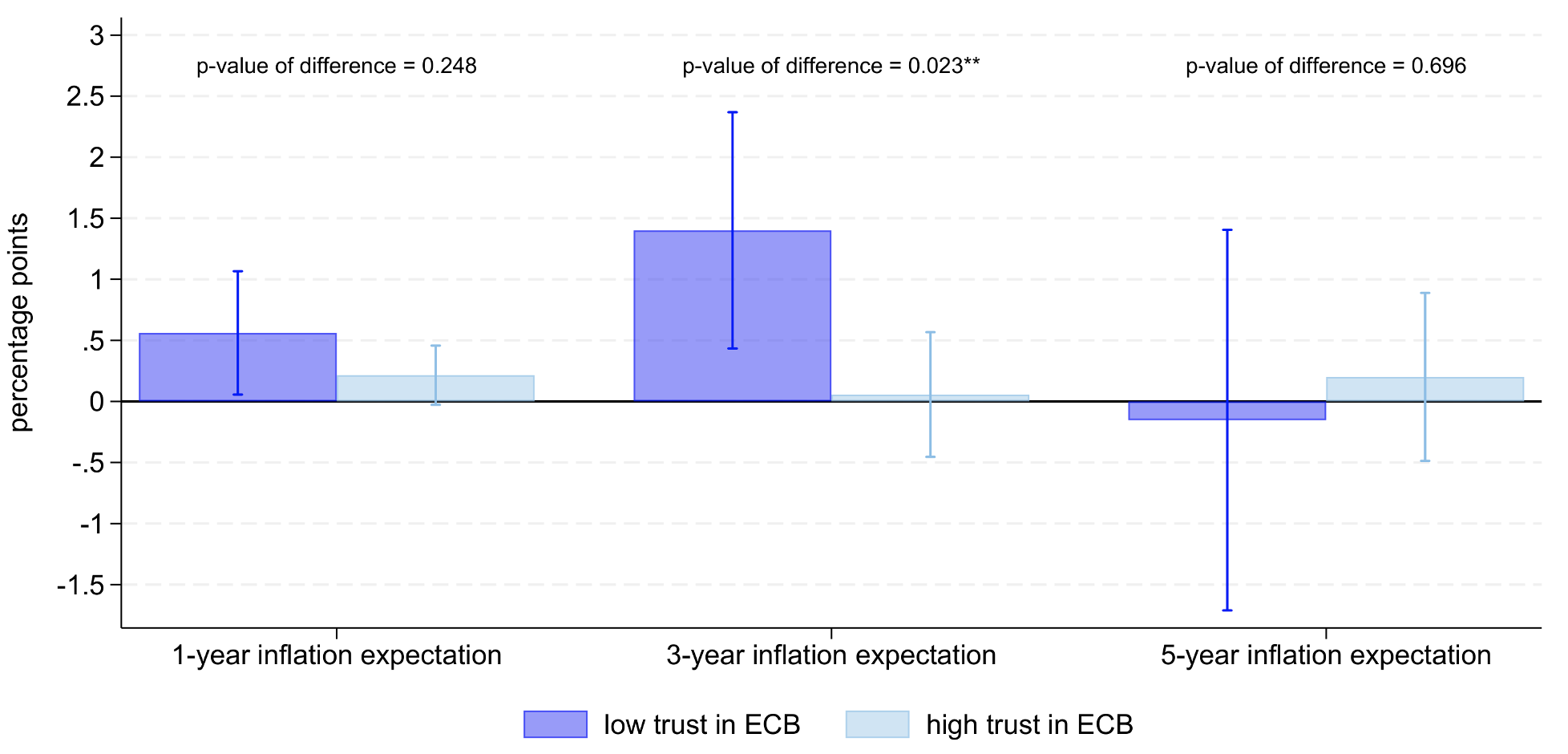
Notes: Effect on German firms’ expected inflation of a one-standard-deviation increase in expected foreign debt induced by the random assignment to the pessimistic projection, in percentage points, with 95% confidence bands. Dark blue bars: firms with below-median trust in the ECB, measured before the experiment; light blue bars: firms with above-median trust. The values above the bars test whether the two groups differ.
Source: Bianchi et al. (2026).
Three pieces of evidence point to expectations about the ECB as the channel. First, firms that expected a relatively low ECB policy rate before the experiment account for the entire effect on inflation expectations. Firms expecting a higher rate do not revise their inflation expectations. Second, the debt news did not raise expected German growth, and firms exporting to the rest of the EU react no differently from other firms, so this is not a demand spillover. Third, low-trust and high-trust firms raised the perceived probability of a euro area sovereign debt crisis by similar amounts, but only low-trust firms raised their inflation expectations. Both groups expect a crisis to become more likely, while only low-trust firms expect the ECB to respond with higher inflation.
German debt news does not move expectations
An alternative explanation is that German firms regard any rise in public debt as inflationary. The German fiscal package of March 2025 allows us to test this. On 4 March, the parties forming the new government announced a €500 billion special fund for infrastructure and climate, financed by borrowing outside the constitutional debt brake. The announcement was unexpected, and ten-year Bund yields rose by more than 30 basis points.
The survey was in the field that week, so we compare the 461 firms that responded in the three days before the announcement with the 350 that responded in the three days after. The two groups look alike in size, sector, and region. Their inflation expectations did not change at any horizon, whether we compare firms answering within one day or within five days of the announcement (Figure 3), and the same holds among low-trust firms. At three years, the estimated effect is about one-tenth of the response to the foreign debt news. German firms therefore appear to regard public debt as inflationary only when it is issued by member states whose debt they expect the ECB to accommodate.
Figure 3 The €500 billion German debt package left firms’ inflation expectations unchanged
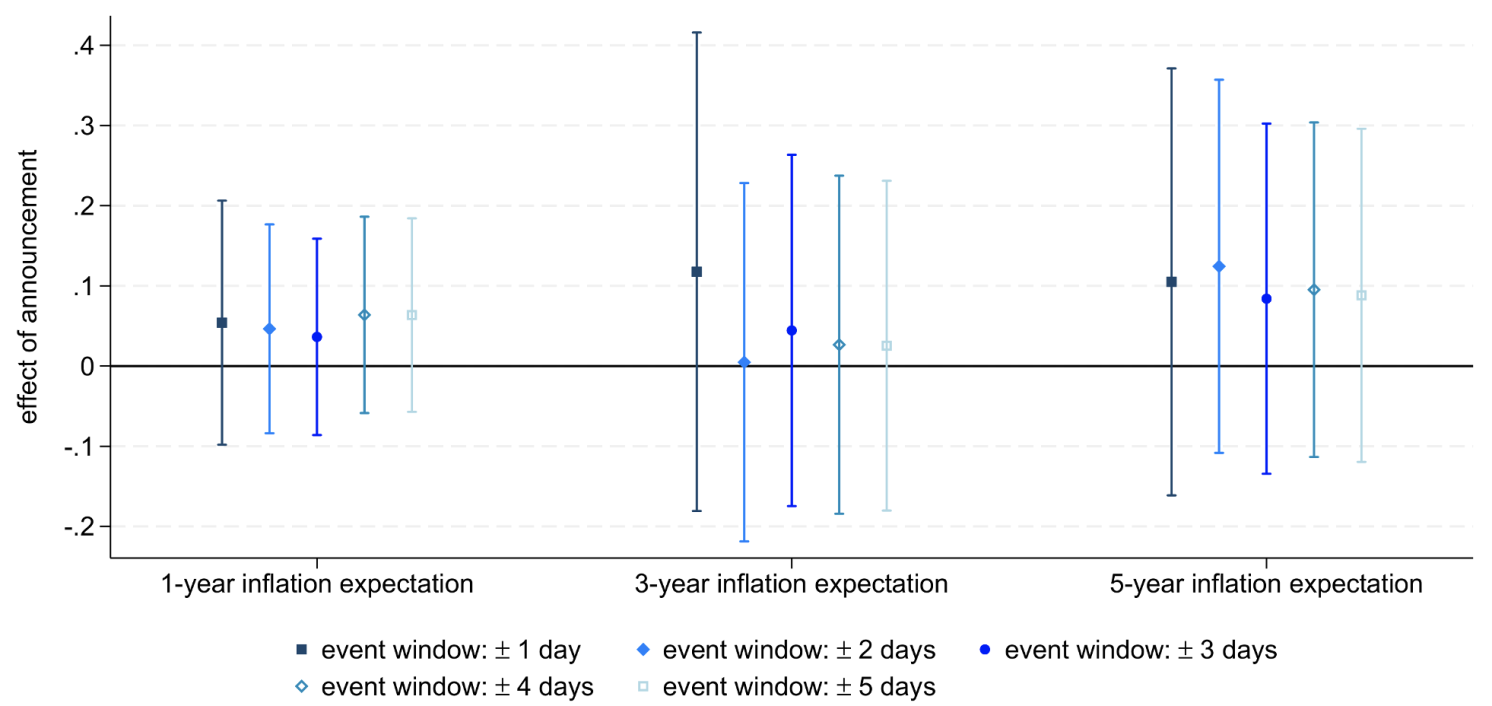
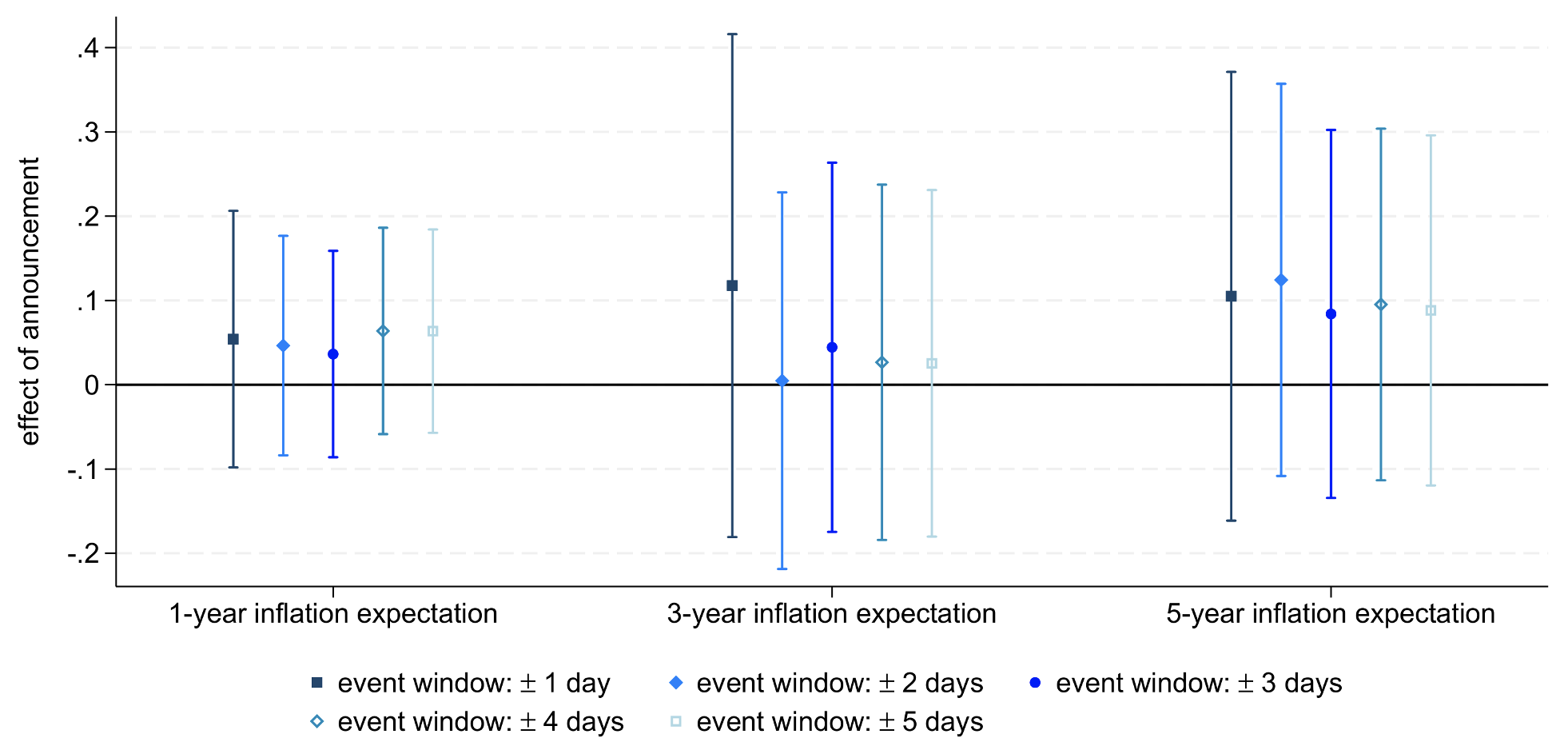
Notes: Difference in expected inflation, in percentage points, between German firms answering before and after the announcement of the German fiscal package on 4 March 2025, for event windows of one to five days around the announcement, controlling for firm size, sector, and region. Vertical lines show 95% confidence bands.
Source: Bianchi et al. (2026).
What this means for policy
Our findings are consistent with the view that long-term inflation expectations in the euro area remain anchored, because five-year expectations did not change in any of our experiments. However, focusing only on long-term expectations can be misleading. A sizeable group of firms behaves in line with fiscal dominance at the three-year horizon, which lies within the medium term over which the ECB aims to return inflation to 2%. Although these firms may not appreciate this feedback, medium-term inflation expectations may affect wage setting, which in turn feeds into firms’ costs and prices, making inflation more persistent even if long-run price stability is ultimately restored.
Our results have three implications for policy. First, distrust in the ECB can amplify the risk of fiscal dominance. Second, firms’ response depends on expected policy rates, because firms that expect the ECB to raise rates regardless of sovereign stress do not react to debt news. Communication making clear that the ECB will not hold back from raising rates because of fiscal concerns could therefore reduce the risk of fiscal dominance. Third, the effect runs from fiscal stress in high-debt member states to inflation expectations in member states with sound public finances. Fiscal consolidation in high-debt countries would therefore facilitate the ECB’s ability to stabilise inflation across the euro area.
Source : VOXeu