

Direct evidence on the effects of financial sanctions remains limited. This column uses correspondent banking data to study how sanctions affect access to global payment networks. The dollar and euro networks offer the most efficient connections to banks in other countries. Furthermore, financial sanctions imposed during 2021-2026 reduced targeted banks’ access to major-currency networks, making it harder for sanctioned institutions to make or receive payments. Non-sanctioned banks in heavily sanctioned countries also lost connectivity to these networks but reoriented towards alternatives, particularly the Chinese yuan. More generally, shifts away from the dollar and towards the yuan remain minimal.
The US Treasury’s recent ‘Operation Economic Outcast’ campaign against Iran aims to sever Iran’s financial connections to the rest of the world. Do sanctions such as those levied against Iran’s banks work? If so, how? Does using sanctions today weaken their effectiveness tomorrow?
A rapidly growing theoretical literature addresses these questions. Farrell and Newman (2019) and Clayton et al. (2024, 2025) discuss how countries can use control over key networks to exert geopolitical power. Bianchi and Sosa-Padilla (2025) model how the use of sanctions might lead to reduced future use of the dollar. But hard empirical evidence is limited on why foreign firms rely on the dollar network or whether sanctions affect banks’ access to it.
In a recnent paper (Matvos and Neiman 2026), we examine these questions using correspondent banking data. We use commercial data from LexisNexis Risk Solutions on correspondent banking relationships – the accounts banks hold with one another to send and receive payments across borders – covering more than 17,000 financial institutions in emerging market and developing economies (EMDEs). We merge these data with data on financial sanctions designated by the US, EU, and the UK from September 2021 to August 2026.
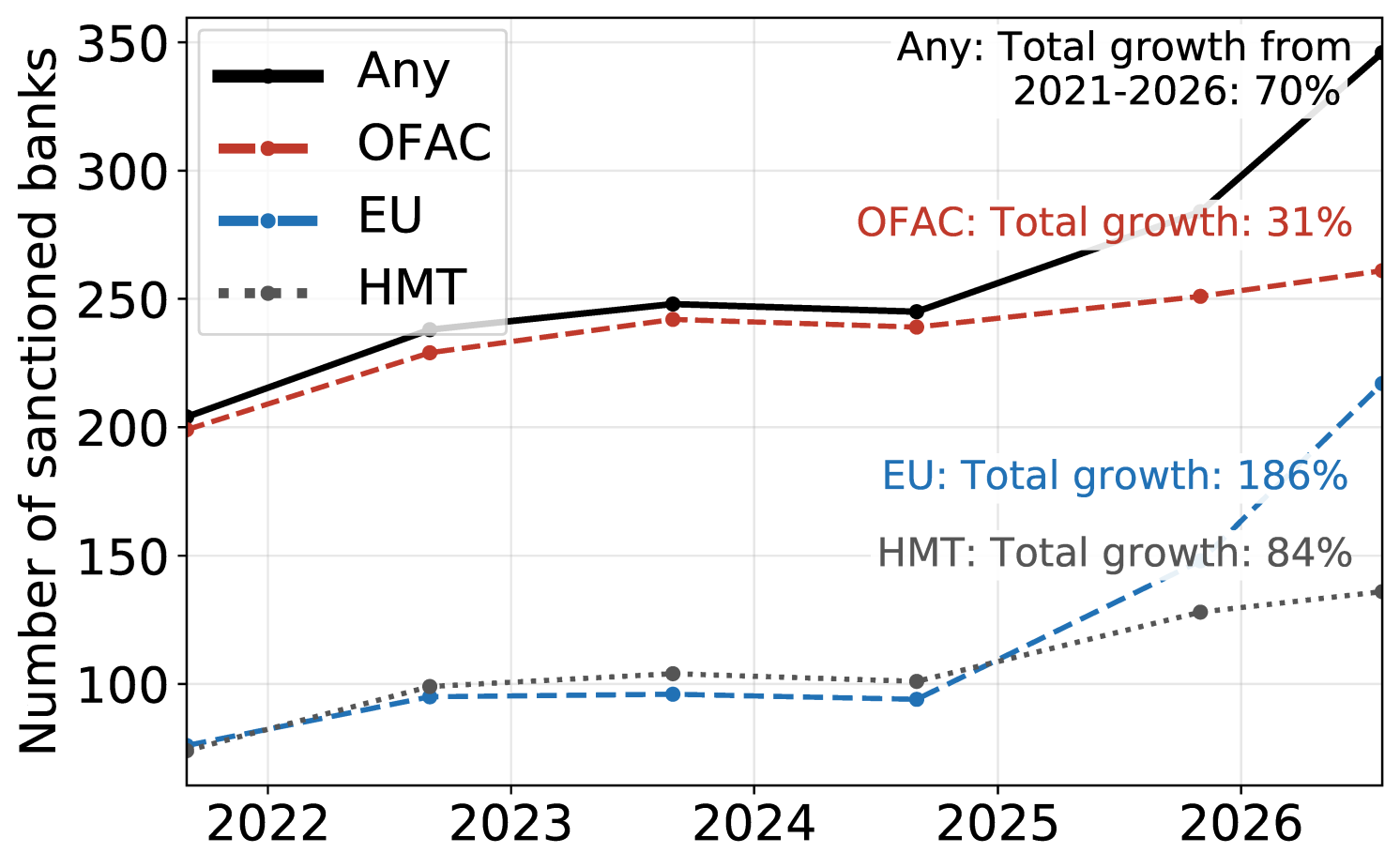
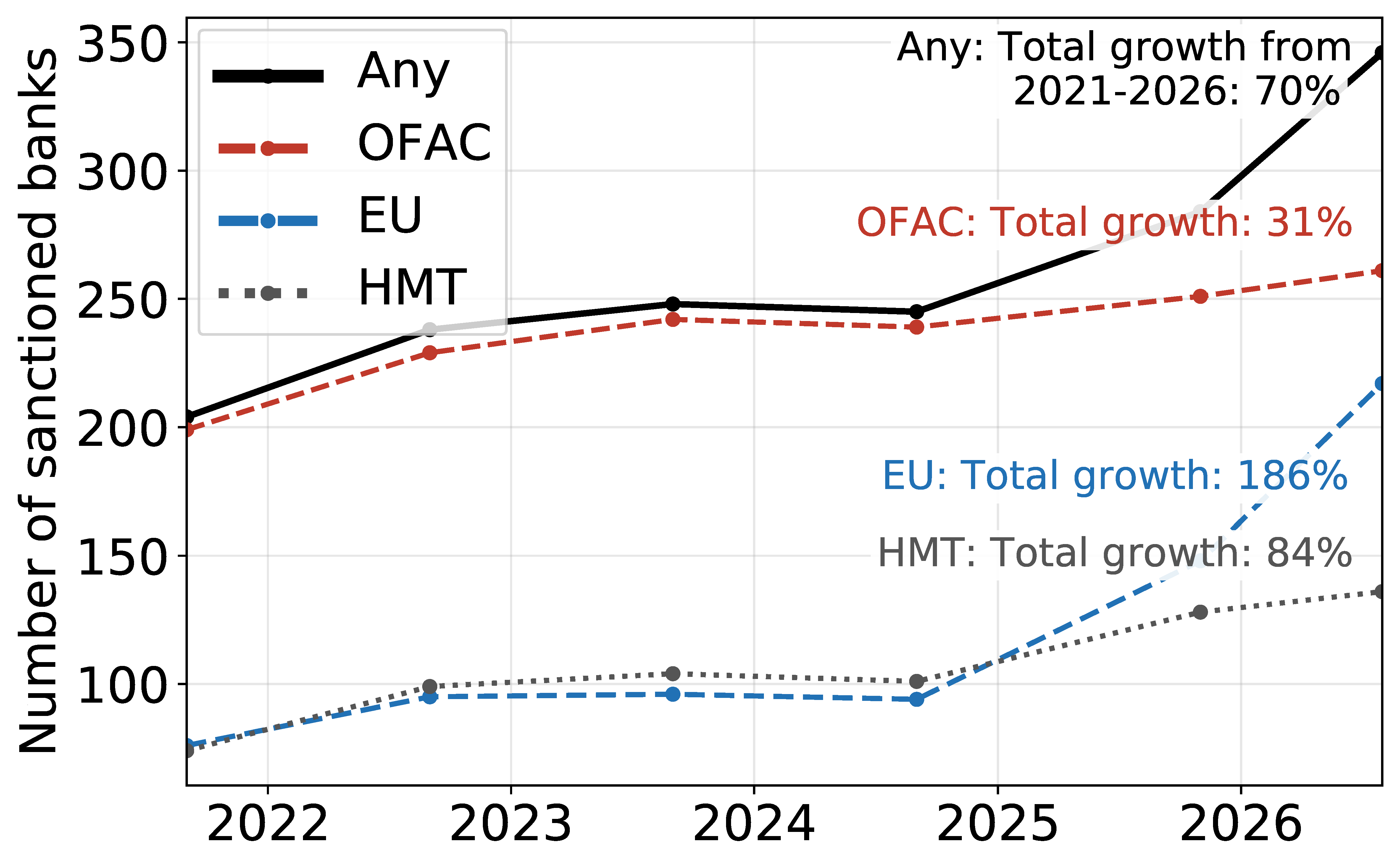
Understanding how financial sanctions work is increasingly urgent as sanctions activity of all kinds has trended upwards for decades (Felbermayr et al. 2020). The number of entities on the US Treasury’s primary sanctions list has grown from under 1,000 in 2000 to nearly 20,000 today. In our sample, the number of emerging market and developing economy banks sanctioned by the US, EU, or the UK rose by about 70% in five years, from 204 to 346 (Figure 1). Russian banks account for most of the increase, with substantial expansions also in Belarus and Kyrgyzstan.
Figure 1 Emerging market and developing economy banks under sanctions, by authority, 2021-2026
Source: Matvos and Neiman (2026), Figure 3.
Our work asks and answers four key questions:
1) Are the dollar (and euro) networks the most useful for global payments?
Yes. To show this, we start by explaining the role of correspondent banks in cross-border payments. Whereas domestic transactions benefit from a shared central bank, this is not the case for international transactions. As such, a bank that wants to receive dollars does so by holding a dollar account at another bank, called a correspondent, which can be credited. Consider an importer paying an exporter. If their banks share a correspondent, the correspondent can settle the payment by debiting one bank’s account and crediting the other’s. If not, the payment must pass through a chain of intermediaries. Each link in the chain – each ‘hop’ – adds fees, compliance checks, the cost of prefunding accounts, and counterparty risk.
Dollar and euro networks typically connect banks in fewer hops than other currency networks. Of emerging market and developing economy banks that list any correspondent, 90% have one for dollars and 88% have one for euros. By contrast, only 62% have one for British pounds, and 34% for yuan. Further, dollar and euro chains connect four to five times as many cross-border bank pairs as yuan chains, and do so in fewer hops – below three on average, versus nearly four for the yuan. For roughly three-quarters of connected bank pairs, the shortest payment path runs through the dollar or euro network. The yuan offers the shortest path about 3% of the time.
Further, the greater connectivity offered by the dollar network is owed in large part to the presence of key hubs that sit in the US jurisdiction. The ten most central banks – hubs in the network – account for 77% of the total PageRank of the dollar network, indicating a high concentration of network centrality. The comparable figure is about half for the euro and the yuan. Access to the most efficient payment infrastructures runs through a small set of institutions to which US and European authorities can deny access.
2) Do sanctions succeed in cutting targets off?
Largely, yes. Sanctions sharply cut targeted banks’ access, across nearly all currencies and counterparty countries.
Sanctioned banks lose their correspondent relationships. Of those banks that are eventually sanctioned and that report at least one correspondent relationship, the likelihood that they have dollar correspondents drops from 89% to 20% after being sanctioned by the US. The share with a US-based dollar correspondent falls to 11%. Comparable losses occur for sanctioned banks’ euro, pound, and yuan correspondent relationships.
Further, their remaining network access also deteriorates. Before designation, eventually sanctioned banks maintain relationships with dollar correspondents that together account for about 15% of the total PageRank of the dollar network. After designation, they lose access to the most important correspondents, so this share falls to below 2%.
As a result, the length of payment chains from sanctioned banks to the rest of the world grows significantly. The number of hops sanctioned banks need to connect with reachable banks in their home countries’ five largest trading partners rises in all currencies we study, other than the Russian ruble.
Sanctions make payments costlier, slower, and riskier, often routed through indirect clearers in third countries.
3) What happens to untargeted banks in heavily sanctioned countries?
In heavily sanctioned countries like Belarus, Kyrgyzstan, Myanmar, and Russia, even untargeted banks lose access to Western payment networks. They similarly lose access to dollar, euro, and pound correspondents. The likely driver is de-risking: correspondents cut ties with entire jurisdictions rather than risk secondary sanctions or compliance failures. The country-level consequences are substantial. Across all Belarusian banks, cross-border correspondent relationships in dollars, euros, and pounds fell from 139 in 2021 to 19 by 2026. Further, the dollar correspondents that remained were located in Kazakhstan and China, not in the US.
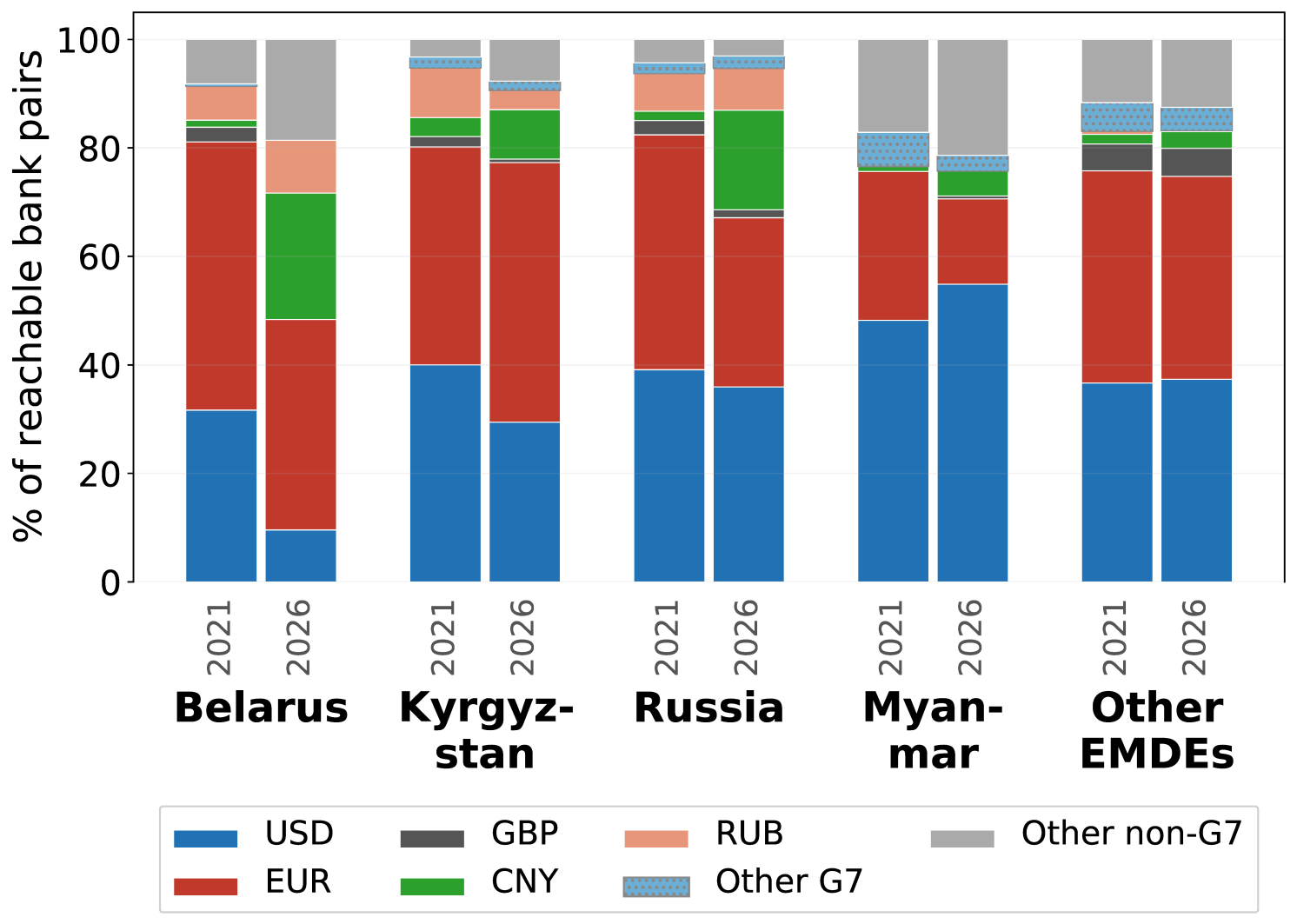
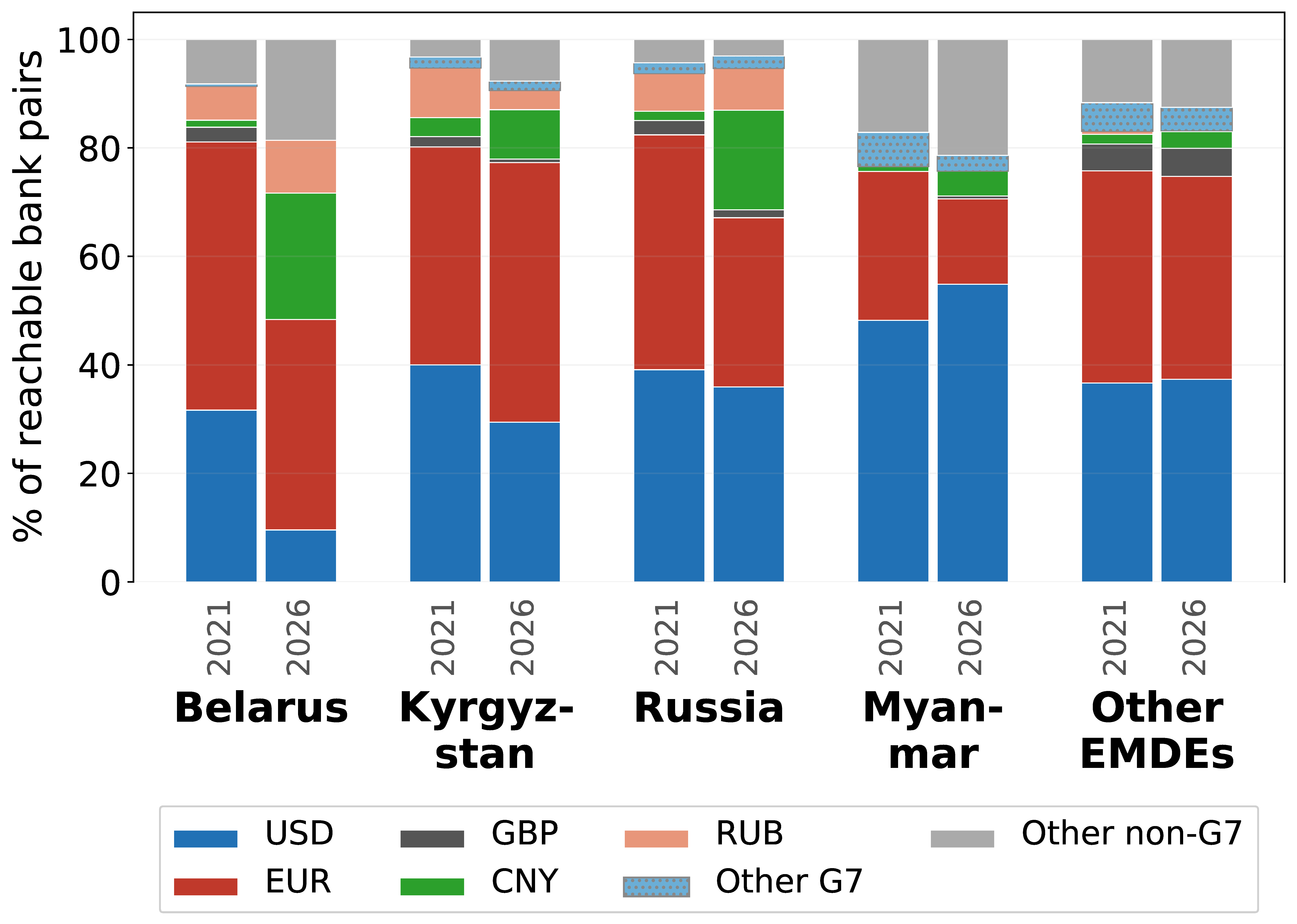
Non-sanctioned banks in these economies, however, shifted towards alternative payment networks. The yuan’s share of their cross-border correspondent relationships rose sharply. As shown in Figure 2, the shift has stark consequences for the relative efficiency offered by each currency’s network. In 2021, the dollar or euro provided the shortest payment path from Belarusian banks to more than 80% of reachable foreign banks. At that time, the yuan almost never offered the path with fewest hops. However, by 2026, the picture had changed. Dollar and euro networks together accounted for less than half of the set of shortest paths, while the yuan accounted for about 20%, more than the dollar alone. Kyrgyzstan and Russia show similar patterns.
Figure 2 Currency delivering the shortest payment route, 2021 versus 2026
Source: Matvos and Neiman (2026), Figure 15.
4) Is this evidence of a global decline in the dollar’s role?
No – not in our data, and not yet. As shown in the final bars of Figure 2, across all other EMDEs, the currency composition of shortest payment routes was essentially unchanged between 2021 and 2026. The dollar and euro still provide the shortest route for roughly three-quarters of reachable bank pairs. The yuan’s share rose by about one percentage point.
Brunnermeier et al. (2022) predicted at the start of the Russia sanctions that the dollar’s dominance would survive, and Eichengreen (2023) reached a similar verdict from data on official reserves. So far, our payments data agree and only document a shift away from the dollar in the small set of economies where sanctions hit hardest.
Source : VOXeu