


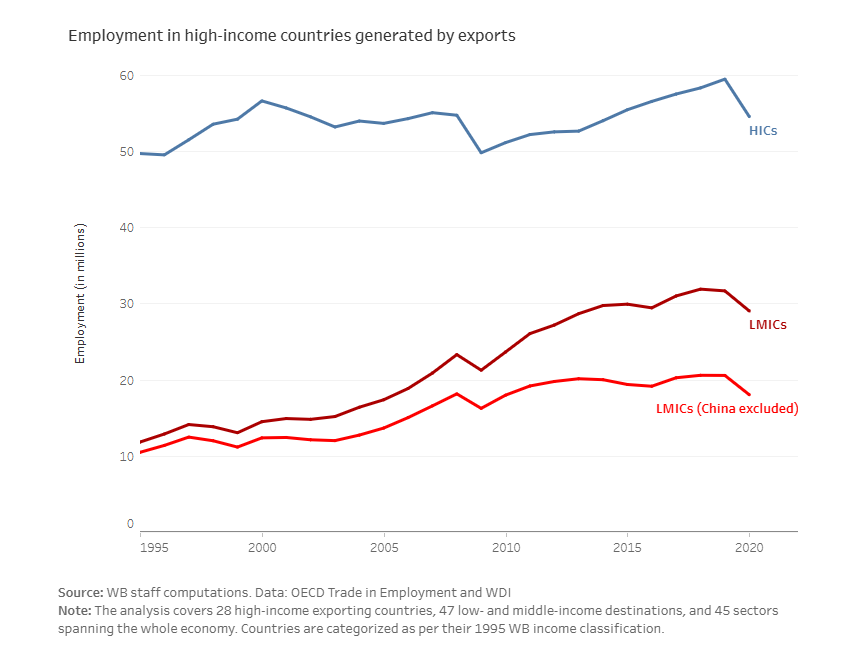
As global trade expands, so does the number of workers in high-income countries whose jobs are tied to exports. More of that growth is generated by exports to low-and middle-income countries than to other high-income countries. Employment generated by exports of goods and services to low and middle-income countries, either directly or indirectly, more than doubled from 1995 to 2020, to almost 29 million. That’s a compound annual growth rate of 3.7 percent. Excluding China, the growth rate was a more modest 2.2 percent. By contrast, employment generated by exports to other high-income countries grew at a rate of just 0.4 percent in the same period, although more jobs – 54.5 million – depend on such exports. The reason for the discrepancy is simple: on average, exports to low- and middle-income economies grow more quickly than those to advanced economies. That growth generates benefits for everyone. Overall, almost a third of total jobs in high-income countries on average are tied to exports either directly or indirectly through supplier relationships.
Source : World Bank