



Emerging market economies that are expected to perform well may attract more foreign capital, making it difficult to establish the causal effects of capital inflows on output. Using professional forecasts to account for expectations about future economic conditions, this column constructs an expectations-based measure of capital inflow shocks. The results suggest that capital inflows raise output by strengthening domestic demand and easing financing conditions; equity-type inflows have larger and more persistent effects, while inflow reversals impose disproportionally large costs.
For good reason, the effects of capital inflows on economic activity have long been debated (Ostry et al. 2015). Capital flows are inherently forward-looking: countries expected to perform well may attract more foreign capital whereas a worsening economic outlook may trigger capital outflows. The observed relationship between capital flows and economic activity may therefore reflect investors’ expectations rather than the causal effects of capital flows themselves. To address this identification challenge, we propose a simple, transparent, and broadly applicable expectations-based framework to construct capital inflow shocks (Ha et al. 2026).
An expectations-based measure of capital inflow shocks
Identifying exogenous capital inflow shocks has been a challenge. Traditional instruments based on global variables may be contaminated because these variables can affect recipient economies through channels other than capital flows. More recent studies have made progress by exploiting natural experiments or granular data, but these approaches often rely on specialised or confidential data and focus on specific types of flows (Williams 2018, Broner et al. 2021, Aldasoro et al. 2023).
We use professional forecasts from Consensus Economics to account for expectations about future macroeconomic conditions and separate observed capital inflows into two components. The first is the component predictable from these forecasts. The second is the unexpected component that is the part of the capital inflow that cannot be accounted for by the forecasts.
We refer to the unexpected component as an expectations-based capital inflow shock. Put differently, our measure asks: given what professional forecasters expected about an economy at the time, how much of the observed capital inflow was unexpected? A country receiving large capital inflows because its economic outlook has improved is different from one receiving an unexpectedly large inflow after accounting for that outlook. The latter provides cleaner variation for identifying the effects of capital inflows themselves on economic activity.
Capital inflows have sizeable real effects
Armed with our new measure of capital inflow shocks, we employ panel local projections to estimate their dynamic effects on output using quarterly data for 27 emerging market economies over 1990-2024. The results show statistically significant expansionary effects that are robust to alternative specifications, including using net rather than gross capital inflows, excluding the post-pandemic period, and using our shock measures as external instruments to address potential measurement error (Figure 1). Importantly, a naïve specification using actual capital inflows substantially overstates the output response, with the peak effect roughly twice as large as our baseline estimate. This highlights the importance of accounting for expectations when estimating the effects of capital inflows.
Figure 1 Output responses to capital inflows
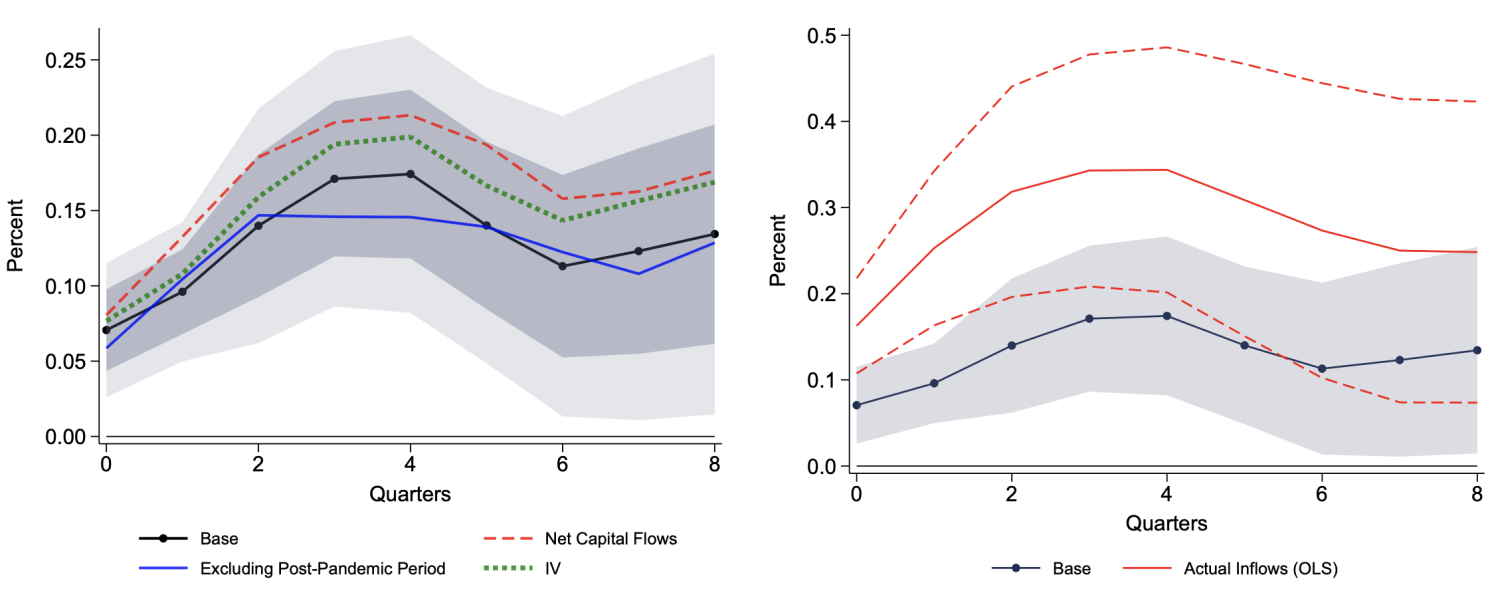
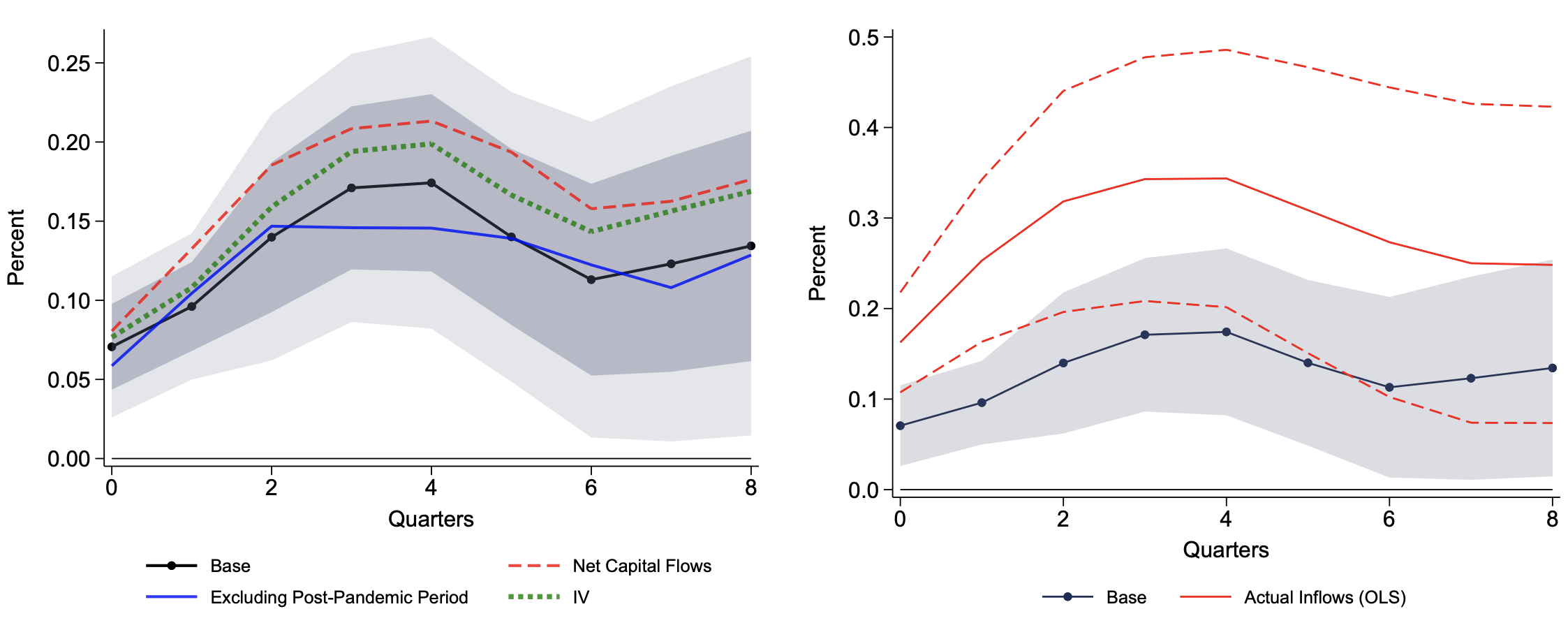
Note: This figure shows the cumulative responses of real GDP to a one-percentage-point increase in capital inflows relative to annualised trend GDP over an eight-quarter horizon. “Base” denotes our baseline estimates based on capital inflow shocks purged of expectation-driven components. “Net Capital Flows” uses net rather than gross capital inflows; “Excluding Post-Pandemic Period” excludes observations after 2020Q1; “IV” shows estimates using measures as external instruments; and “Actual inflows (OLS)” reports estimates from a regression using actual capital inflows. Shaded areas indicate 68 and 90 percent confidence intervals for the baseline specification in the left panel and the 90 percent confidence interval in the right panel.
The responses of macroeconomic and financial variables shed light on how capital inflows affect economic activity. On the one hand, capital inflows stimulate domestic demand: investment and consumption rise alongside lower interest rates and higher asset prices. On the other hand, alongside currency appreciation, imports increase while exports respond little, resulting in weaker net exports. Taken together, the results suggest that the expansionary effects operating through domestic demand and easier financial conditions outweigh the contractionary effects associated with currency appreciation and weaker net exports.
The expansionary effects are broad-based across different types of capital inflows, but their magnitude and persistence vary considerably. Equity-type inflows – FDI and portfolio equity – generate larger and more persistent increases in output than debt-type inflows – portfolio debt and other investment (Figure 2). Importantly, we find no evidence that any major category of inflows is contractionary, in contrast with some previous studies using aggregate macroeconomic data that report contractionary effects for certain types of capital inflows (Davis 2015, Blanchard et al. 2017). Our findings are instead consistent with growing firm- and industry-level evidence that many types of capital inflows can stimulate economic activity (CGFS 2021).
Figure 2 Impulse responses of output to capital inflow shocks: Equity vs debt
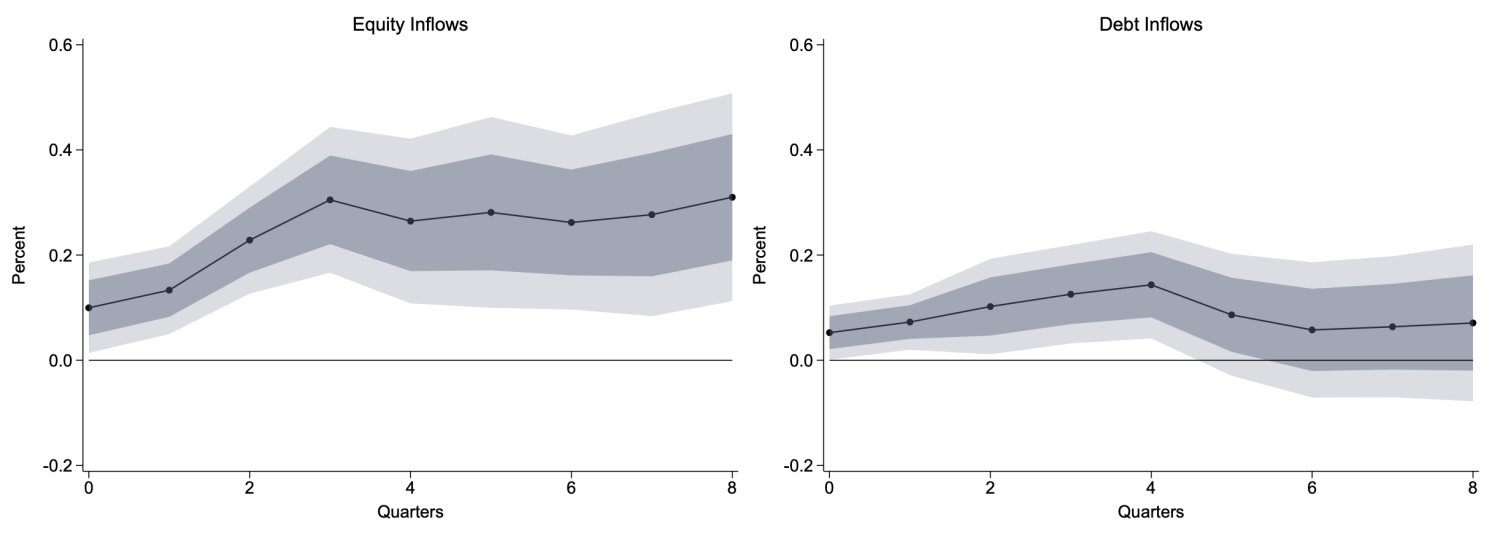
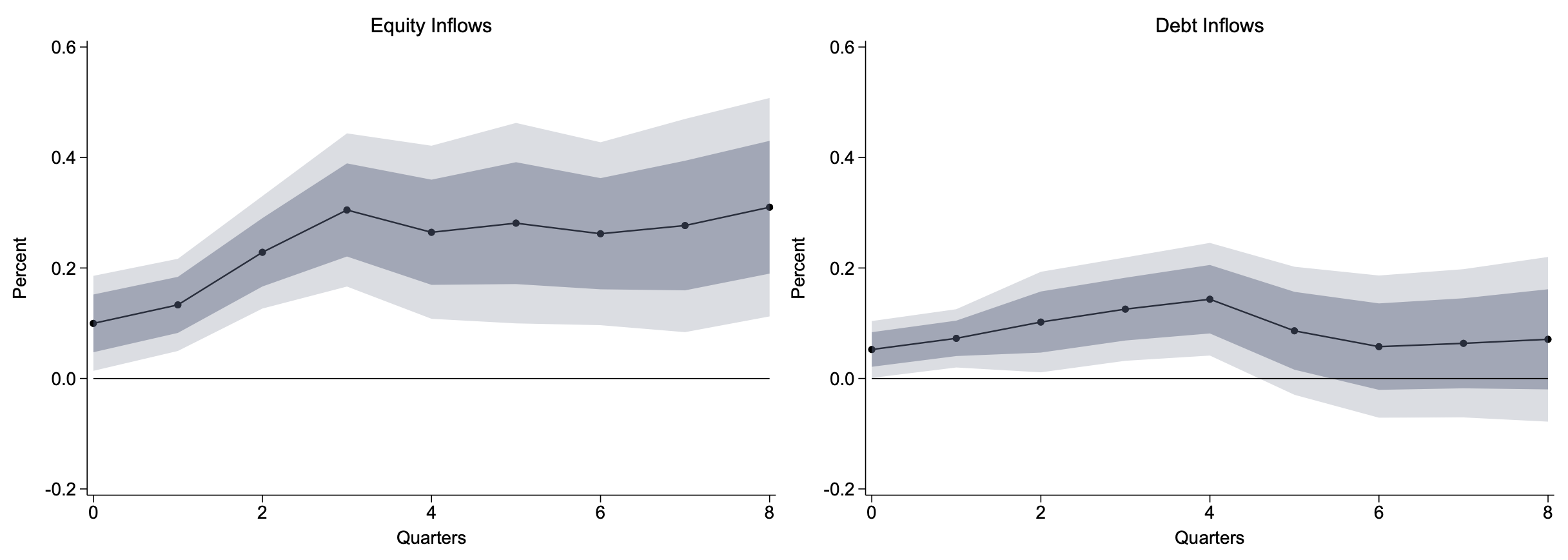
Note: This figure shows the cumulative responses of real GDP to a one-percentage-point increase in the ratio of equity-type (left) or debt-type (right) capital inflows to annualized trend GDP over an eight-quarter horizon. Equity-type flows are the sum of direct investment and portfolio equity investment. Debt-type flows are the sum of portfolio debt investment and other investment. Shaded areas are 68 and 90 percent confidence intervals.
Finally, the output effects of capital inflows are markedly asymmetric. Capital inflow reversals lead to substantially larger declines in output than the increases associated with positive inflow shocks of comparable magnitude (Figure 3). Thus, while capital inflows support economic activity, their reversals can impose disproportionately large output costs. This finding is consistent with the literature documenting the severe macroeconomic consequences of sudden stops in capital flows (Calvo 1998, Mendoza 2010).
Figure 3 Asymmetric effects of capital inflow shocks on output
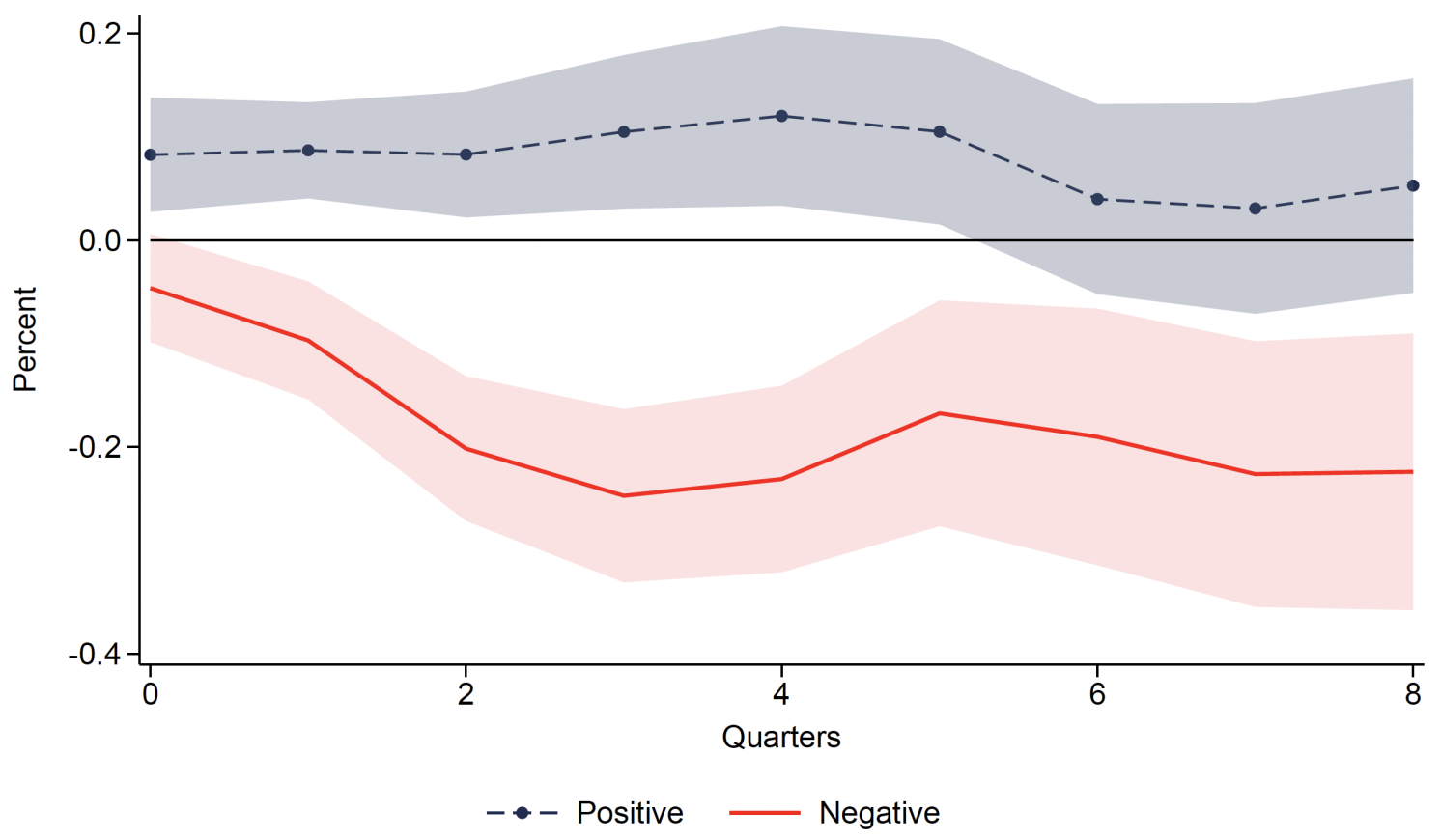
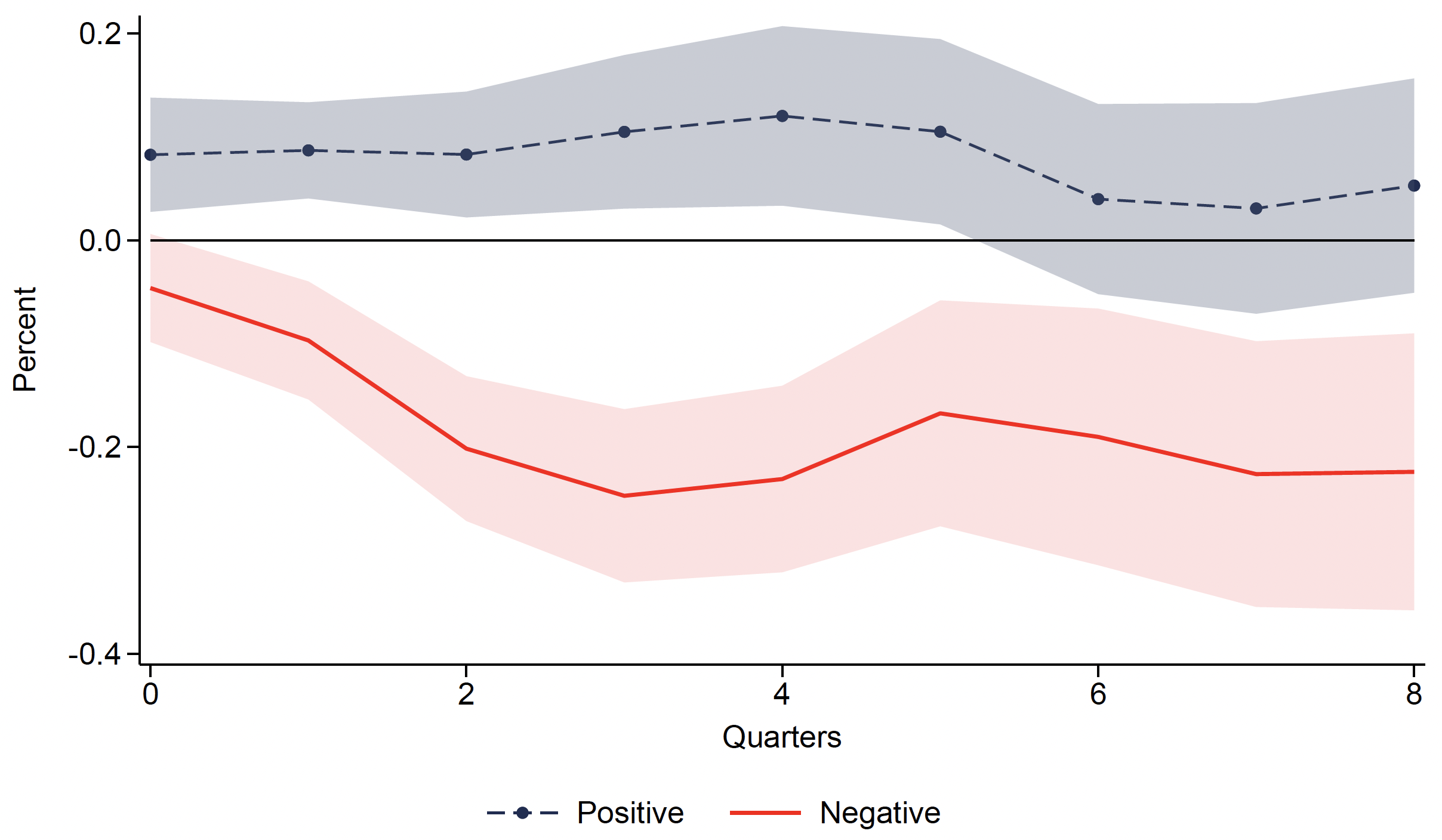
Note: This figure shows the cumulative responses of real GDP to a one-percentage-point change in the ratio of capital inflows to annualized trend GDP over an eight-quarter horizon. Shaded areas are 68 percent confidence intervals.
Rethinking the effects of capital inflows
For policymakers weighing the benefits and risks of financial integration, our findings provide support for both sides of a long-standing debate. Foreign capital does what economic theory has long suggested: it provides financing that supports investment and economic activity. Even after accounting for expectations, capital inflows have meaningful expansionary effects on the real economy, with particularly strong and persistent effects from equity-type inflows.
At the same time, concerns about sudden reversals are well founded. Capital flow reversals impose disproportionately large output losses relative to the gains generated by similarly sized increases in inflows. This asymmetry is particularly relevant in the current global environment of heightened uncertainty and volatile financial conditions. The challenge for policymakers is therefore not simply to attract more foreign capital, but to secure the benefits of foreign financing while strengthening macroeconomic and financial resilience to costly reversals.
Source : VOXeu