

Professional judgement comes from learning by doing, but AI has the potential to disrupt this learning process. This column explores how randomised access to an AI patent-writing product affects the performance of lawyers on certain writing tasks. Using the AI tool raised the quality of the drafts and compressed performance differentials, especially among junior lawyers. However, on a subsequent task without AI tools, expertise gains from the previous AI use appeared only among senior lawyers with seasoned judgement.
Professional judgement comes from learning by doing: junior workers in law, medicine, science, engineering, and consulting (among others) master foundational skills by performing core job tasks, often under the supervision of senior practitioners. AI has the potential to disrupt this learning process (Beane 2024, Asriyan et al. 2026). While AI systems are easy to operate, they are hard to evaluate, so professional judgement is one crucial ingredient that the user supplies.
Experiments in writing, customer service, and management consulting find that AI tools compress performance differentials across experience and skill levels, enabling junior workers to perform more like experienced professionals in the moment. Producing work at that level could facilitate expertise acquisition, since AI supplies worked examples of professional practice and on-the-spot feedback that a supervisor may not offer and that a junior worker may hesitate to request. Empirical studies in radiology, business problem-solving, job-seeker writing, and legal education show that when AI tools are thoughtfully embedded into training workflows, less-experienced workers can improve their independent performance (He et al. 2026, Cruces et al. 2026, Lira et al. 2025, Bednar et al. 2026).
But there is a potential tension between performance and learning. By lightening the cognitive load required to produce work products, AI might stunt the mental muscles that workers build while doing that heavy cognitive lifting (Shen and Tamkin 2026, Bastani et al. 2025, Kosmyna et al. 2025).
Does that happen in practice? Almost no existing research answers this question. That’s because assessing AI’s consequences for professional learning demands something more than measuring short-term performance; it requires quantifying how sustained AI usage affects expertise acquisition. We ran an experiment to answer this question (Autor et al. 2026).
At 11 intellectual property law firms that are engaged in regular, non-exclusive business with Google, we randomised access to an unreleased Google Labs AI-driven patent-writing assistance product, InFlow. A total of 133 lawyers participated in the experiment. At each firm, a subset of lawyers was randomly assigned to receive InFlow accounts and InFlow training, with the remainder of participating lawyers assigned to the control group.
We first compared the performance of treatment and control lawyers in standard patent-drafting work. All submissions scored were scored by blinded patent attorneys at an independent law firm on a standardised rubric covering enforceability, accuracy, strategic ambiguity (the tactical scoping of claims), completeness, and clarity. At both 10 and 90 days, the ratings showed that InFlow raised the quality of the patent drafts produced, by 0.34 standard deviations at 10 days and 0.38 standard deviations at 90 days (Figure 1). The gains came from the bottom of the distribution rather than the top: fewer weak drafts, more mid-range drafts, but no increase in the number of exceptional ones. Thus, using InFlow compressed performance differentials. Tellingly, junior lawyers gained the most on quality and saved the most time, finishing the 10-day task 18 minutes faster than their untreated peers.
Figure 1 Impact of AI access on performance on patent drafting and redlining tasks: Pooled scales and component subscales, overall and by seniority
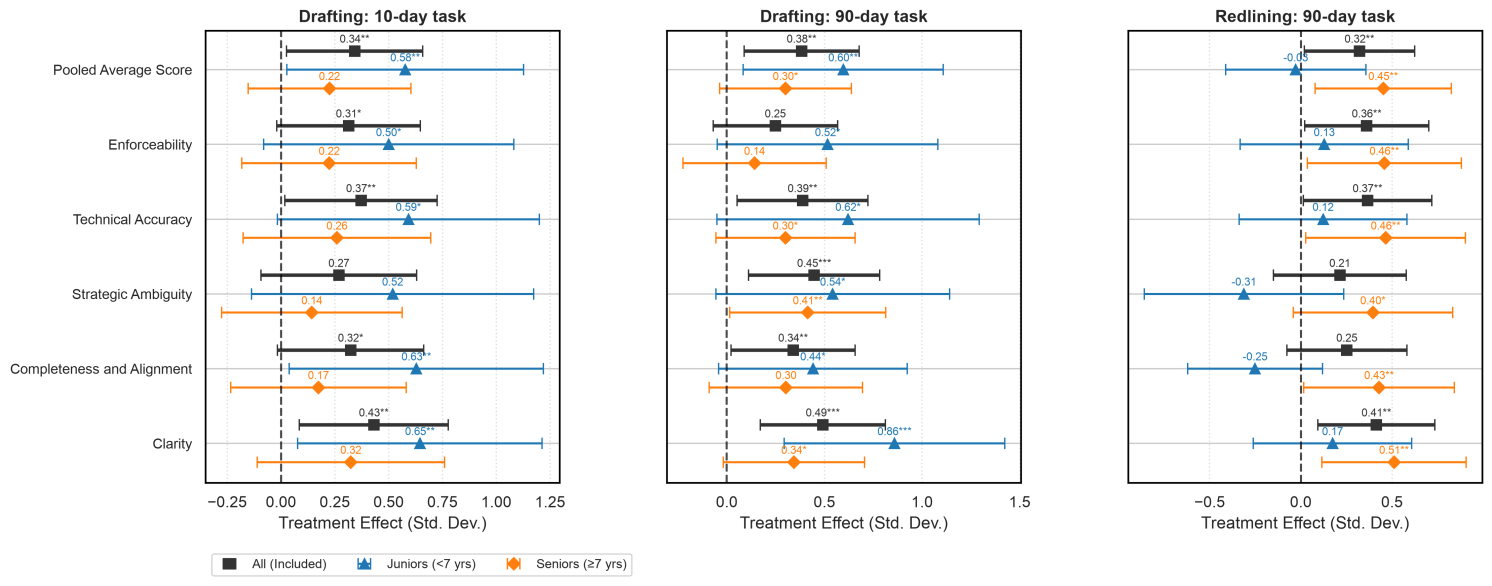
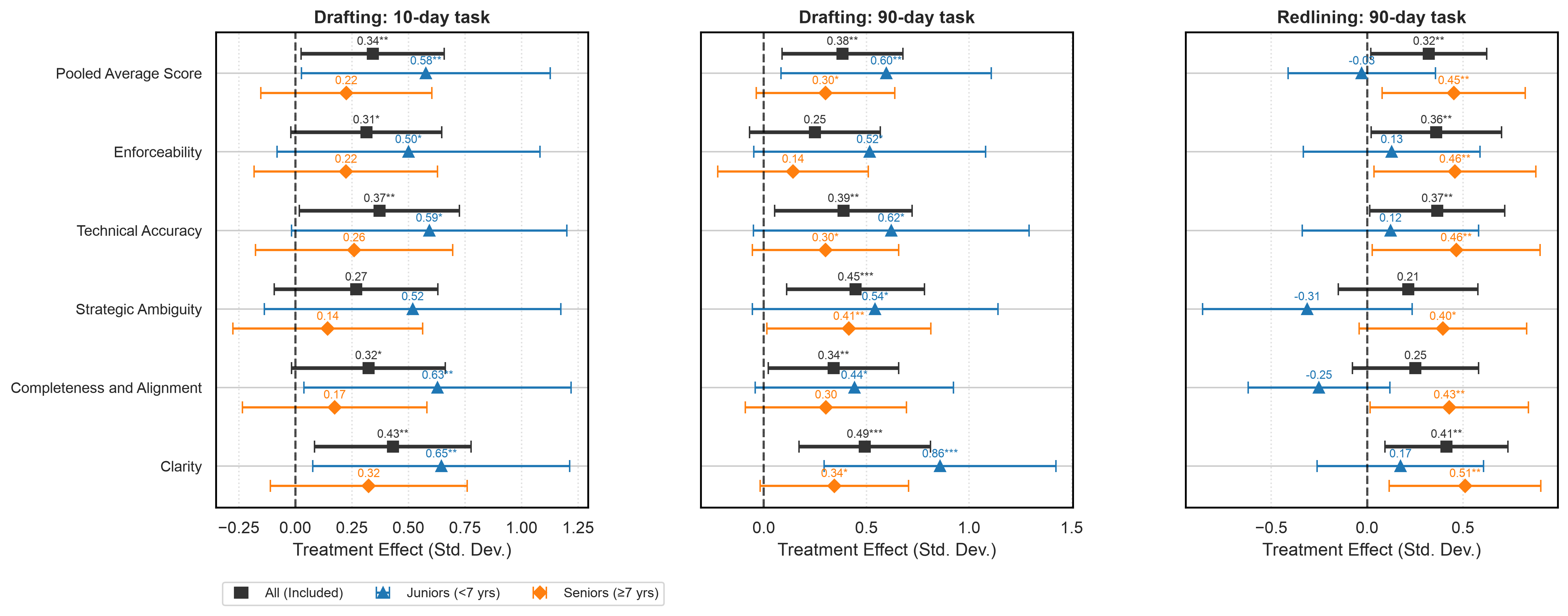
Notes: Estimated impact of AI access on patent drafting and redlining quality. Results are reported for all lawyers (black squares), junior lawyers under 7 years of experience (blue triangles), and senior lawyers with 7+ years of experience (orange diamonds). All estimates account for differences across law firms and adjust for slight variations in how many ratings each lawyer received.
This finding provides a jumping-off point for our central question: did improved performance in AI-assisted tasks carry over to non-AI-assisted work? For this evaluation, lawyers were asked to mark up a flawed patent application without using AI. This ‘redlining’ task consists mainly of reading and marking up existing work rather than producing new text, and hence foregrounds expert judgement. This is something that patent lawyers routinely perform unaided by AI.
The positive news is that treated lawyers outperformed controls by 0.32 standard deviations on this unassisted task, suggesting that AI facilitated skill acquisition. The less encouraging news is that these gains were concentrated entirely among senior lawyers – those with seasoned judgement – who outperformed control subjects by 0.45 standard deviations (Figure 1). We detected no average gain among juniors.
Instead, scores of juniors bifurcated: more very low scores, fewer mediocre ones, more good ones, and no more excellent ones (Figure 2). While our small sample of juniors does not allow for definitive conclusions, our tentative interpretation is that AI assistance acted as a learning springboard for some juniors and as a learning hammock for others – enabling them to deliver adequate work without making the effort to learn.
Figure 2 Performance distributions of treated and untreated subjects on redlining task: Overall and by experience level
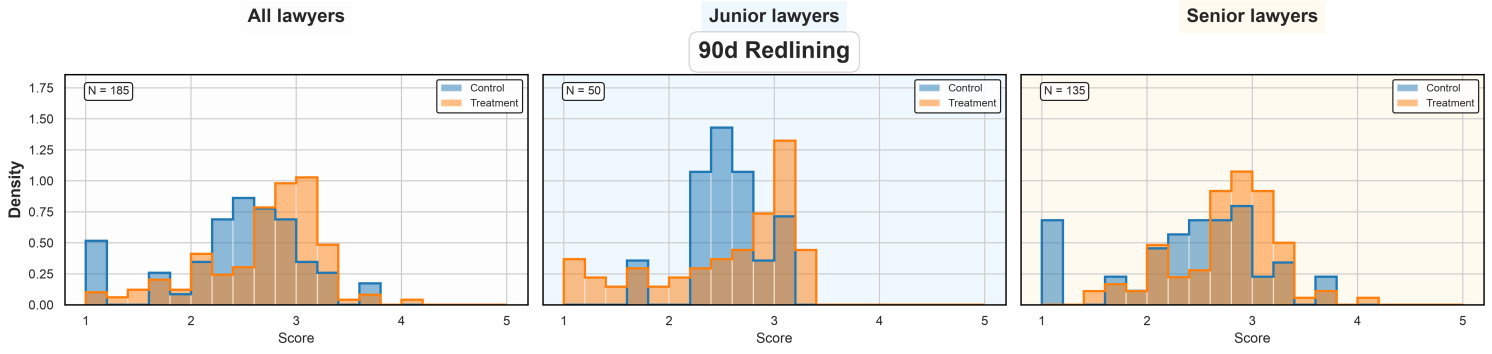
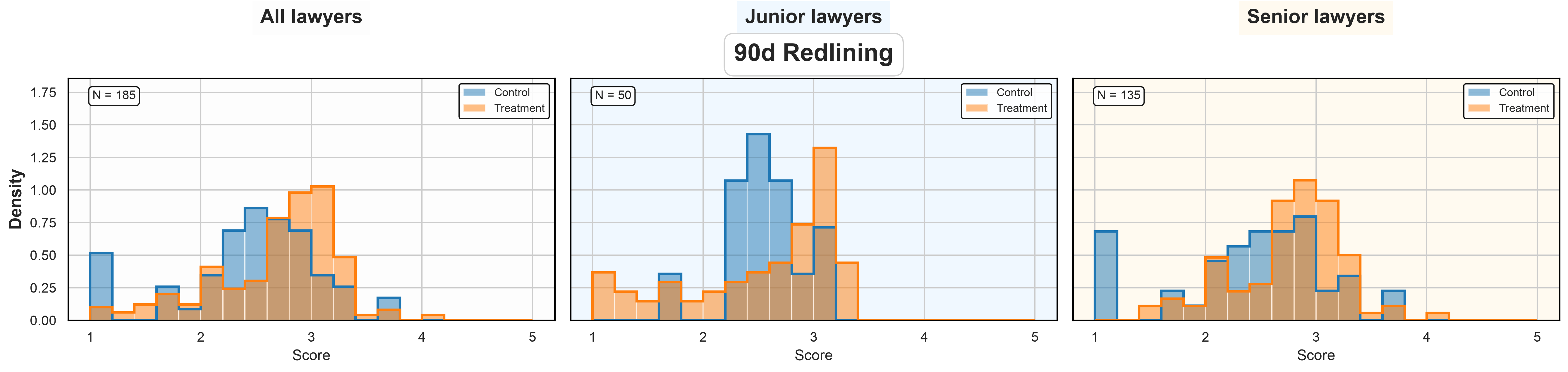
Notes: The figure shows distributions of the average redlining score for treated (orange) and control (blue) subjects by experience for all lawyers, junior lawyers under 7 years of experience, and senior lawyers with 7+ years of experience. Observations are individual ratings.
The submissions themselves show what separates seasoned from fledgling judgement. Treated seniors spent longer on redlining than juniors, restructuring the draft to address its legal liabilities and annotating their edits to supply the principle behind them. In follow-up interviews, seniors described treating AI output not as a finished product, but as a ‘logic auditor’: it weakened their attachment to existing prose and forced them to articulate the why and how of structural edits, activating and sharpening their foundational expertise.
Juniors laboured sequentially through stylistic and administrative corrections, while repeatedly identifying serious defects without correcting them. Many juniors left notes that read as instructions to an assistant that was not there. This diagnose-without-execute voice was equally common among juniors in the treatment and control groups, so we do not attribute it to use of InFlow – though it might reflect habits gained from regular use of AI outside of the experiment.
The caveat in interpreting these results is that our sample is relatively small, reflecting the high hourly billing rate of top-tier lawyers. Additionally, we observe the effect of access over only three months, which is brief relative to the years across which patent expertise is built. Moreover, our findings reflect 2024–2025 AI capabilities. Models have continued to advance rapidly since that time, so their effects on skill development may have shifted in both more positive and more negative directions.
These limitations underscore opportunities for further experimentation, some of which we hope to pursue in the months ahead. One unambiguous takeaway from our work is that assessing the effect of AI assistance on skill development requires evaluations that separate the contribution of the software from the expertise of its user.
Raising measured output and building expertise are separate objectives. Our results suggest that they conflict for lawyers with limited experience while they reinforce one another for lawyers with seasoned judgement. Foundational expertise may be what allows AI-assisted practice to translate into seasoned professional judgement.
Given the ubiquity of AI tools, one could ask whether seasoned judgement is any longer necessary. We believe that it is: lawyers will continue to require judgement in courtrooms, in client meetings, in briefing with colleagues. Here, the tool is not available to compensate for expertise that inexperienced lawyers have not yet developed.
Source : VOXeu