



Green innovation is central for the transition to a low-carbon economy, but there are concerns that economic downturns may slow technological progress by reducing firms’ incentives and resources to innovate. This column shows that green and non-green innovation respond very differently to the business cycle. While non-green innovation declines after contractionary shocks, green innovation increases. A model of directed technical change explains this divergence through the more backloaded profits of green technologies and the reallocation of scarce innovation inputs during downturns. The findings imply that R&D subsidies are more effective – and generate relatively more green innovation – during downturns.
Climate change is one of the defining challenges of our time, posing severe threats to lives, livelihoods, ecosystems, and the global economy. Carbon pricing remains a central tool for reducing emissions, but it can also entail considerable economic and distributional costs, which have contributed to public resistance to more ambitious climate policy (Känzig 2026, Känzig and Konradt 2023). Green innovation can help ease this trade-off by reducing the cost of the transition and allowing emissions to fall while sustaining economic growth.
A large literature emphasises the importance of technological change for the low-carbon transition. Energy prices and environmental policy can redirect innovation towards cleaner technologies (Popp 2002, Acemoglu et al. 2012). However, climate-related innovation has slowed in recent years, raising concerns about whether technological progress is advancing rapidly enough to achieve climate targets (Hasna et al. 2024). At the same time, innovation is shaped by macroeconomic conditions. The Covid-19 pandemic renewed concerns that downturns may slow the green transition by tightening financial constraints, reducing profits, or shifting firms’ R&D priorities. Consistent with this concern, aggregate R&D and patenting are procyclical (Barlevy 2007, Aghion et al. 2010, 2012), and tighter financial conditions can weigh particularly heavily on green innovation among young and constrained firms (Aghion et al. 2026).
But does green innovation necessarily fall when the economy contracts? In recent research, we examine how business cycle fluctuations shape both the pace and direction of innovation (Känzig et al. 2026). Our main finding is a striking divergence: while non-green innovation is procyclical, green innovation is countercyclical. This pattern appears both over the business cycle and in response to identified macroeconomic shocks.
Green and non-green innovation over the business cycle
We measure innovation using patent applications and classify green technologies using the European Patent Office’s technology codes for climate-change mitigation. Patents are particularly useful for our purposes because they allow us to distinguish not only how much firms innovate, but also the direction of innovation.
Figure 1 shows the responses of patenting to a contractionary monetary policy shock that raises the federal funds rate by 25 basis points. We focus here on the response to monetary policy shocks as a stand-in for well-identified demand shocks. Overall patenting declines substantially. This is consistent with existing evidence that monetary tightening depresses innovation (Ma and Zimmermann 2023).
Figure 1 Green and non-green patenting responses to a monetary policy shock
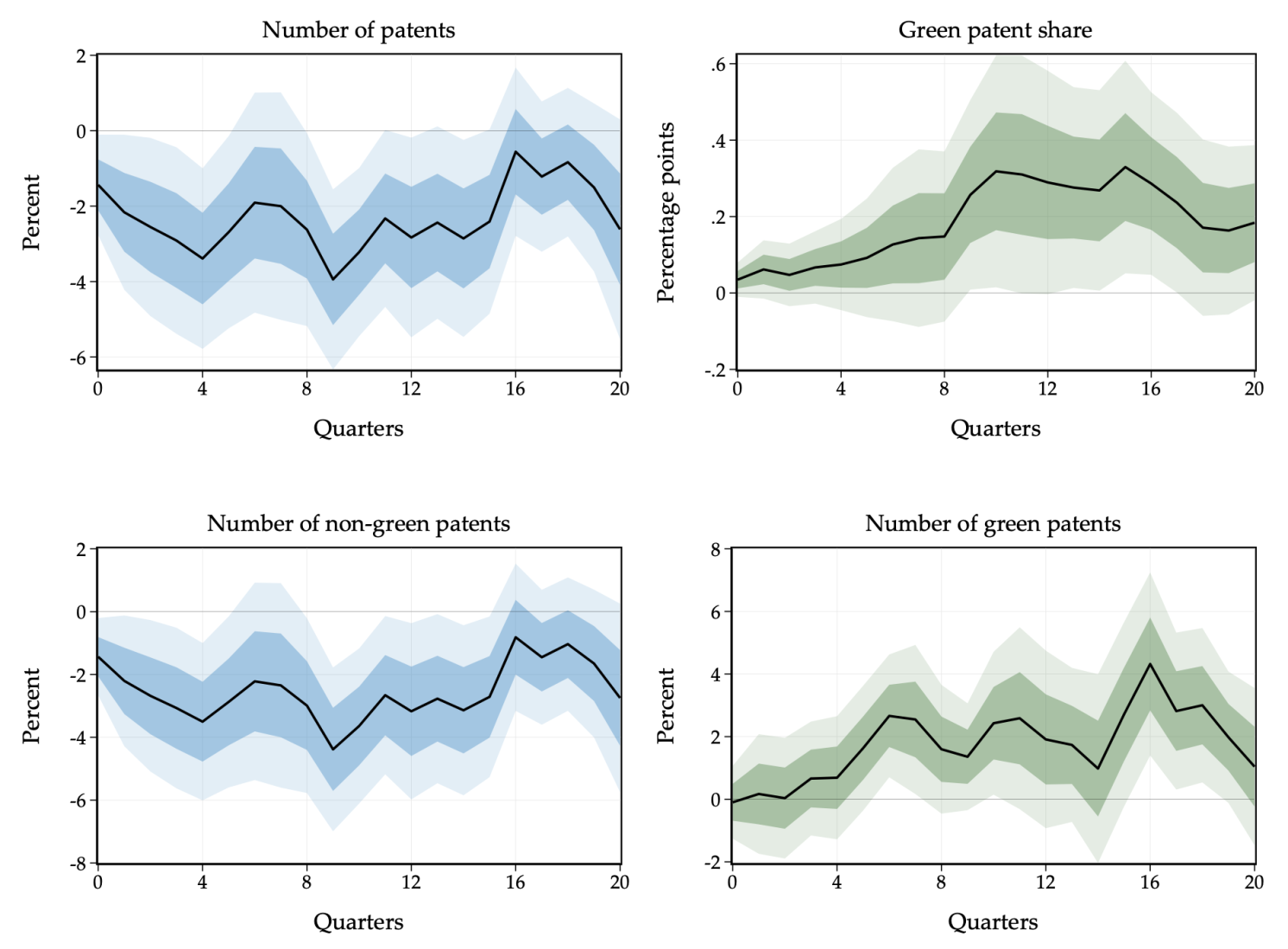
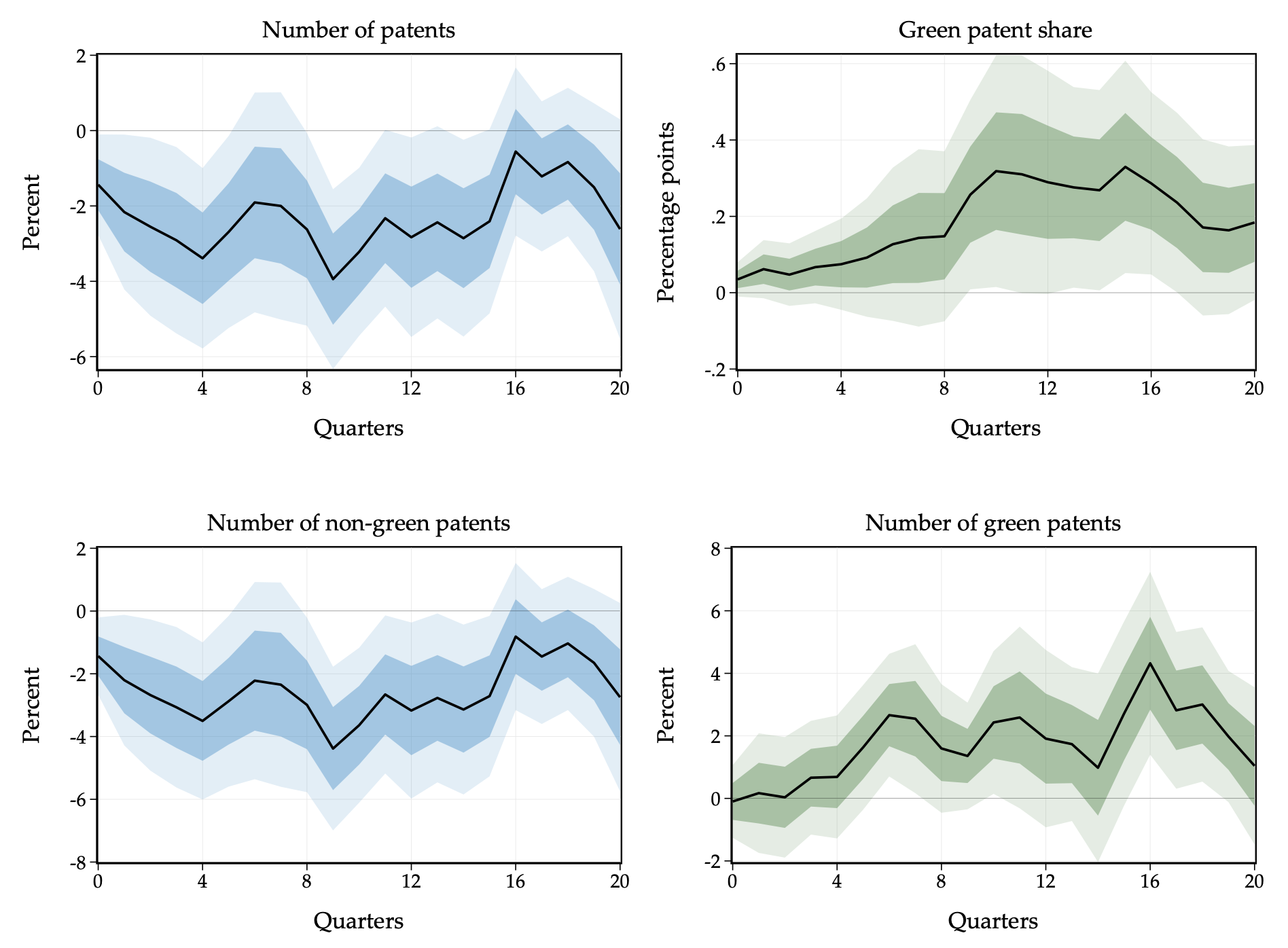
Notes: Responses of US patenting to a contractionary monetary policy shock, normalized to increase the federal funds rate by 25 basis points on impact. Shaded areas denote 68% and 95% confidence intervals.
But the aggregate response masks sharply different dynamics across technologies. Non-green patenting falls markedly while the number of green patents rises. As a result, the green patent share increases persistently, reaching about 0.3 percentage points after roughly 15 quarters.
The result is not specific to this particular source of macroeconomic fluctuations. We obtain very similar patterns when we study unexpected changes in GDP over the business cycle. The results are also robust across alternative definitions of green technologies, when controlling for patent quality, and across sectors and geographies.
Importantly, the increase in green innovation also occurs within firms. Following a monetary tightening, firms reduce their non-green patenting but increase green patenting, raising the green share of their patent portfolios. Thus, the aggregate pattern does not simply reflect a reallocation across firms specializing in different technologies. Firms themselves redirect inventive activity towards green technologies. What can explain these sharply different responses?
Why green innovation behaves differently
The central mechanism in our model comes from a simple feature of the climate transition: green is in the future. As the economy transitions away from fossil fuels, the market for green technologies expands. Green technologies therefore generate profits that are relatively more backloaded: a greater share of their value comes from profits expected further in the future. The value of a patent is the discounted value of these future profits, so green patents effectively have a longer duration than non-green patents.
This matters because business cycle shocks are temporary. A recession sharply reduces current and near-term profits but has a much smaller effect on profits far into the future. Since a larger share of the value of green patents comes from those distant profits, their value is less sensitive to short-run fluctuations in economic activity.
We call this the green duration channel. In the model, it implies that the relative value of green innovation rises during downturns. Firms therefore have an incentive to reduce green R&D by less than non-green R&D when the economy contracts.
This channel can explain why the share of green innovation is countercyclical, but not why the absolute number of green patents rises. In general equilibrium, however, an additional force comes into play through the market for scarce innovation inputs, particularly skilled R&D labor. When a downturn reduces non-green innovation, demand for scientists falls, lowering their equilibrium wage and hence the cost of R&D. Because green patent values are relatively insulated from the downturn, green projects benefit disproportionately from these lower innovation costs. If this force is sufficiently strong, green innovation increases even as aggregate innovation declines.
We carefully calibrate the model to the US economy and find that it reproduces the empirical pattern. Following a contractionary monetary policy shock, the value of non-green innovation falls considerably more than the value of green innovation. Non-green innovation declines, while green innovation rises, generating an increase in the green share similar to that observed in the data.
Evidence for the mechanism
The model makes several predictions that can be taken directly to the data. First, if the green duration channel is important, green patent values should fluctuate less over the business cycle than non-green patent values. We test this prediction using the market-implied values of US patents constructed by Kogan et al. (2017).
The evidence strongly supports this prediction. Green patent values are significantly less cyclical than non-green patent values. Following a contractionary monetary policy shock, the value of non-green patents falls persistently, whereas green patent values are much less affected.
Second, if declining innovation costs help generate the increase in green patenting, we should see lower prices for scarce R&D inputs during downturns. Using earnings data for scientists from the Current Population Survey, we find that scientist earnings decline significantly following a monetary tightening.
Third, the model predicts a reallocation of innovative labor towards green activities. Using inventor-level data from the US Patent and Trademark Office, we find that the number of green inventors employed by firms increases after a contractionary monetary policy shock.
Figure 2 Responses of patent values, scientists’ earnings and green inventors
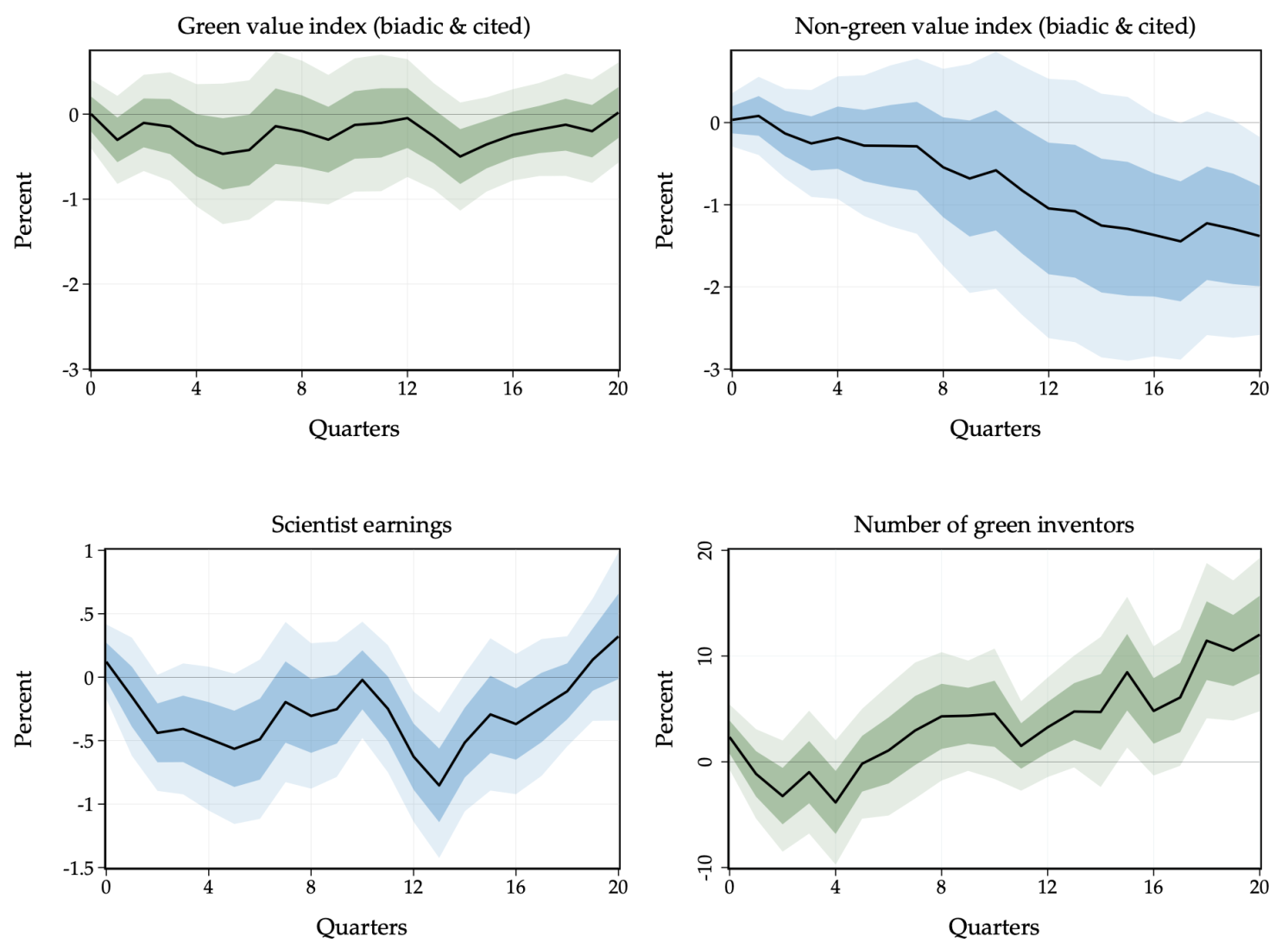
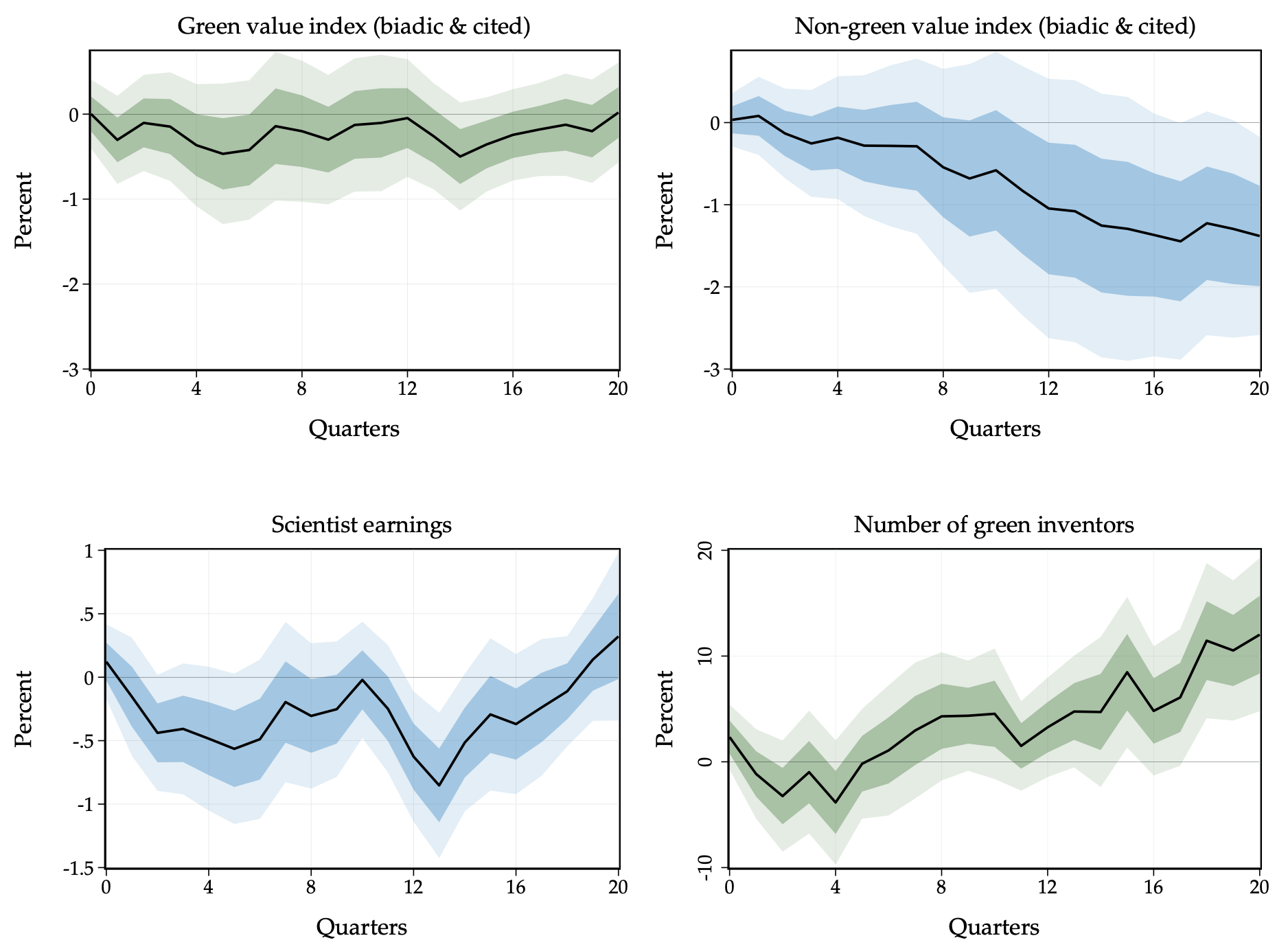
Notes: Responses of patent values, scientist earnings and the number of green inventors to a monetary policy shock, normalised to increase the federal funds rate by 25 basis points on impact. Shaded areas denote 68% and 95% confidence intervals.
Part of this response comes from inventors who had not previously produced a green patent at the firm, consistent with an active reallocation of researchers towards green technologies.
Together, these results provide direct empirical support for the mechanism: green patents are less exposed to short-run economic fluctuations, and downturns lower the cost of scarce innovation inputs and facilitate their reallocation towards green R&D.
Implications for innovation policy
Our findings have two broader implications. First, temporary macroeconomic fluctuations can have persistent effects on the direction of technological change. Innovation builds the stock of technologies available in the future. A temporary downturn that shifts inventive activity from non-green towards green technologies therefore leaves a lasting technological legacy even after the recession itself has disappeared.
Second, the effectiveness of innovation policy depends on the state of the business cycle. When R&D wages are lower in downturns, a given amount of subsidy spending can finance more innovative activity. Moreover, the increase in effectiveness is somewhat stronger for green innovation.
These results do not imply that recessions are desirable: aggregate innovation falls during downturns, as does economic activity more generally. Instead, they show that the timing and composition of innovation policy matter. Periods in which private innovative activity is depressed may offer an opportunity for R&D support to generate more innovation per dollar while simultaneously directing more technological progress towards green technologies.
Source : VOXeu