



Public services increasingly use predictive algorithms to direct scarce support towards those most at risk. But are these also the people who benefit most from intervention? This column explains how to navigate this trade-off and shows why it matters in practice. Job search counselling gets people into work faster, but has little effect on those at greatest risk of long-term unemployment. Combining predictions of risk and responsiveness can make scarce support substantially more effective, while highlighting the need for different support for those hardest to help.
Governments face growing pressure to make scarce public resources go further. Predictive algorithms increasingly guide decisions about who receives support, from unemployed workers to patients and households in poverty. These algorithms can help identify those most at risk of poor outcomes. But prediction and targeting are different problems: identifying who is most at risk does not establish who benefits most from a particular intervention (Kleinberg et al. 2015, Athey 2017). Allocating support effectively requires understanding both who needs help and how much the available intervention can improve their prospects.
Long-term unemployment makes this distinction particularly pressing. It imposes substantial costs on workers and public finances, making its prevention especially valuable. Employment services increasingly seek to identify workers at risk of long-term unemployment and intervene before their spells become prolonged (Desiere et al. 2019). In Belgium, too, employment services use predicted risk to prioritise jobseekers for counselling. Yet the effectiveness of directing support towards those most at risk has received little scrutiny.
Much of the policy debate instead centres on reducing benefits, on the argument that stronger financial incentives will accelerate the return to work. Belgium provides a prominent example. Previously the only EU country without a general time limit on unemployment benefits, it is now implementing a reform that limits entitlement to a maximum of two years. Yet stronger financial incentives alone often do little to improve the employment prospects of long-term unemployed workers, whose job-finding responds less to benefits even as the value of income protection increases (Kolsrud et al. 2018).
Differences in employment prospects, rather than unemployment benefits, help explain why some workers remain unemployed for so long (Mueller and Spinnewijn 2025). Workers with better prospects find jobs sooner, leaving an increasingly selected group with poorer prospects among the remaining unemployed. Preventing long-term unemployment thus requires understanding not only who is at risk, but also whether the support offered overcomes barriers already present at the start of a spell.
In a new paper, we study these allocation decisions using administrative data covering registered unemployment spells at the Flemish Public Employment Service, VDAB, between 2018 and 2022 (Ernst et al. 2026). Its profiling system provides opportunities to estimate the effects of job search counselling, how they differ across workers, and how they evolve over time.
Conceptually, we show that allocating support requires combining two pieces of information: how much an intervention improves someone’s chances of finding work, and their chances of finding work without it. In our dynamic framework, the return to counselling is approximately proportional to the first divided by the second. A given improvement in job-finding chances is more valuable for someone who would otherwise remain unemployed for longer. But workers with poorer prospects may also respond less to counselling, creating a trade-off between directing support towards those most at risk and those most responsive. The same reasoning extends to policies that help people leave other adverse states, such as illness, poverty or homelessness.
Job search counselling can work
VDAB uses more than 400 predictors to estimate each jobseeker’s probability of finding employment within six months. Those with a predicted probability below 65% are prioritised for proactive outreach after five weeks of unemployment and considered for caseworker assignment. Those above the threshold receive this outreach three months later.
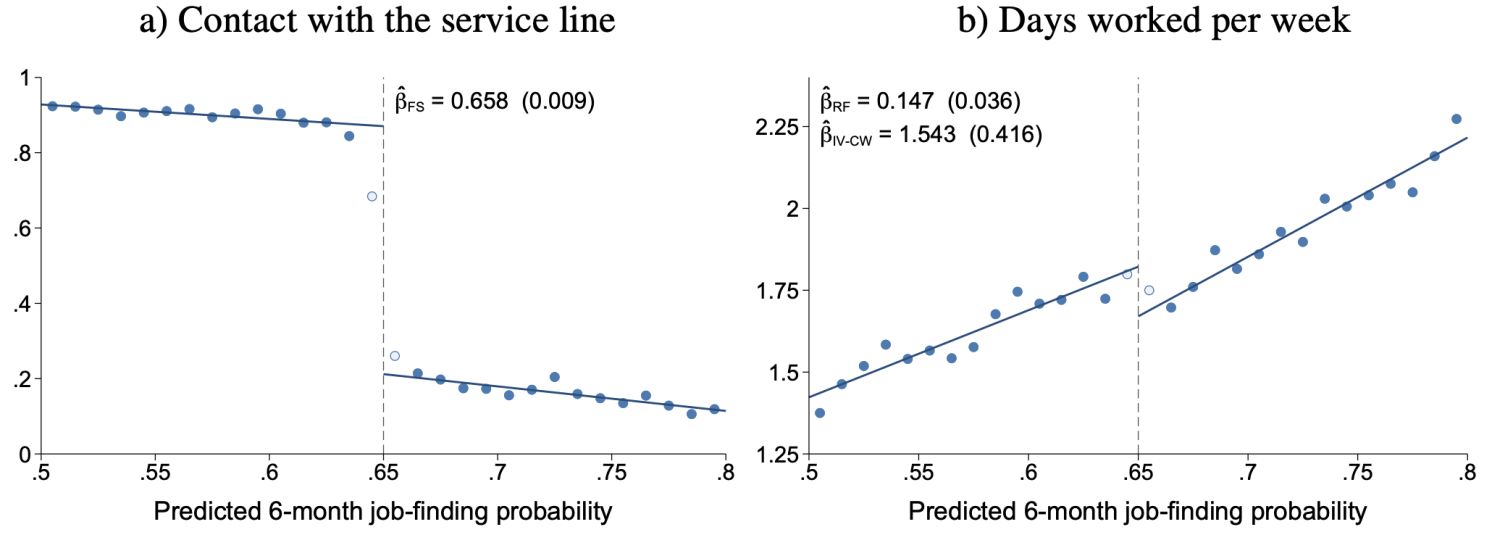
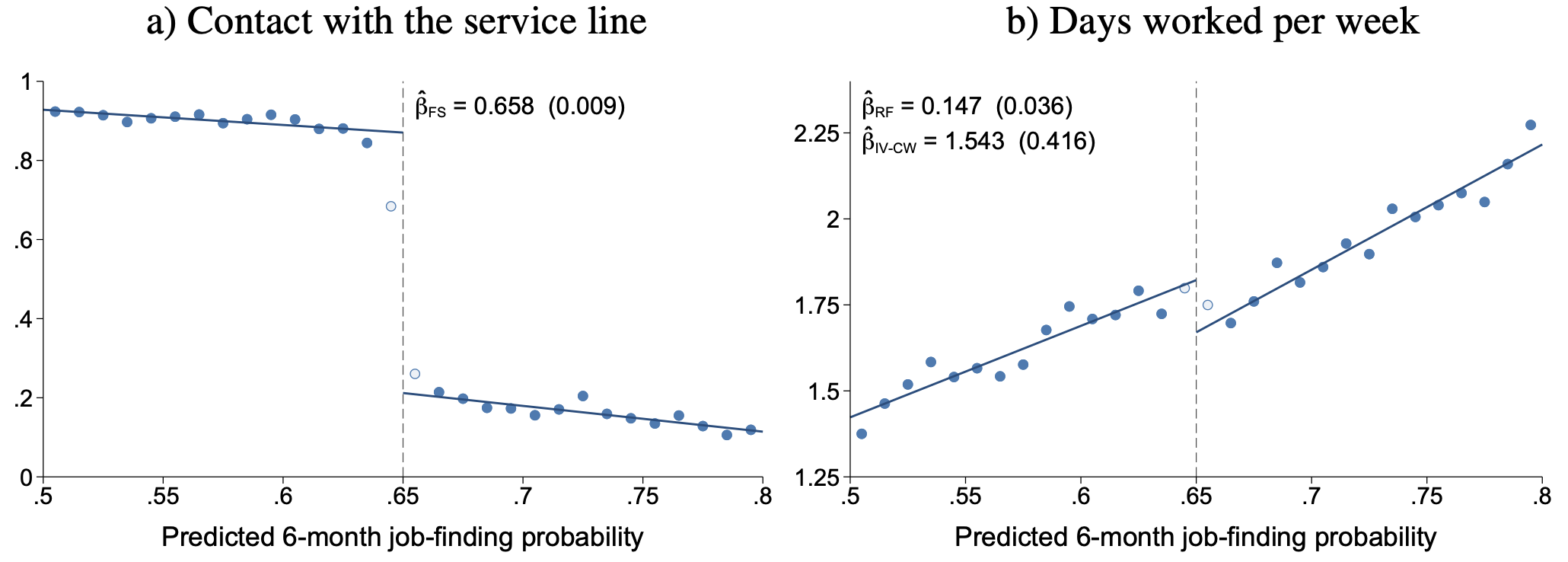
This threshold creates a quasi-experiment. Workers just below and just above it have very similar predicted prospects, but sharply different access to early support. Figure 1 shows the resulting jump in contact with the service line and the corresponding improvement in employment. Prioritisation increases days worked by approximately 9% over the following three months. If anything, subsequent jobs also appear more stable.
Figure 1 Early outreach increases contact and employment
Source: Ernst et al. (2026), Figure 3, panels a and c.
Note: The threshold is a predicted 65% chance of finding work within six months. Employment is measured in weeks 6–17. The lower-probability side receives priority outreach.
These estimates capture a bundle of outreach, counselling and caseworker support rather than the effect of a single meeting. Nevertheless, they show that this policy can help jobseekers find employment faster, which is notable given how much effects depend on programme design and context (Card et al. 2018).
Those most at risk respond least to this support
While the counselling seems effective, the question remains whether it has been effectively targeted. To study who responds, we exploit a second threshold: jobseekers returning to unemployment within six months of their previous spell are automatically reassigned to their former caseworker. Comparing workers on either side of this threshold allows us to estimate effects across different risk groups, beyond the narrow range covered by the first design.
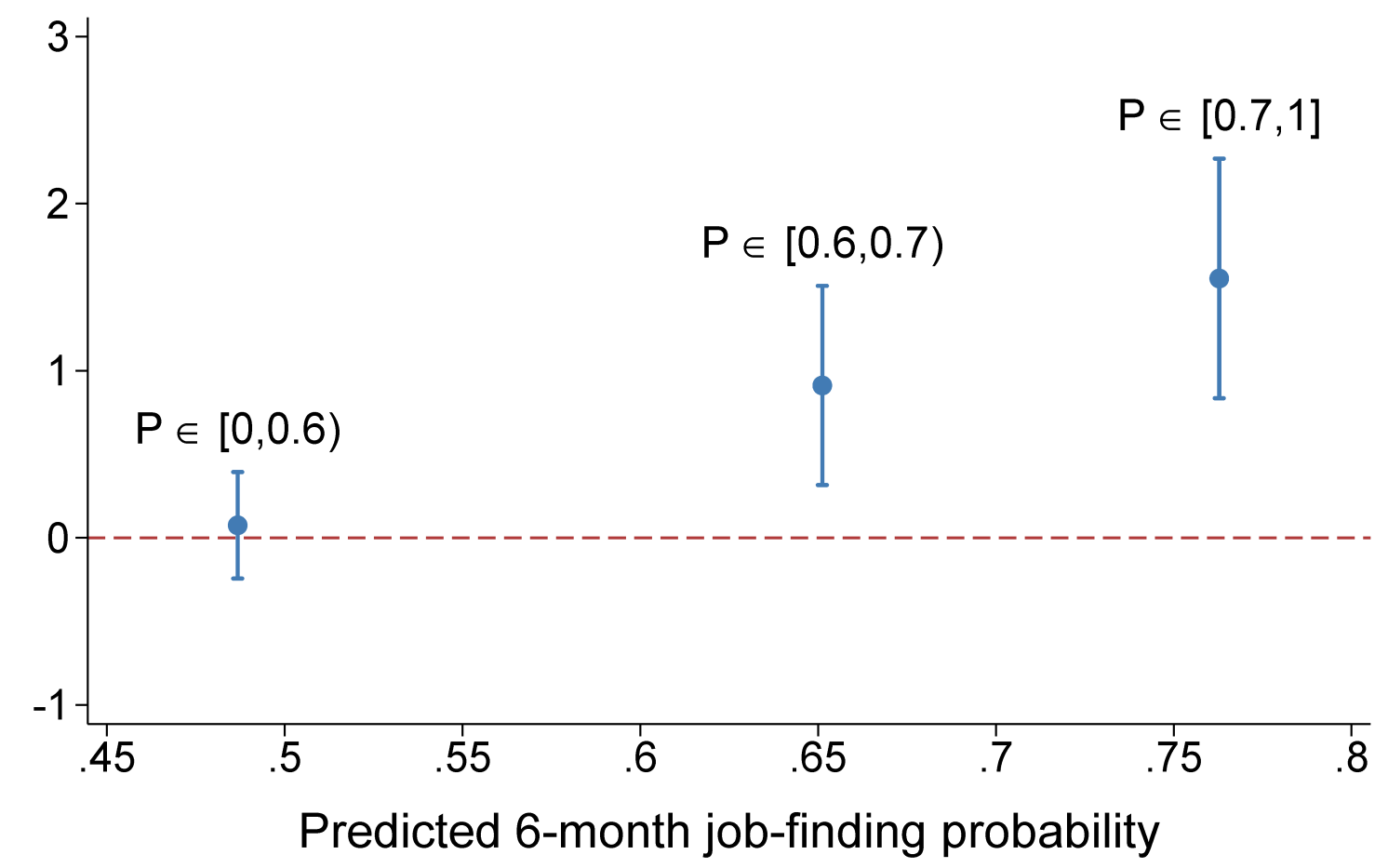
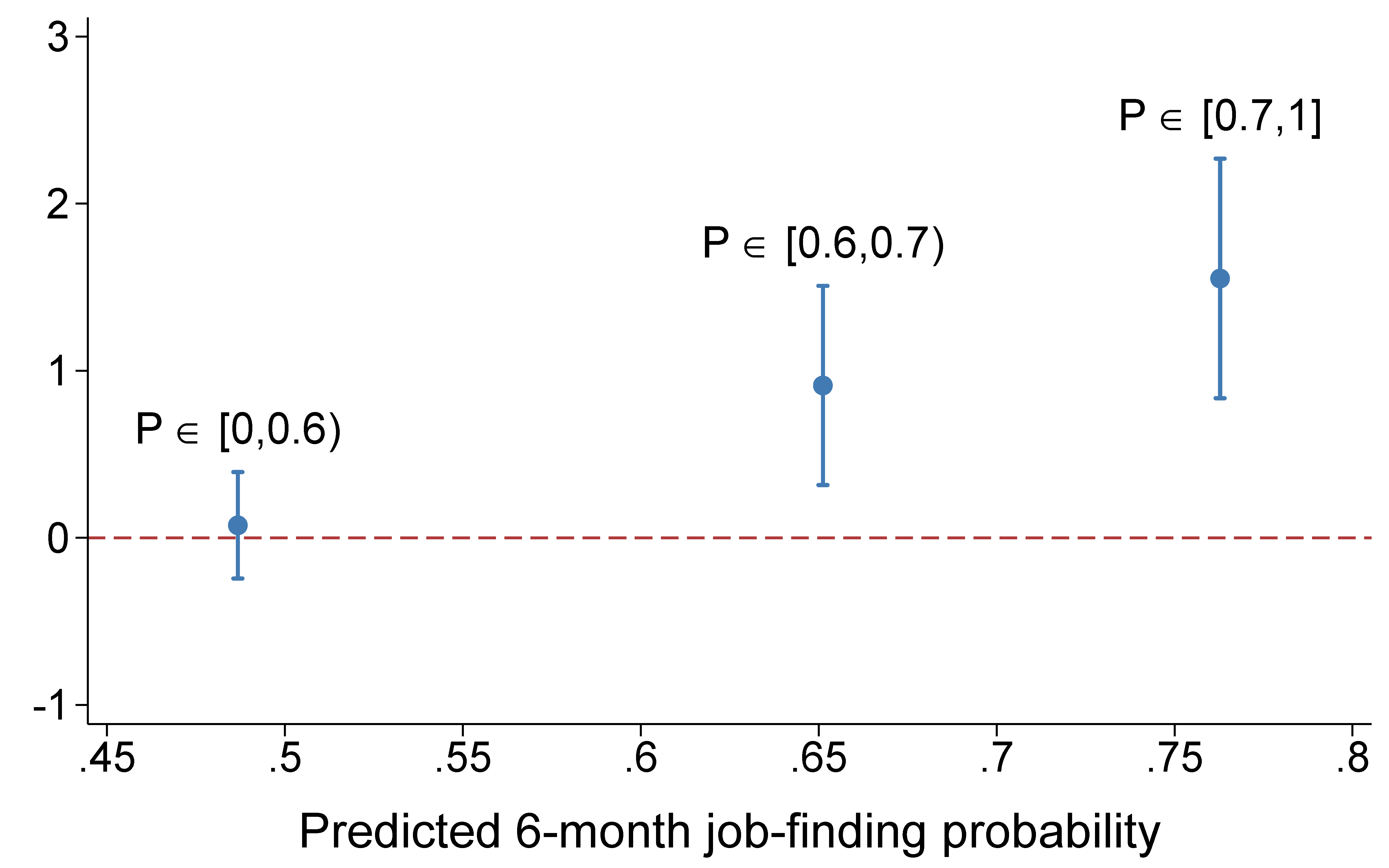
Figure 2 reveals a striking pattern. Among workers with the poorest predicted employment prospects, the estimated effect is close to zero. Effects are large and statistically significant among workers with better prospects, and increase further in the group with the highest predicted chances of finding work. The workers prioritised by risk-based targeting are therefore the least responsive to this particular support.
Figure 2 Workers at greatest risk respond least to counselling
Source: Ernst et al. (2026), Figure 4, panel d.
Note: Estimates use automatic reassignment to a previous caseworker around the six-month threshold. Outcomes cover the first four weeks. Bars show 95% confidence intervals. A higher horizontal-axis value means lower unemployment risk.
Combining risk and responsiveness improves targeting
These findings do not imply that employment services should simply help those easiest to place. Workers with poor employment prospects have more to gain from escaping unemployment. Effective targeting must balance this larger potential benefit against the likelihood that the intervention actually delivers it.
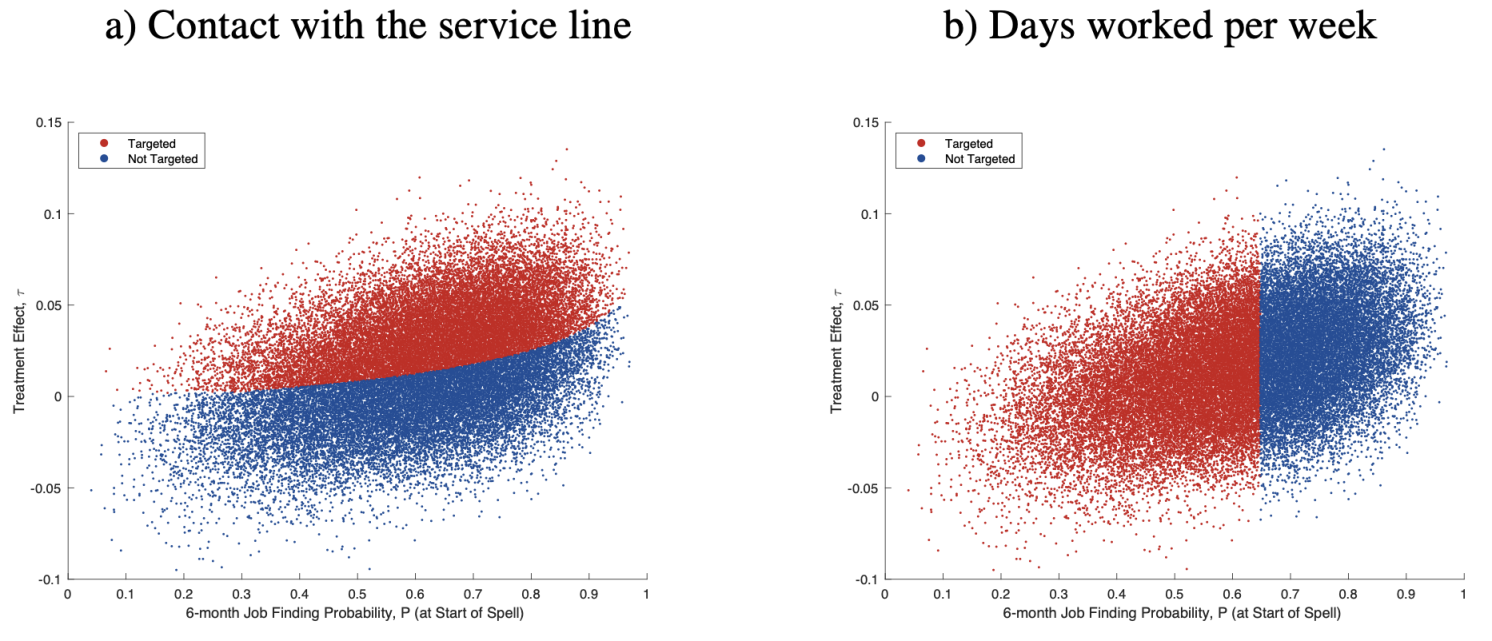
Figure 3 illustrates the distinction using a model calibrated to our estimates. Each point represents a simulated worker type, characterised by baseline job-finding prospects and responsiveness to counselling. The figure highlights substantial heterogeneity within risk groups. Under risk-only targeting, support goes to workers with the lowest job-finding probabilities, regardless of responsiveness. Under optimal targeting, both dimensions matter: workers with poor prospects can be prioritised even with modest treatment effects, while those with better prospects need larger treatment effects to qualify.
Figure 3 Optimal targeting combines risk and responsiveness
Source: Ernst et al. (2026), Figure 8, panels b and d.
Note: Left: optimal targeting. Right: targeting solely by low job-finding probability. Red points are targeted; blue points are not. Points represent simulated worker types, with all policies facing the same budget.
The potential gains are substantial. Holding the budget fixed, optimal targeting generates welfare gains nearly three times those of random assignment in our baseline calibration. Risk-only targeting instead performs worse than random assignment, because it systematically selects workers who respond little to the intervention. We show that a simple targeting rule – predicted responsiveness divided by baseline job-finding prospects – captures most of the gains of the optimal policy.
These comparisons are model-based and depend on assumptions about welfare losses from unemployment, treatment costs, and how the estimated effects generalise. Nevertheless, the central ranking is robust across the paper’s sensitivity analyses, including greater social welfare weights for jobseekers facing larger expected unemployment losses. Giving greater priority to disadvantaged workers does not remove the need to find interventions that work for them.
Intervene early, before responsive workers leave
The same distinction helps determine when to intervene. As unemployment lengthens, three things could change: how much counselling helps a given worker, which workers are still unemployed, and how many are still unemployed.
To isolate the first, we use the second round of outreach. As noted, workers above the 65% threshold are contacted about three months later. Around the threshold, this reverses which group is more likely to receive support, now about four months into the spell. Counselling delivered at this later stage appears about as effective as early counselling for similar workers, although the estimates are imprecise. Support does not seem to lose its effect on a given person as unemployment lengthens.
What changes is who remains. Workers with good prospects tend to find jobs quickly, so those still unemployed after several months are increasingly workers with poor prospects. These workers also respond less to counselling. This has opposing implications: support for the average long-term unemployed worker is less likely to work, but when it does work, it is worth more, because that worker would otherwise have stayed unemployed much longer. In our calibration, the second force dominates, and the average return to counselling among those still unemployed rises over the spell.
That does not mean support should wait, because resources are limited. With a fixed budget, a service intervening early can pick the workers with the highest returns from the full cohort. If it waits, many of the most responsive workers have already left: they found jobs, but more slowly than they would have with help, and that gain cannot be recovered. This ‘harvesting’ motive favours early intervention. When we allocate a fixed budget optimally across both people and time, most of the workers selected for support receive it early in their spell.
Evaluate support and differentiate what is offered
Employment services need evidence on both who is at risk and what helps whom. Predictive models can identify workers likely to remain unemployed, while experiments and credible quasi-experiments establish how different workers respond to support. Combining these two types of evidence can make scarce counselling resources substantially more effective.
The findings also have broader implications for tackling long-term unemployment. Identifying workers with poor underlying prospects earlier is valuable, but does not by itself establish how to help them. Differentiation must therefore concern not only who receives support and when, but also what support is offered. Those at greatest risk should remain a policy priority, especially as income protection is reduced. Their limited response to current counselling calls for developing and evaluating alternatives that address the barriers they face.
Source : VOXeu