


A pregnant woman in rural Nigeria calls a health line and asks, in the Yoruba language, whether bleeding in her sixth month is normal. An AI system answers. Whether it tells her to rest or to go to a hospital depends on which system the health line chose to deploy, a choice made long before her call.
AI services like this one are spreading across developing countries, from health and farming to schooling. As these services become cheaper to build, buyers face more and more options, and from the outside a good system and a bad one look the same. Choosing well takes the capacity to evaluate what is being bought, which is still scarce. And when buyers cannot judge quality, poor products stay on the market and adoption suffers.
The natural way to screen AI systems is to test them before they reach people. This is the first step in evaluating an AI service, and the tests the AI industry uses for it are called benchmarks. Why can’t today’s benchmarks do this job for development? What would better ones look like? And why should they be built as a public good?
Why today’s AI benchmarks fall short
A benchmark is a standardized test: every system faces the same tasks and is scored the same way, so that the results can be compared. For a service like the health line, however, most of today’s benchmarks say little, for three reasons.
First, they test proxies. Most benchmarks are made of exam questions and translation exercises, because these are easy to score, and the score is taken to stand for a broader ability. As researchers have long warned, a high score on the proxy says little about how a system handles the open questions people actually ask.
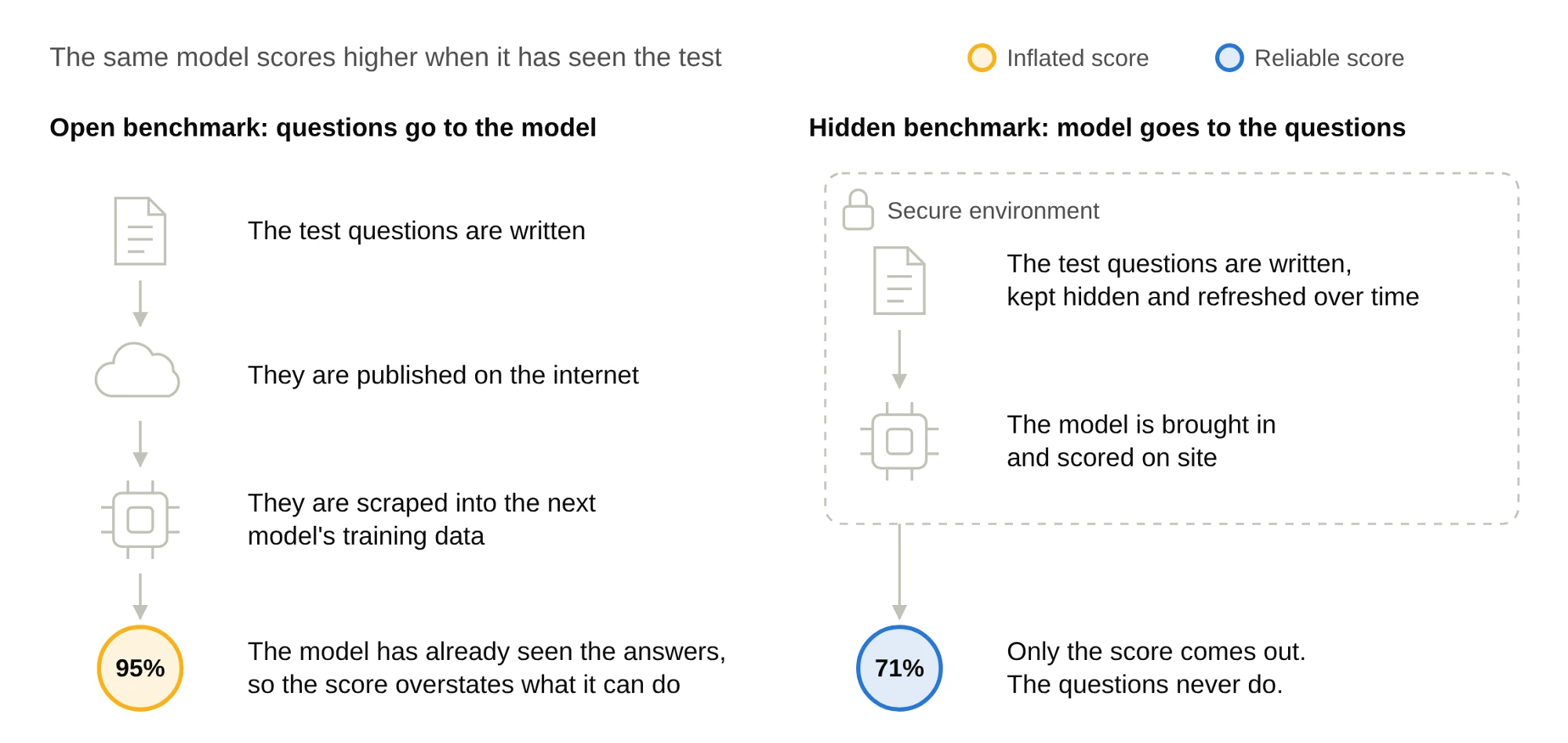
Second, they leak and wear out. Tests published online end up in the data used to train the next model, which can then score well without solving the problem. Even well-guarded tests age: in a study of 60 widely used benchmarks, about half could no longer tell the leading models apart.
Third, they are built far from where these services run. Most are written in English and in text, while many people with limited literacy use their phones by voice. Even benchmarks in other languages come mostly from a handful of countries with abundant data.
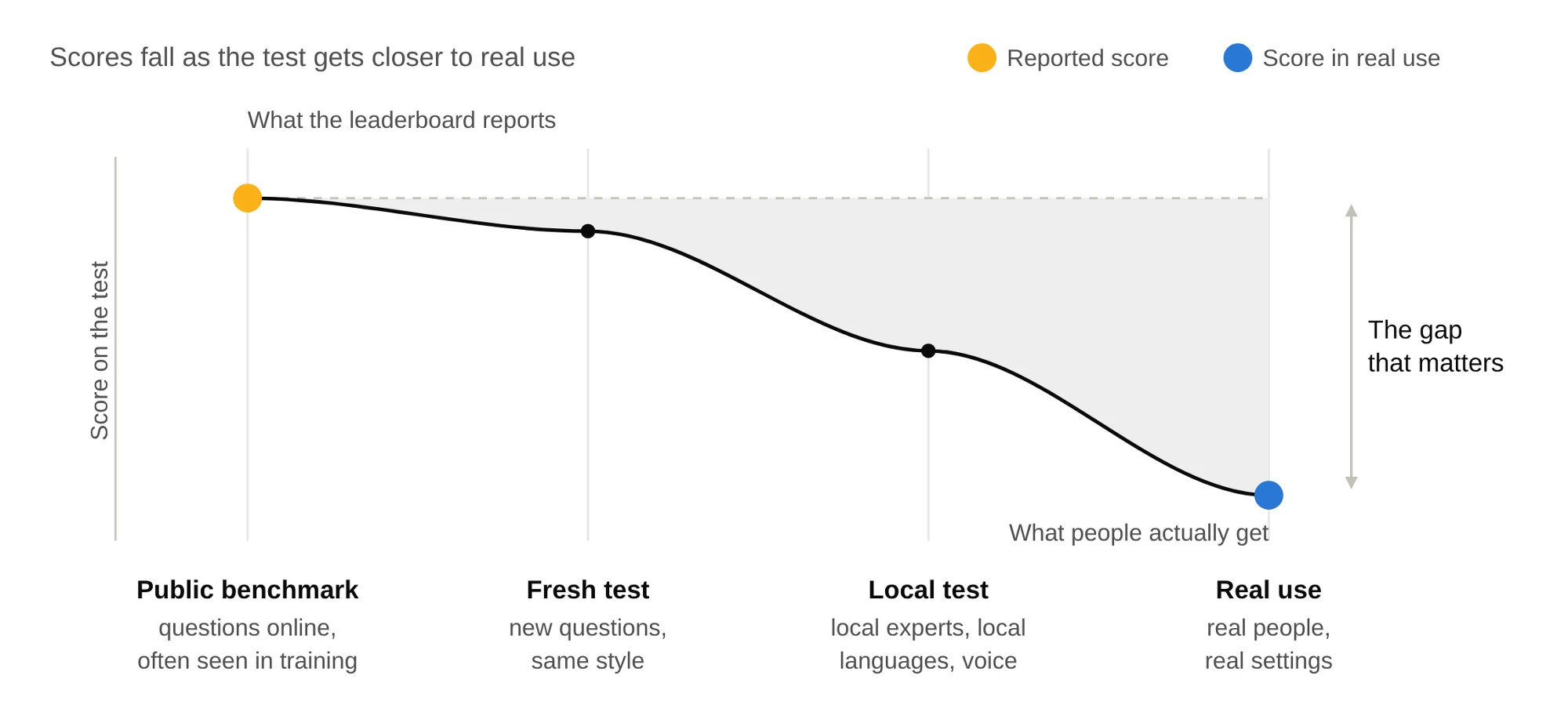
The result is a blind spot where the stakes are highest. On everyday questions written by native speakers, the strongest model tested in 2025 answered 96 percent correctly in Western European languages but only 80 percent in Sub-Saharan African ones. In our own work on Nigerian Twitter, hate speech detectors that performed well on curated samples scored less than half as well on a representative sample of posts. The gap tends to widen as tests get closer to real use (Figure 1), and for most tasks and places in the developing world, nobody has built a test at all.
What benchmarks built for development look like
If we want AI to deliver for development, we need benchmarks that test systems on real tasks, in the conditions where they are deployed.
Take the Nigerian health line. A benchmark for it would start from the questions women actually ask, drawn where possible from calls recorded with consent. Callers speak Yoruba mixed with English over poor connections, and speech recognizers must understand them. Local midwives and doctors would grade the answers, because good advice in one health system can be bad advice in another. A system trained mostly on guidance from richer countries might tell the caller to phone her maternity unit, which is sound advice where every pregnant woman has one to call. She may have none, and bleeding at this stage is a danger sign, so she needs to know which nearby facility can handle an emergency. Averaged with hundreds of other answers, that reply would barely register, so dangerous errors are counted separately. This will matter even more as AI systems move from answering people to acting on their behalf, since their reliability has improved far less than their capability.
Such a test keeps its value only if it is protected. The tasks therefore stay in a secure environment, which also protects the callers’ recordings. Models are brought there to be tested, and only the scores come out (Figure 2). Since even hidden benchmarks lose their edge as models improve, the tasks are also refreshed over time.
A benchmark like this does two things. It screens: it shows whether a system can do the job safely, and whether a smaller and cheaper model would do it just as well, which is what makes small AI work in practice. And it shapes the market. By showing where systems fall short in poorer countries, it tells model builders what to fix, and once governments and funders use the results, their buying power rewards the builders who close these gaps. The AI industry will keep competing on benchmarks. The question is whose tasks are on the test.
Building AI benchmarks as a public good
Several efforts are already building pieces of this. LINGUA Africa funds open speech and text data in more than 50 African languages, and the Agency Fund and Endless Health are building health AI benchmarks. The EvalEval Coalition has developed Evaluation Cards, a common way of reporting results that the UK AI Security Institute already uses.
What is still missing is continuity: hidden tests of deployed tasks across sectors and countries, maintained over the years, run on every new model and reported in one place. The market will not supply this on its own, because such a test is a public good. Once it exists, it can inform every buyer at no extra cost, and nobody can be kept from using published results, so each buyer has reason to let others pay. Model builders could fund it, but a test paid for by those it grades is hard to trust.
For AI in development, the World Bank is well placed to build and maintain such benchmarks with its partners. It sells no model, so it has no stake in the scores. It also works with the governments of most developing countries and has long protected sensitive data with them. We are piloting this approach in our lab and would love to hear from anyone who would like to be part of it:
A benchmark is only the first step, however. It can tell us whether a system gives women the right advice, but not whether that advice makes them safer, which depends on what happens after the call. That is the question impact evaluations answer, and the Bank has run them with governments for more than two decades. The two work together: benchmarks show which systems are worth evaluating, and evaluations in turn show how to build better benchmarks.
AI could bring people expertise and services they have never had access to, and increasingly act on their behalf. Whether it does so safely will depend on our ability to tell which systems deserve people’s trust. For the woman calling the health line, that starts long before her call, with a test built around the questions she actually asks.
Source : World Bank