


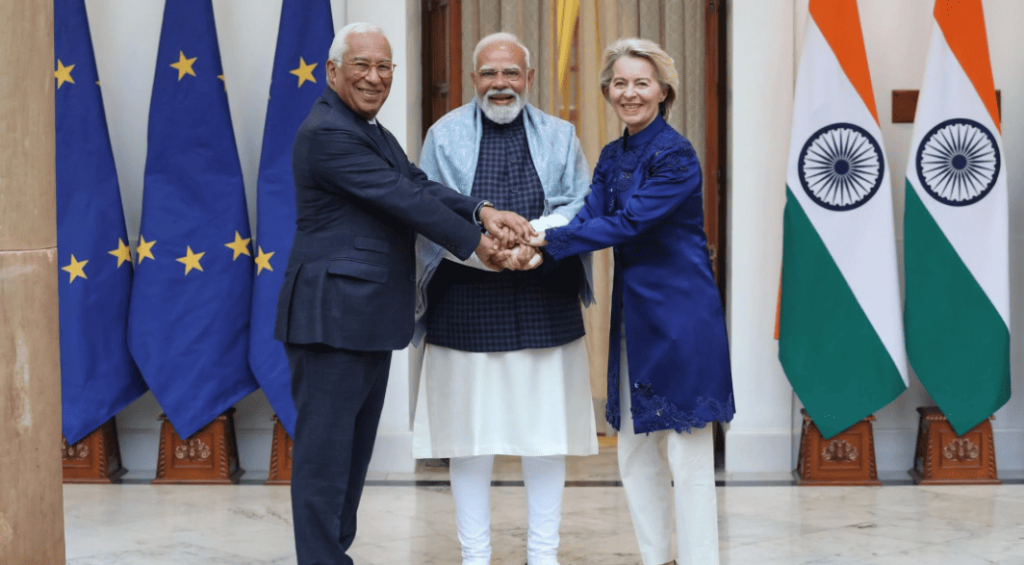
While recent analysis has focused on direct impacts of US tariffs and potential retaliation, major US trading partners have intensified trade negotiations with each other, including the recently completed EU–Mercosur and EU–India deals. Using a quantitative trade model, this column shows that deep integration – involving non-tariff barrier reductions – can offset welfare losses from US tariffs and generate net gains. Paradoxically, US tariffs may ease political economy constraints by strengthening incentives for export-oriented industries to lobby for deeper integration elsewhere.
Much of the recent debate on US tariff actions has focused on their direct impacts and the prospect of retaliation (Ignatenko et al. 2025, Clausing and Lovely 2024, Conteduca et al. 2025, Bouët et al. 2024, Cerdeiro et al. 2025, WTO 2025). Yet a striking development has received less attention: major US trading partners have intensified discussions, negotiations, and ratifications of potentially significant preferential trade agreements – including EU–Mercosur, UK–India, EU–India, EU–CPTPP, deepening of RCEP, and completion of the EU Single Market. Are these two phenomena related?
In our recent work (Rotunno and Ruta 2025), we assess the trade and real income implications of different policy responses by trading partners to US tariffs: retaliatory tariffs, industrial policy to support affected domestic producers, and economic integration with other countries to offset the loss of US market access. In this column, we focus on the findings from simulations of different economic integration scenarios in the presence of US tariffs, showing that deep integration may not only offset the negative effects of US tariffs but could actually be accelerated by them.
Model and scenarios
The analysis uses a standard quantitative trade model based on Caliendo and Parro (2015), extended to allow for production subsidies (see also Ju et al. 2024). This model features firms that use a single factor of production and traded intermediate inputs, operating under constant returns to scale and perfect competition. Importantly, subsidies and trade costs (import tariffs and non-tariff trade barriers) introduce a wedge between producer and consumer prices. The model is solved in changes relative to a baseline with pre-2025 tariffs and is calibrated for 74 countries and a rest of the world aggregate, across 25 sectors (24 goods sectors and one service sector aggregate), using data from the OECD TiVA database.
The baseline US tariff scenario takes the import tariffs implemented by the US as of September 2025, sourced from the WTO–IMF Tariff Tracker. The economic integration scenario adds the implementation of preferential trade agreements (PTAs) that have been signed since 2023 (e.g. EU–Mercosur, EU–India and UK’s accession to CPTPP), currently under negotiations (e.g. Canada–Mercosur) and that could be negotiated in the future (e.g. EU–CPTPP, deepening of RCEP and completing the EU Single Market). Because of these agreements, bilateral trade costs go down as tariffs are brought to zero and non-tariff trade barriers are reduced.
Figures 1 and 2 show the countries involved in the PTAs, with darker colours indicating deeper reductions in average tariffs and non-tariff barriers. Trade-weighted tariff reductions are modest (at most 1 percentage point), as baseline tariffs are already low and PTA partners often represent a small share of trade. Non-tariff trade cost reductions – calibrated using estimates from Mattoo et al. (2022) – are more substantial (up to 6%), particularly for EU countries and East Asian economies due to the assumed deepening of the EU Single Market and RCEP. We simulate both a shallow integration scenario (tariff reductions only) and a deep integration scenario (adding non-tariff trade cost reductions).
Figure 1 Average simulated reductions in trade-weighted tariffs


Notes: Import-weighted average of product-level tariff reductions for countries involved in the economic integration scenario (see Rotunno and Ruta 2025 for details).
Figure 2 Average simulated reductions in trade-weighted non-tariff trade barriers


Notes: Import-weighted average of sector-level reductions in non-tariff barriers for countries involved in the economic integration scenario (see Rotunno and Ruta 2025 for details).
Deep trade agreements offset losses from US tariffs
Deep economic integration can counteract export losses from US tariffs. Figure 3 shows that US tariffs alone reduce total goods exports for the US and major trading partners, with sharper contractions for countries facing higher tariffs (India) or more exposed to the US market (Canada and Mexico). Shallow tariff-only integration reduces these losses but fully offsets them only for a handful of countries such as the UK and Japan. Deep integration, however, generates significant export gains even with US tariffs in place. East Asian economies see the largest increases (up to 18%) through RCEP deepening and EU–CPTPP agreements. Intra-EU trade rises by around 10% from single market deepening, while China’s exports increase by around 5%.
Figure 3 Simulated changes in goods exports under the US tariffs and integration scenarios


Notes: The baseline scenario uses US tariffs as of January 2025 and tariffs for other countries as of 2023 circa. All counterfactual scenarios include US tariffs as of September 2025 (see Rotunno and Ruta 2025 for details).
Deep integration is the only policy response that can counteract welfare losses from US tariffs. Figure 4 shows that US tariffs reduce real income for the US itself – as efficiency losses from distortions outweigh terms-of-trade gains – and for most trading partners, lowering world real income by 0.16%. Shallow integration brings marginal welfare improvements, but deep integration boosts real income substantially: up to 2% for Japan, Indonesia, and small East Asian countries, and 1.4% for the EU through Single Market deepening. Overall, world real income rises by 0.45% under deep integration, fully offsetting US tariff losses. In our paper we show that alternative responses – retaliatory tariffs and subsidies to support producers impacted by the tariffs – fail to offset these welfare losses.
Figure 4 Simulated changes in real income under the US tariffs and integration scenarios


Notes: The baseline scenario uses US tariffs as of January 2025 and tariffs for other countries as of 2023 circa. All counterfactual scenarios include US tariffs as of September 2025. Changes in real income includes changes in net government revenues rebated lump sum to consumers (see Rotunno and Ruta 2025 for details).
How US tariffs may unlock deeper integration
These findings point to economic integration as the main welfare-generating response to US tariff actions. By removing distortions – especially frictional trade barriers – deeper trade agreements can compensate for lost US market access and boost aggregate efficiency. Importantly, our results also highlight the political economy challenges of deeper integration. Shallow liberalisation cannot offset US tariff spillovers, as decades of trade opening have already reduced tariffs substantially. Reductions of non-tariff barriers are necessary but politically harder to implement, as these often involve reforms to investment, competition, or intellectual property regimes, and harmonisation of regulations and standards that can be sensitive to change. Such deep integration was welfare-improving even before US tariffs, yet remained politically infeasible due to opposition from domestic interest groups negatively affected by these reforms.
Could higher US tariffs ease these political economy constraints? As Baldwin (2025) notes, higher US barriers may prompt export-oriented industries to lobby for market access elsewhere through deeper trade agreements. Additional analysis supports this dynamic. We find that the share of trade covered by PTA partners increases more with US tariffs than without them, suggesting that higher US tariffs increase the market access value of trade agreements, creating stronger political economy incentives for deep integration reforms that were previously blocked despite their welfare benefits.
Source : VOXeu