


When the philosopher and poet Ralph Waldo Emerson wrote in 1841, “Every sweet hath its sour; every evil its good”, nitrogen was surely the last thing on his mind. Yet his words perfectly encapsulate the paradox of nitrogen in development.
Once called azote —lifeless — nitrogen is anything but. It is embedded in DNA and RNA, in proteins, and in every living cell, and is a vital nutrient for growing crops. Nitrogen fertilizer was once hailed as a miracle that could feed the world while sparing forests from the plough. But the miracle has now turned toxic in some regions due to nutrient mismanagement, with consequences for soil, water, and air, and cascading impacts on the broader economy.
A global system out of balance
A century ago, nitrogen was the limiting factor for global agriculture. That changed in 1909 when Fritz Haber developed an artificial way to “fix” nitrogen from the air. Carl Bosch scaled the breakthrough for commercial use. Both won Nobel Prizes for their work making “bread from air” a reality, boosting yields and feeding billions.
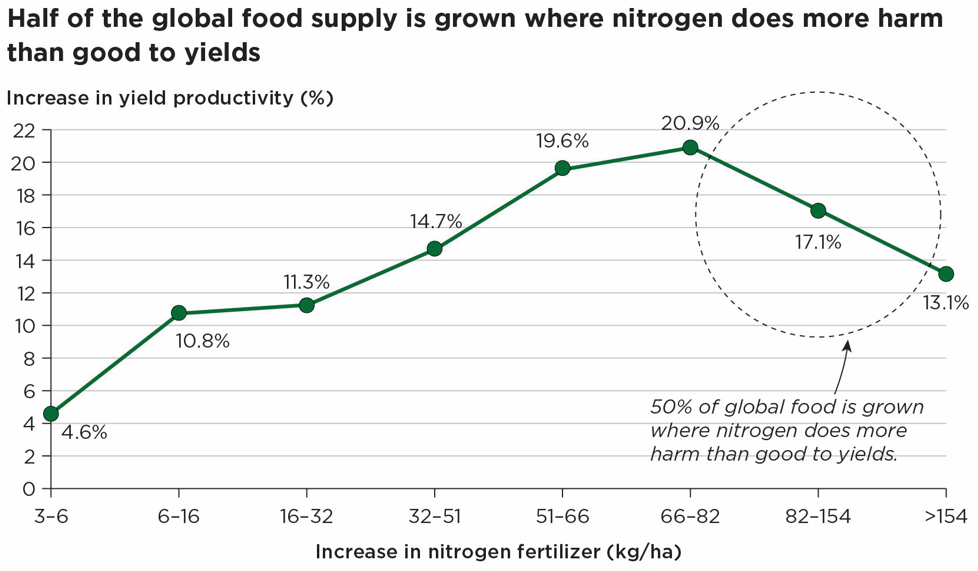
Since then, global nitrogen fertilizer use has soared, especially in Asia. More nitrogen, however, does not always mean more yield. Nearly half of the global food supply comes from regions where nitrogen fertilizer does more harm than good to yields. Subsidies that favor nitrogen over other nutrients, encourage overuse and degrade soil health are partly responsible, particularly in areas of South and East Asia. In parts of Africa, fertilizer use is lower but blanket subsidies still favor one-size-fits-all use over precision. .
Nitrogen alone often fails to raise yields because of other nutrient deficiencies and soil acidity that limit crop responses. Both extremes hurt productivity, underscoring the need for balanced fertilization.
Source: Chapter 4, Reboot Development: The Economics of a Livable Planet.
The nitrogen cascade
Agriculture is by far the largest driver of reactive nitrogen losses globally, exacting a staggering environmental toll. Nearly half of the fertilizer applied to fields never nourishes crops. Where does it go? Some leaches into water supplies as nitrates associated with cancer, developmental delays and “blue baby syndrome”. Nitrogen runoff also fuels hazardous algal blooms that devastate coastlines and deplete fisheries, costing an estimated $12–18 billion between 2003 and 2015 alone. Some volatilizes as ammonia or nitrogen oxides, worsening air pollution and respiratory disease. And some converts to nitrous oxide, a greenhouse gas around three hundred times more potent than carbon dioxide and a major threat to the ozone layer.
Nor is it certain that nitrogen-driven yield gains will spare forests: without conservation policies, the “rebound effect” can mean higher farm profitability accelerates, rather than arrests, the advance of agriculture into forests and natural habitats.
Emerson’s insight has come to pass. Today, nitrogen is a boon and a burden: critical for food production, yet its unbalanced use—worsened by misguided subsidies—is damaging soils, water, and air. Evidence suggests we have transgressed the safe planetary boundary for reactive nitrogen, creating among the world’s largest externalities, costing hundreds of billions—perhaps trillions—each year.
A better way
The good news is that smart nitrogen management delivers extraordinary returns. It can deliver benefits up to 25 times greater than costs, through better yields, cleaner water and air, and fewer pollution-related illnesses.
It starts with making every unit of nitrogen count. Applying the right nutrients, at the right rate, at the right time, and in the right place can boost efficiency. This is hard in practice when information is scarce, and cheap fertilizer encourages blanket use. Repurposing harmful subsidies and investing in extension services toward better nutrient management is essential. Precision agriculture can help, from satellite data and mobile advisories to low-cost leaf color charts that help farmers tailor nitrogen to crop needs. Regenerative practices that retain moisture and sustain microbial activity to build soil health make every unit of fertilizer work harder. Fertilizer companies can innovate too, with slow-release formulations that deliver nitrogen when plants need it most, like time-release medicines. Reducing food loss and waste can also ease pressure on land and fertilizer use.
Equally critical is addressing what is already in the ground. Decades of excess have left a legacy of stored nitrogen in soils and aquifers that continues to seep into waterways, partly explaining why water quality goals remain stubbornly out of reach. Here, nature-based solutions are key. Wetlands are among the planet’s most cost-effective, yet overlooked, nitrogen filters. Like nature’s kidneys, they intercept runoff and filter out nutrients before they reach rivers and coasts. They also store carbon, support biodiversity, and buffer floods. Yet the world has lost some 3.4 million square kilometers of wetlands, an area roughly the size of India, mainly to agricultural drainage. Targeting wetland preservation and restoration can help meet water quality targets with minimal impact on agriculture.
Finally, coordinated policies are key. Because nitrogen shifts form as it moves through soil, water, and air, fixing one problem can unintentionally create another. A range of initiatives – the 2025 Belém Declaration on Fertilizers, the EU’s Farm to Fork Strategy, and the Kunming-Montreal Global Biodiversity Framework – are addressing policy silos. With support from the World Bank Group, countries are increasingly learning from one another — as exemplified by a new program helping six governments in Africa to redesign their farm support to restore soils while maintaining yields, as well as efforts bringing together seven countries in South and Southeast Asia to reduce inputs in the rice sector.
The opportunity is clear: better nitrogen management can cut pollution without jeopardizing productivity and is a win for food security, health, and the environment. The challenge now is to close the gap between ambition and action; to keep the sweet and finally lose the sour.
Source : World Bank