

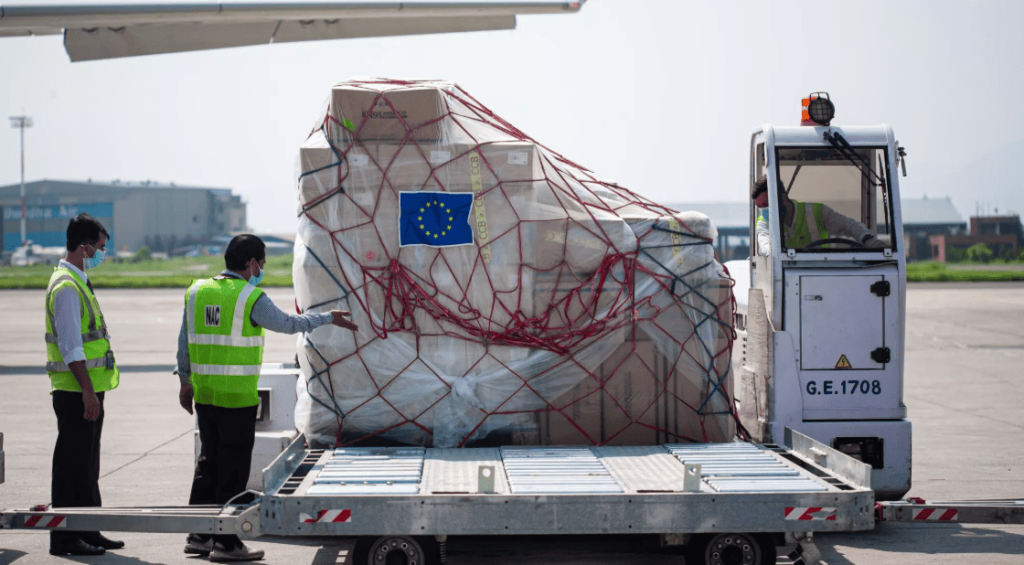
European Union development aid is emphasising poverty reduction less and directing attention to other geopolitical priorities.
As part of the planned European Union budget for 2028-2034 – the so-called Multiannual Financial Framework (MFF) – the European Commission proposed in mid-2025 what would be the largest amount to date for partnerships with, and diplomacy directed at, the world outside the EU (European Commission, 2025b). Worth €200 billion, or 0.14 percent of EU gross national income (Figure 1), this budget line, called the Global Europe Instrument (GEI), would be 90 percent classified as official development assistance (ODA).
Corresponding to annual ODA-equivalent spending of about €26 billion, this would put the EU among the world’s largest providers of development finance. The EU sum would be comparable to Germany’s $29.1 billion in ODA in 2025, the highest among members of the Development Assistance Committee (DAC), which acts as a forum for donors that are part of the Organisation for Economic Co-operation and Development (OECD, 2026).
According to the EU treaty, the primary objective of EU development cooperation policy should be poverty reduction. However, the proposal comes at a time when development policy is expected to serve an increasing number of objectives (Bahí et al, 2026). EU countries expect EU development cooperation to align more closely with broader foreign policy, economic and geopolitical goals.
Reflecting this evolution, the GEI replaces the previous approach of binding thematic spending targets (requiring certain shares of spending to meet climate and environment goals, for example) with regional allocations, complemented by a global allocation for cross-cutting and multilateral actions, and an unallocated reserve (the ‘cushion’) to be deployed for energy needs or to shift between regions. This design may help the EU respond to emerging challenges, but it also makes the balance between development and other strategic objectives, such as migration management, neighbourhood stabilisation, accession support and geopolitical partnerships, less transparent (Grabbe et al, 2024; Dom, 2025).
In addition, two features of the proposed GEI suggest less emphasis on poverty reduction. First, the requirement for 90 percent of GEI spending to qualify for ODA is actually a reduction from the current level of 93 percent, and the 90 percent would apply to a smaller base since Ukraine is excluded from the calculation. Second, a United Nations Sustainable Development Goal target for developed economies to spend at least 0.2 percent of GNI on aid for the least-developed countries is included in the Commission proposal only as a non-binding objective.
These elements raise the question of whether the proposed geographic allocation of ODA under the GEI remains aligned with the development needs of recipient countries. What happens to poverty targeting when a development instrument is redesigned to serve a broader set of strategic objectives?
The GEI in a global context
The GEI arrives at a moment of severe disruption in global development finance. In 2025, global ODA from OECD DAC member countries fell by 23.1 percent to $174.3 billion. A 56.9 percent cut to United States aid accounted for three-quarters of that fall, but European donors have also made significant reductions. Germany plans a 3 percent cut in 2026 and an additional €9 billion in cuts by 2029. France and the United Kingdom have also reduced ODA spending (OECD, 2026; Loft and Brien, 2026).
The proposed increase in EU ODA through the GEI thus matters. At 0.14 percent of EU GNI, the Commission’s proposal is substantially higher than the 0.11 percent allocated in the 2021-2027 MFF (Figure 1). It should be noted that the 0.14 percent level proposed by the Commission could be reduced in the final budget, after negotiations with EU governments.
Figure 1: EU external spending, 2021-2027 and 2028-2034 (% of GNI)

Source: Bruegel based on European Commission (2025a, 2025b). Note: spending in 2021-2027 includes current instruments the Neighbourhood, Development and International Cooperation Instrument (NDICI-Global Europe), humanitarian aid and pre-accession instruments, the Common Foreign and Security Policy (CFSP) budget and support for Overseas Countries and Territories. For 2028-2034, ‘other’ includes the CFSP budget, support for Overseas Countries and Territories (including Greenland), Sustainable Fisheries Partnership Agreements and Regional Fisheries Management Organisations and other actions. See the text of this analysis for other spending categories.
Geographic allocation: strategic goals vs development need?
The proposed GEI allocates resources to five regions (Europe; Middle East, North Africa (MENA) and the Gulf; sub-Saharan Africa; Asia and Pacific; Americas and Caribbean), complemented by the global allocation and an unallocated cushion. Unlike the comparable budget line in 2021-2027, it no longer contains binding thematic spending targets. These currently include a minimum of 30 percent on climate goals, 10 percent minimum for migration, 20 percent for human development and minimum amounts for geographical regions. Instead, there would be an overarching climate target across all headings of 35 percent.
Such thematic targets have ensured minimum levels of spending on development objectives regardless of shifting geopolitical priorities. Under the GEI, the balance between development, migration, the EU’s neighbourhood, EU enlargement and broader strategic objectives is expressed primarily through geographic allocations and flexible funding mechanisms: the regional distribution of resources is the clearest indicator of the instrument’s underlying priorities.
To assess whether the proposed allocation remains aligned with the development needs of recipients, we compare GEI regional allocations against three benchmarks: population, poverty and the regional allocation pattern of the World Bank Group (WBG). Population provides a benchmark for equal per-capita treatment, extreme poverty captures the concentration of development need, and the WBG benchmark reflects the allocation choices of the largest development finance institution.
On a per-capita basis, the MENA and Gulf region would receive €10.90/person/year from 2028-2034 (Figure 2, left panel), the highest allocation. By contrast, Asia and the Pacific would receive €0.51/person/year, notwithstanding its population of 4.2 billion. Sub-Saharan Africa would receive €5.90/person/year.
The differences become even more pronounced when measured against poverty (Figure 2, right panel). Sub-Saharan Africa, which hosts the vast majority of the world’s extreme poor, would receive around €16 annually per person living in extreme poverty (on less than $2.15 per day, 2017 PPP). MENA and the Gulf would receive €319/person/year in extreme poverty, nearly twenty times as much. We exclude Europe from Figure 2, as GEI spending there would be focused on activities related to membership preparations for potential future EU countries.
Figure 2: GEI spending (2028-2034) per capita and per person in extreme poverty by geography

Source: Bruegel based on European Commission, World Bank Poverty and Inequality, UN WPP 2024.
To quantify the extent to which allocations diverge from poverty need, we construct a ‘geopolitical premium’: the difference between a region’s actual allocation share and the share it would receive if resources were distributed in proportion to extreme poverty (Figure 3). A positive premium means over-allocation relative to poverty; a negative premium means under-allocation. We compare what the premiums would be for GEI as proposed, to the premiums seen in actual disbursements between 2021 and 2024.
Figure 3: Geopolitical premium (percentage points)

Source: Bruegel based on European Commission (2018a, 2018b, 2025a, 2025b) and OECD CRS dataset, World Bank PIP. Note: ‘NDICI 2021-2027’ values relate to actual disbursements from 2021-2024. See also the note to Figure 1.
A poverty-proportional allocation provides a useful benchmark, but it assumes that resources should be distributed solely according to the location of the world’s extreme poor. To complement this approach, we calculate how the GEI regional allocations would be distributed if they followed the regional allocation pattern of World Bank Group (International Development Association and International Bank for Reconstruction and Development) disbursements during 2021-2024 (Figure 4).
The divergence from the WBG benchmark is most pronounced in Asia and the Pacific, and in MENA and the Gulf. The former would receive 9.9 percent of the GEI regional allocations, compared to 31.5 percent if the WBG benchmark were applied. MENA and the Gulf would receive 24.8 percent under the GEI against a benchmark share of 6.7 percent. Sub-Saharan Africa’s GEI allocation (35 percent) would be close to its WBG benchmark share (35.9 percent).
Figure 4: Regional allocation shares

Source: Bruegel based on OECD CRS data for IDA and IBRD. Note: NDICI refers to actual EU ODA disbursements (2021-2024) for GEI-mapped countries; see also the note to Figure 1; the WBG benchmark is based on average annual IDA and IBRD disbursement shares over 2021-2024.
Less poverty-focus
At a time when major donors are scaling back their ODA budgets, the proposed increase in the GEI could partially offset ODA reductions at member-state level and further centralise development policy at EU level. If poverty reduction is considered a global public good, it is likely to be underprovided when major donors reduce their contributions. Cuts to development assistance, particularly by the US, have widened the financing gap. A stronger EU role can help mitigate the shortfall and sustain the provision of development finance. The EU contribution becomes more important when collective efforts weaken.
However, within the EU allocation plan, the benchmarks used in this analysis show a pattern of selective divergence: relative under-allocation to Asia and the Pacific with substantial over-allocation to the MENA and the Gulf region, with the gap widening relative to the current budget cycle.
Regions with the highest concentrations of extreme poverty would receive the lowest spending per poor person. The relatively high intensity of funding in the MENA and the Gulf region, a focal point of EU migration and energy policy, may indicate that GEI allocation reflects strategic considerations.
The Commission proposal (European Commission, 2025b) did not state any intention to shift the instrument away from poverty reduction, and the proposal sets no needs- or poverty-based allocation rule. But the allocation pattern is what a strategically-driven distribution would produce. While current spending is anchored to poverty reduction and requires prioritisation of the countries most in need, the Commission proposal refers to poverty far less and does not make binding the 0.2 percent of GNI spending target for the least-developed countries.
To some extent, the EU’s apparent geopolitical reorientation is a legitimate response to a changing world. The various shocks experienced during the current budgetary period (2021-2027) suggest that allowing more flexibility could increase the budget’s effectiveness in responding to a volatile world.
Nevertheless, the removal of floors for spending on certain priority policies, such as climate, the reallocation away from regions where extreme poverty is concentrated, and the risk that flexible resources are redirected toward emerging crises raise concerns about whether spending under GEI will deliver on the EU’s poverty-reduction objective (Bahí et al, 2026).
Greater flexibility need not mean less accountability. Because the GEI sets out regional allocations rather than binding targets, the balance between development and strategic objectives will become visible only during implementation, through programming, reallocation and use of the cushion. Regional commitments and disbursements against development-need indicators, including the extreme-poverty headcount, should therefore be tracked. When the mid-term evaluation of GEI is done, it should set out the resulting allocation pattern explicitly. This would enable the European Parliament and EU governments to monitor whether spending remains consistent with the EU’s poverty-reduction objective, and to correct course as needed.
Source : Bruegel