

Women entrepreneurs represent a powerful yet largely untapped source of job creation and economic growth. Removing barriers faced by women entrepreneurs would significantly boost economic growth, as women-led businesses can play a central role in creating more jobs for women.
To realize this potential, it is essential to support growth-oriented women-led small and medium enterprises (WSMEs)—the “missing middle” —that can generate substantial job creation and productivity growth. Yet these businesses face major financing constraints, as they are too large for microfinance yet often considered too small or risky for banks and investors.
Limited data and evidence on what works to improve access to finance for growth-oriented WSMEs remains a key challenge, as highlighted in a dynamic evidence reviewconductedin 2022 and 2025. Existing evidence predominantly focuses on microenterprises, with limited studies on WSME financing for growth-oriented enterprises. While further research is needed to assess what works for growth-oriented WSMEs, emerging findings point to three critical strategies for improving access to finance for growth-oriented WSMEs and supporting jobs and business growth: better segmentation, tailored product design, and effective digital delivery.
Segmenting and targeting growth-oriented businesses with job creation potential
WSMEs are not a homogeneous group, they have diverse motivations, entrepreneurial journeys, and financial and non-financial needs, spanning sectors and business models from agricultural cooperatives and family enterprises to innovation-driven startups. Segmenting businesses, for example by the growth rate of annual enterprise revenue, is essential to avoid one-size-fits-all approaches, tailor financial and non-financial support, and identify businesses with the greatest job-creation potential. Various studies on debt financing show high heterogeneity in outcomes, largely due to the lack of effective segmentation. This suggests that better segmenting women borrowers is critical to improving the overall impact of lending interventions.
A new WSME segmentation framework and toolkit based on a qualitative and quantitative analysis in Colombia, Pakistan, and Uganda, identifies three growth segments (low, moderate, high) and six growth profiles (survival, livelihood, stability, aspired expansion, legacy building, and wealth creation). The framework enables development institutions, financial service providers, and business support organizations to better target priority segments and align financial and non-financial services with their needs. For example, within the high-growth segment, entrepreneurs focused on wealth creation are often motivated by scale and profit and are more open to equity, while legacy builders prioritize long-term family involvement and control and therefore prefer debt-based financing solutions.
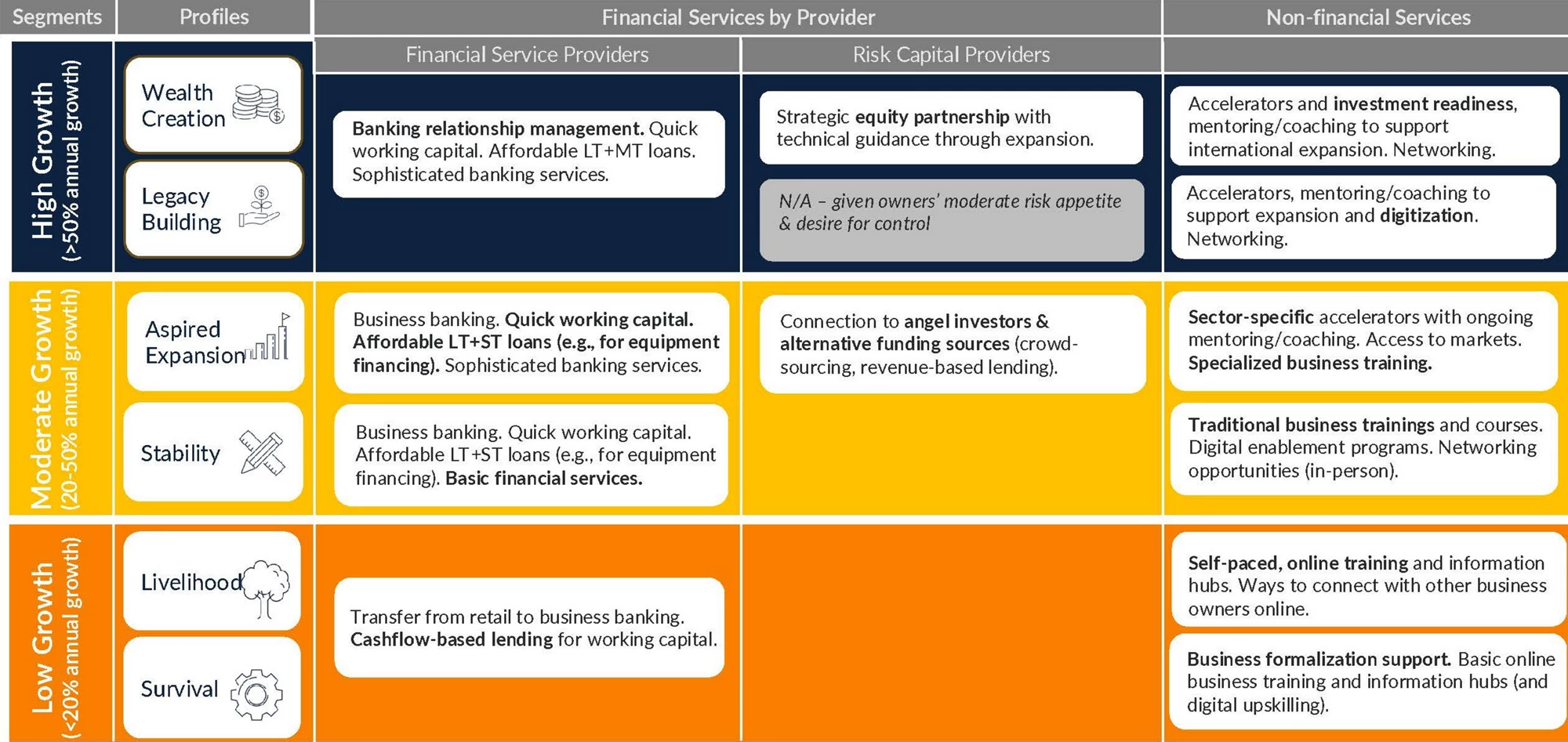
WSME growth segments and profiles. Source: Argidius Foundation, CCX, DGGF, and We-Fi. 2025. What Enables Her Business to Grow.
Although country-specific data from the study show that WSMEs employ a majority of women (63% in Colombia, 52% in Pakistan, and 56% in Uganda), more research is needed to understand how different growth segments and profiles affect the number and quality of jobs, especially for other women.
Designing financial products and services centered on women’s needs
Designing financial products around women entrepreneurs’ needs is critical to ensuring they can access, use, and benefit from finance in ways that enable business growth and job creation. Yet traditional lending models often overlook barriers like limited credit histories and unequal property rights, restricting women’s ability to provide collateral.
Alternative credit assessment methods have shown promising results in helping more women-led businesses access financing. For example, an experiment in Ethiopia shows that psychometric credit scoring doubled women’s likelihood of accessing a formal loan (from 42 to 90 percent). In Nigeria, women-led firms that received cashflow-based loans were 20 percentage points more likely to borrow from formal sources two years later, an effect not seen among men. Similarly, data from a large FinTech lender in Mexico indicate that digital transaction data reliably predicted creditworthiness for borrowers without credit histories, approving 2.6 times more women.
Other design features (e.g., flexible repayment terms) and alternative financing models (e.g., asset-based lending, revenue-based financing or factoring) may further ease barriers. But more evidence is needed, particularly for larger WSMEs. Moreover, there is still very limited evidence on how equity financing (including early-stage financing such as acceleration, angel investing, and crowdfunding) and insurance products impact women’s business growth and access to additional financing.
Delivering digital financial solutions that address women’s contextual constraints
How financing is delivered and disbursed matters. Digital delivery approaches can make financial services more accessible and trusted, considering women’s contextual constraints, including mobility, time, and social barriers. For example, findings from Sub-Saharan Africa show that formal women-owned firms using mobile money increased their investment and demand for credit—an effect not observed among men-owned firms. A study in Mexico found that MSMEs receiving FinTech loans saw 19.4% higher two-year sales growth, with an even larger effect for women-owned firms (41.9%).
While digital credit can boost women’s business performance, it also carries risks such as over-indebtedness or digital exclusion. Evidence is still limited on how digital delivery channels, including embedded finance, expand women’s use of financial products and services and improve their access to additional financing.
Bridging research and policy to drive collective knowledge
Better understanding what works to improve women’s access to finance will require more research and stronger data systems, particularly better supply-side data. The Women Entrepreneurs Finance Initiative (We-Fi) with its flagship initiative, the WE Finance Code, plays an active role in advancing this agenda across its partners, including within the World Bank Group and regional multilateral development banks.
For example, the annual We-Fi research conference was launched to address key knowledge gaps on women’s entrepreneurship and promote the application of existing evidence in program and policy design. Co-organized with the European Bank for Reconstruction and Development and Inter-American Development Bank Group, the conference brings together researchers, policymakers, and practitioners from more than 25 institutions, including universities, development finance institutions, NGOs, and public and private sector organizations.
The World Bank Group has set a target of reaching 80 million more women and women-led businesses with access to capital by 2030. Achieving this target will require putting data and knowledge at the center of action—continuing to close critical evidence gaps on financing women entrepreneurs, using evidence for program and policy design, and strengthening knowledge exchange across the entrepreneurial ecosystem for scale, replication, and innovation. In doing so, data and knowledge can translate into improved access to finance for WSMEs, accelerate business growth, maximize job-creation potential, and expand economic opportunities for women more broadly.
Source : World Bank