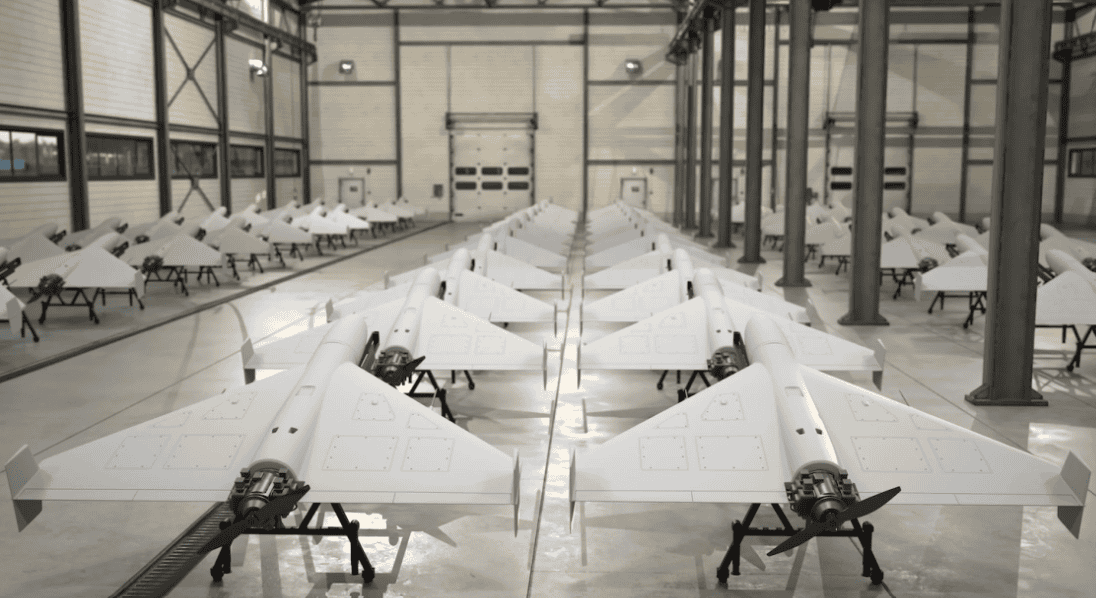


Defence budgets are rising across Europe, and several EBRD economies are leading the shift. Whether higher spending supports domestic industry depends on who can supply it. Drawing on the EBRD Transition Report 2026-27, this column shows that emerging Europe’s defence industry combines large, unproductive state-owned incumbents with young defence-tech startups that rarely advance beyond the earliest funding stage. Drones offer an opportunity, but the market for military drones is smaller than the one for commercial drones and supply chains depend heavily on China.
For a quarter of a century after the end of the Cold War, defence spending fell almost everywhere. The global average halved, from about 3.9% of GDP in 1991 to less than 2% by the mid-2000s (EBRD 2026). Following Russia’s full-scale invasion of Ukraine in 2022, governments in Europe and beyond have committed to sustained increases in defence spending. NATO’s new annual spending target has been set at 5% of GDP, and several economies in the EBRD regions are at the forefront of this shift. In EBRD economies in the EU, for instance, defence spending rose from 1.3% of GDP in 2013 to 2.7% in 2025. In 2019 it exceeded the global average for the first time since 1989 (EBRD 2026).
Military equipment can be imported, manufactured domestically under licence, or produced independently, and these choices are shaped by the size and structure of the domestic industry. In this column, we describe the defence industrial base of EBRD economies and what this implies for how much of the new demand domestic firms can meet.
A concentrated industry and an import dependent region
Globally, the defence industry is highly concentrated. Eight countries account for more than 80% of arms exports (SIPRI 2026), and in Europe supplier concentration in aerospace and defence is twice as high as in high- and medium-tech manufacturing (EBRD 2026). This concentration reflects high barriers to entry: sunk costs in R&D and specialised capital, economies of scale, security and qualification requirements, and the premium that buyers place on proven systems (Rogerson 1995, Dunne 1995).
Most economies in the EBRD regions import their military goods. Poland and Türkiye, the top exporters among them, together account for about 3% of global arms exports. Whether higher spending translates into demand for domestic industry therefore depends on the industrial base that is available to expand output.
State-owned incumbents: Large but unproductive
In the new EBRD Transition Report (EBRD 2026), we use firm-level data to examine the defence industrial base in emerging Europe. The industry combines state-owned incumbents, which are large but relatively unproductive, with defence technology startups, which are young, concentrated in drones and short of growth capital.
Using data on ownership, employment and revenue from Orbis, we find that state-owned enterprises account for 20% of revenue and 34% of employment in emerging Europe’s aerospace and defence sector. The equivalent shares in advanced Europe are 4% and 3%. This level of state ownership is closer to that of Russia (about 30per cent on both measures) than to that of advanced Europe. It is also specific to defence: in the rest of manufacturing, state ownership accounts for between 1% and 2% of revenue and employment in both regions.
These shares imply that state-owned defence firms in emerging Europe employ, on average, about eight times as many workers as private firms and generate roughly half the revenue per employee. While large firms can, in theory, achieve economies of scale, the productivity of the region’s large state-owned defence firms is low (Figure 1). The median private defence firm in advanced Europe is around 2.5 times as productive as its counterpart in emerging Europe; for state-owned firms, the differential rises to 6.6 times. In emerging Europe, the median state-owned firm tends to fall below the private median on productivity but sits towards the upper end of the size distribution. In advanced Europe, state-owned firms tend to be both large and relatively productive.
Figure 1 State-owned defence firms in emerging Europe are large but less productive than private firms


Note: This chart shows the distribution of the productivity and size of private firms in the aerospace and defence sector in each country. State-owned firms are shown as markers along the distribution. The data point for each firm corresponds to the latest year in the 2015-24 period for which positive revenue and employment are recorded. All economies shown have at least 30 privately owned firms in the sample.
Source: Orbis and authors’ calculations.
Ukraine shows why this matters when demand rises suddenly. When Ukraine’s defence procurement increased rapidly after 2014, state-owned enterprises were slow to adapt, and private firms’ share of military procurement rose from 25% in 2015 to 54% in 2020 (Kuzmuk and Scarazzato 2025).
Defence-tech startups: limited progression beyond early-stage funding
A new generation of defence-technology firms has also appeared. The share of defence firms that have raised venture funding is similar in emerging Europe, advanced Europe and the US, according to Dealroom data. Venture-backed firms in emerging Europe are younger, however, and far more concentrated in drone technology. They also lag behind in knowledge production, with far fewer of them holding patents than their counterparts in the US and advanced Europe.
Yet, these firms raise little capital and seldom advance beyond the earliest funding stage (Figure 2). A startup’s progress can be traced through its successive funding rounds (pre-seed and seed funding, followed by Series A, B, C and so on), each of which represents a step up in the capital raised and the scale of the business. Among defence firms in emerging Europe that have raised funding at pre-seed or seed stage, only 18% go on to a Series A round or beyond, compared with 42% in advanced Europe and 50% in the US. Just 4% reach Series B or beyond, compared with 22% and 28%, respectively. This limited progression through funding rounds suggests that access to growth capital remains a constraint.
Figure 2 Defence technology firms in emerging Europe rarely scale up beyond the earliest funding stage


Note: Based on firms with at least one equity round (from pre-seed through to late-stage and growth equity), including those that raised equity only at pre-seed stage. Grants, debt, and mergers and acquisitions are excluded. Bars show firms reaching each funding stage or above as a percentage of total firms raising funding at pre-seed or seed stage. “EBRD economies in Europe” (emerging Europe in the text) comprises EBRD economies in the EU and the Western Balkans, plus Moldova, Ukraine and Türkiye.
Source: Dealroom and authors’ calculations.
The emerging drone industry
Russia’s war on Ukraine has made drones central to military conflict. Barriers to entry in this segment are lower than for traditional defence equipment with high fixed production costs, and smaller economies in the EBRD regions have established strong positions in the markets for drone inputs and finished systems. Four of them (Ukraine, Estonia, Poland and Türkiye) are among the top ten economies globally for growth in the number of drone firms since 2021 (Figure 3).
Figure 3 Four EBRD economies are in the top 10 globally for post-2021 drone company growth


Note: Drone companies are defined as firms whose recorded activities involve unmanned systems, such as the development or manufacture of aerial, ground or underwater drones, or of related components, software and services (including counter-drone technology). Firms are grouped together on the basis of the country in which they are headquartered.
Source: Dealroom and authors’ calculations.
Türkiye is the world’s largest exporter of finished military drones. It accounted for 41% of global exports in the heavyweight class in 2024, ahead of the US (21%) and Israel and China (11% each), while Poland is the second-largest exporter in the medium-weight class. (Trade data classify drones by weight; most small drones have commercial uses, while large drones are mainly military.) Exports of drone inputs have also grown rapidly: Serbia’s increased 3.2-fold between 2019-21 and 2024, while Bulgaria’s doubled.
The market that these producers sell into is small: large and medium-sized drones are worth about $1.6 billion a year, compared with more than $5 billion for the commercial market, where China accounts for 65% of exports. Supply chains also depend on China, which accounts for 71% of Ukraine’s imports of key drone inputs. And well-capitalised entrants such as Helsing and Anduril are rapidly gaining share in the higher-end segment of the market.
Conclusions and implications
Higher defence budgets will not by themselves build a competitive defence industry in emerging Europe. Most economies import their military goods, the incumbents that could expand output are disproportionately state owned and unproductive, and the new firms that are emerging rarely raise the capital they need to grow. Policy can help on three fronts. Better access to growth capital would allow promising defence-tech firms to scale up. Where an industrial base and spare capacity exist, joint procurement, for instance through EU instruments such as SAFE, can give producers in small national markets the scale they lack. And production under licence can support domestic jobs and help local firms learn from foreign technology. Economies with little defence industry of their own can still benefit by supplying inputs to defence producers elsewhere, although access is not automatic.
Source : VOXeu