
For commodity-exporting emerging market and developing economies (EMDEs), recent years have delivered something more unsettling than the usual commodity cycle of boom and bust. Overlapping shocks — from the pandemic to the Russian invasion of Ukraine and the conflict in the Middle East — have caused wide swings in commodity prices, weakened public finances, and raised debt. The core challenge for commodity exporters is not just managing price volatility but rebuilding the fiscal buffers needed to withstand it.
A widening fiscal gap
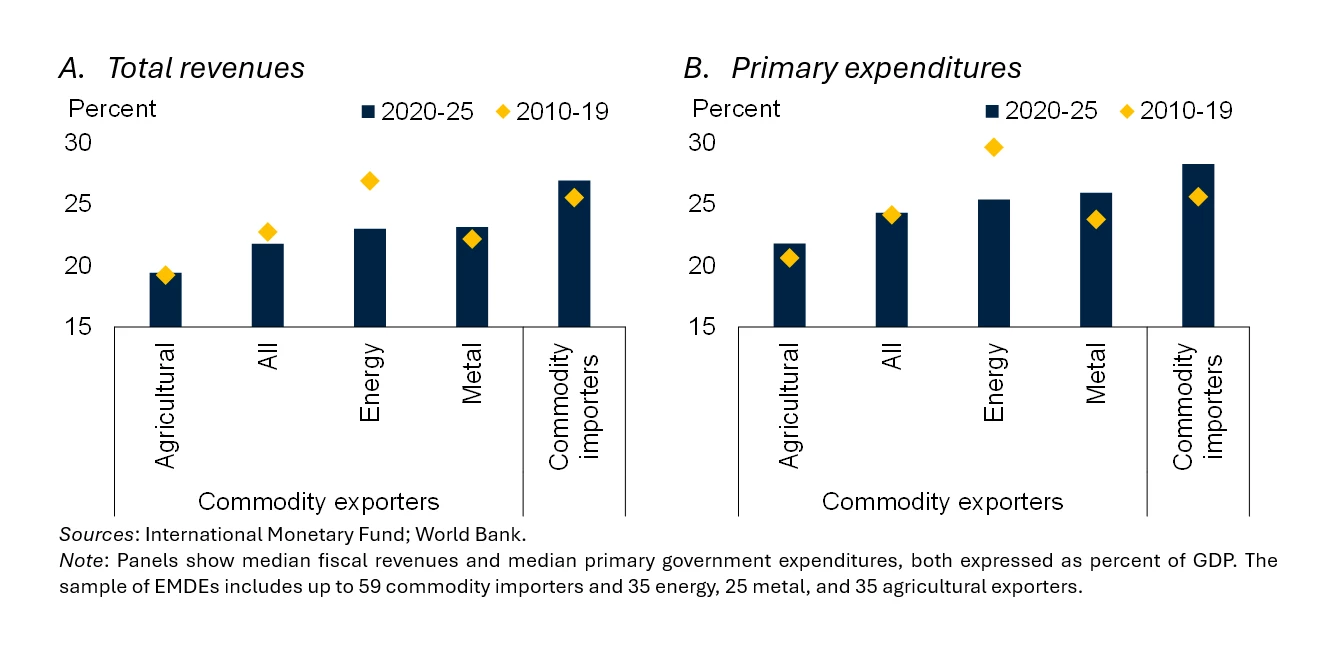
Start with revenues, and the picture is worrying. In the median commodity-exporting EMDE, government revenues averaged about 22 percent of GDP over 2020–25, well below the 27 percent average in commodity-importing EMDEs and slightly below what exporters themselves collected a decade earlier (Figure 1A). Energy exporters saw the largest decline from the previous decade, while revenues in agricultural exporters remained broadly unchanged at about 19 percent of GDP, the lowest among commodity exporters.
Meanwhile, median primary expenditure over 2020–25 remained unchanged from a decade earlier, at about 24 percent of GDP (Figure 1B). That aggregate masks real differences: metal and agricultural exporters increased spending, while energy exporters pulled it back, though not enough to bring it below revenues. The result is a widening fiscal gap, leaving fiscal positions exposed to another turn in commodity prices.
Figure 1. Revenues and expenditures
Mounting debt risks
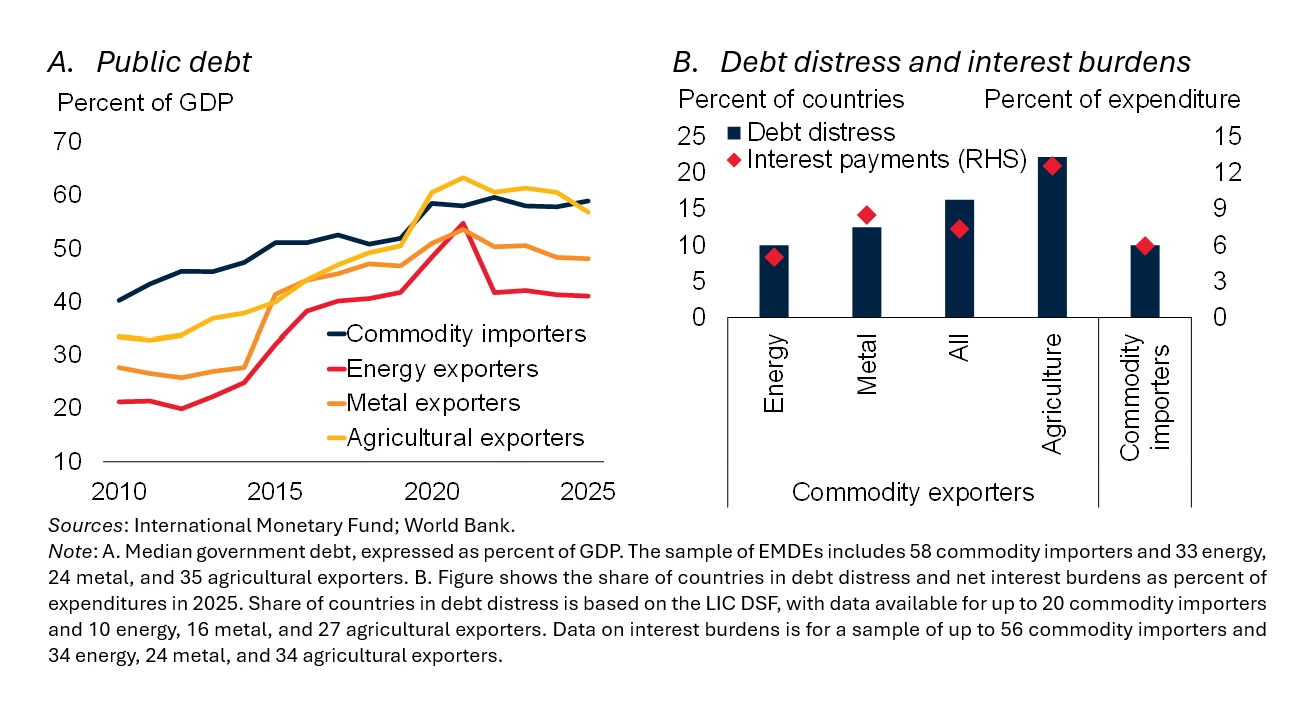
That imbalance has resulted in a serious debt problem. The median government debt ratio among commodity-exporting EMDEs has nearly doubled since 2010, with notable spikes around the 2014–16 oil-price collapse and the COVID-19 shock (Figure 2A). Agricultural exporters carry the heaviest debt burden, at 57 percent of GDP, followed by metal exporters (48 percent) and energy exporters (41 percent). The consequences are showing up in debt distress indicators. Under the ‘Joint World Bank–IMF Debt Sustainability Framework for Low-Income Countries’ (LIC DSF), around 16 percent of commodity exporters are currently in debt distress — a share that rises to over 22 percent among agricultural exporters (Figure 2B).
Interest payments add to the pressure. Agricultural and metal exporters spend a higher share of their government budgets on interest payments than commodity importers do, despite their lower debt-to-GDP ratios. Similarly, although energy exporters have the lowest median debt ratios, their interest payments are broadly comparable to those of commodity importers. The implication is that commodity exporters pay more to borrow, a likely sign that markets view them as riskier borrowers with more limited market access.
Figure 2. Debt risks in commodity exporters and importers
Fiscal frameworks: progress and gaps
The deterioration in fiscal positions is not only a narrative about volatile commodity markets but also reflects governments’ policy responses to that volatility. Fiscal policy has tended to move with the commodity cycle rather than against it: spending rises after positive price shocks and contracts during downturns, amplifying the very pressures that governments should be cushioning.
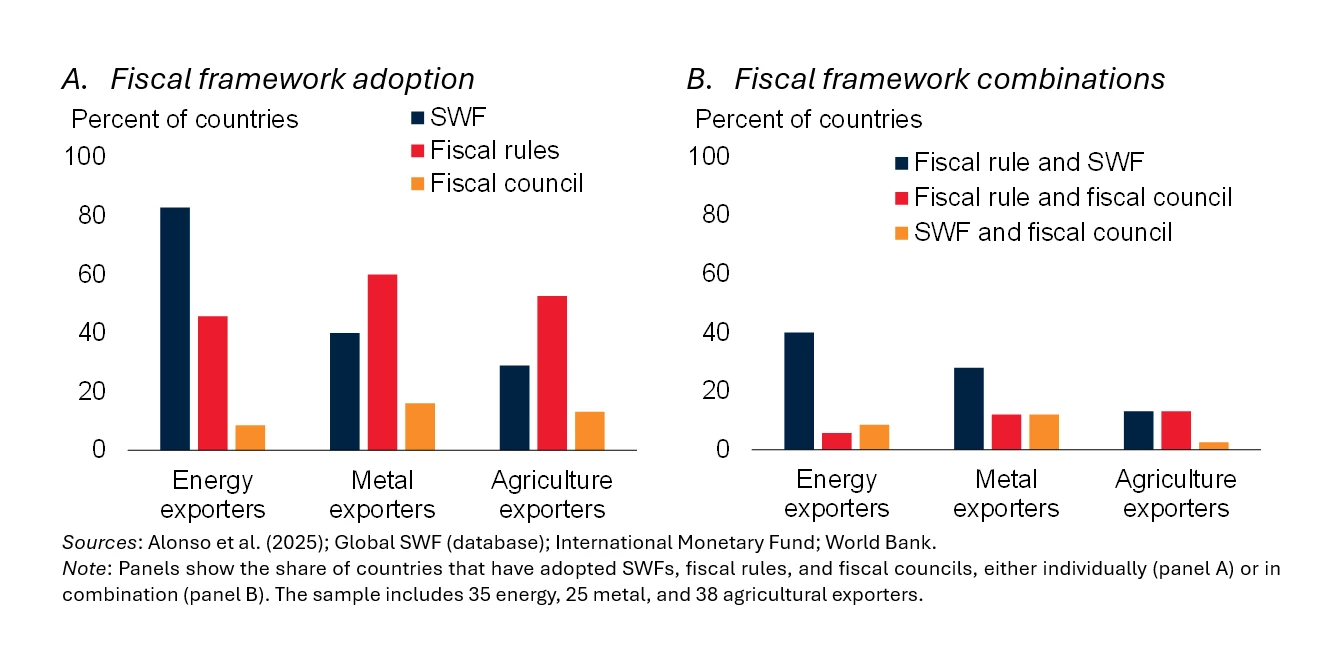
Commodity exporters have made meaningful strides in adopting tools designed to break this pattern. Over the past two decades, the use of fiscal rules and sovereign wealth funds (SWFs) has expanded significantly. Energy exporters have led the way on SWFs, with over 80 percent having an operational fund by 2024, while metal exporters have the highest rate of fiscal rule adoption (Figure 3A). Agricultural exporters trail on both fronts. A growing number of countries have also moved beyond single instruments, combining rules with funds or pairing them with fiscal councils in some cases (Figure 3B). Fiscal councils remain rare among commodity exporters, partly because the political pressure to spend during booms makes independent budget oversight difficult to sustain.
Figure 3. Fiscal framework adoption in commodity exporters
The spread of these frameworks, however, masks a persistent enforcement gap. Rules can be suspended or rewritten when downturns make compliance inconvenient. SWF withdrawals can be made outside of agreed frameworks, while fiscal councils can be sidelined when their assessments challenge spending priorities. The aggregate fiscal record bears this out directly, as these tools alone have not translated into stronger fiscal outcomes. What matters is whether the underlying institutional environment — including framework design, transparency requirements, and political commitment — is strong enough to make them bind.
A narrowing window
The fiscal risks facing commodity exporters reflect years of incomplete adjustment. Many countries adopted fiscal frameworks but did not fully enforce them, built buffers but later spent them, and left deeper structural weaknesses unaddressed. With debt distress risks on the rise, the window for gradual adjustment is narrowing. The next downturn will find fewer governments in a position to respond. For this to change, adoption of fiscal frameworks must be matched by genuine enforcement and broader institutional support. These are not new recommendations. What is new is the urgency to act on them.
Source : World Bank