



Geopolitical tensions are increasingly reshaping the flow of trade, investment and capital flows. This column documents that the same process is also reshaping bank lending. Using confidential supervisory data on thousands of international bank lending relationships, the authors show that banks systematically curtail lending to firms exposed to geopolitical risk. The effects are strongest when risks are linked to sanctions and when lending crosses geopolitical blocs, suggesting that geopolitics is a key determinant not only of how much banks lend but also of where they lend – even to their largest clients.
The past decade has witnessed a series of geopolitical shocks, including Russia’s invasion of Ukraine, US–China tensions, and renewed tensions in the Middle East. These events have heightened concerns that geopolitics is becoming a structural driver of economic outcomes.
Policymakers are increasingly concerned that geopolitical tensions are fragmenting the global economy. The IMF has warned about the implications of geopolitical fragmentation for trade, investment, and financial stability (IMF 2025). Indeed, a growing literature has shown that geopolitical risk can reduce international trade, foreign direct investment, portfolio flows, and bank stability (Caldara and Iacoviello 2022, Gopinath et al. 2025, Niepmann and Shen 2024). Yet one important question remains underexplored: how do geopolitical tensions affect banks’ lending to individual firms? And what factors determine the size of this response? This matters because cross-border bank lending remains a critical source of finance for large firms and an important channel through which shocks propagate internationally.
In new research (Reinhardt et al. 2026), we investigate this issue using highly granular data on UK banks’ largest exposures and firm-level geopolitical risk. We show not only that geopolitical risk reduces lending, but also that it changes where banks lend. Lending retrenches more strongly across geopolitical blocs than within them and the largest responses occur when banks’ borrowers are facing sanctions related risk.
From geopolitical tensions to credit decisions
Most existing measures of geopolitical risk are constructed from newspaper coverage (Caldara and Iacoviello 2022). While useful, they cannot distinguish between firms operating in the same country but facing very different geopolitical exposures.
To address this limitation, we combine confidential supervisory data on UK banks’ large cross-border exposures with a firm-level measure of geopolitical risk derived from corporate earnings calls. The resulting dataset allows us to observe lending relationships between UK banks and individual firms around the world, while simultaneously tracking how exposed those firms are to geopolitical concerns.
The UK provides a particularly informative setting because it hosts one of the world’s largest international banking centres. Through London, global banks intermediate vast amounts of international credit, making it an ideal laboratory for studying how geopolitical shocks transmit through cross-border financial networks.
Geopolitical risk reduces cross-border lending
Our central finding is straightforward: banks cut lending to firms experiencing higher geopolitical risk.
A one standard deviation increase in firm-level geopolitical risk reduces the growth rate of cross-border bank lending by approximately 4 percentage points over the course of a year. The effect is economically meaningful and remains robust across a wide range of specifications.
Importantly, our findings emerge even after comparing firms within the same country, sector and quarter. This suggests that the effect is not simply capturing broad macroeconomic conditions but rather the specific geopolitical risks faced by individual firms.
Not all sectors are affected equally
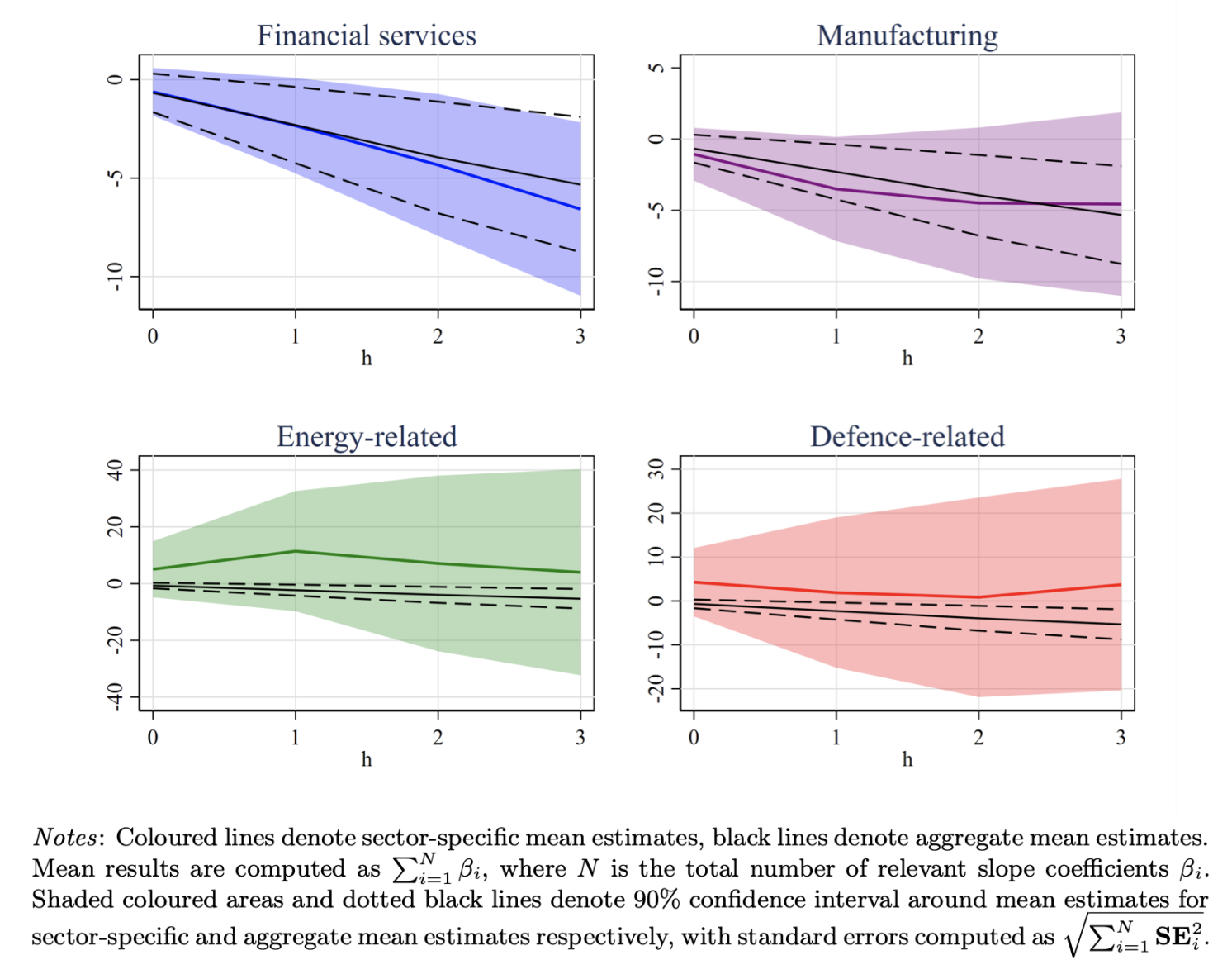
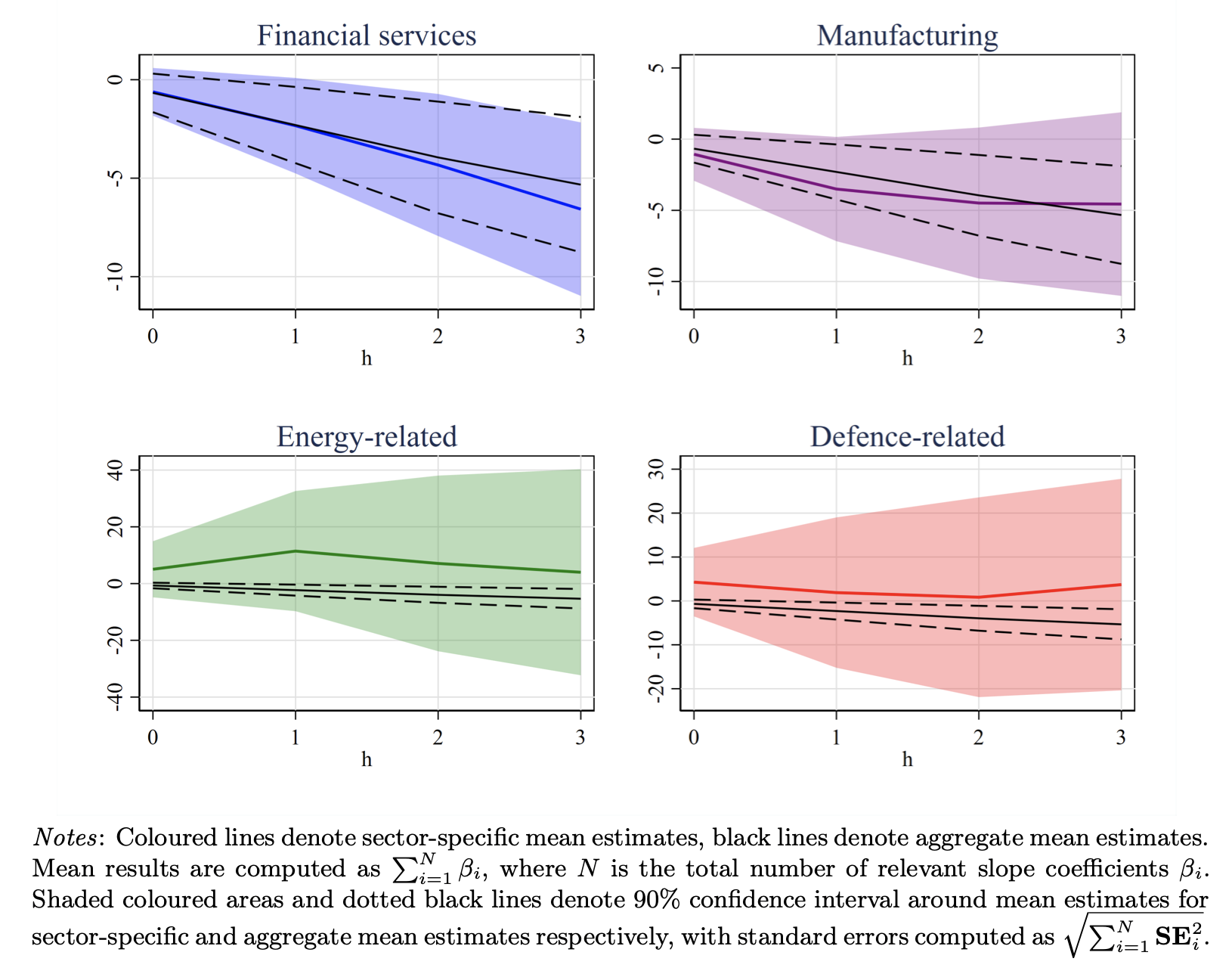
Geopolitical risk does not affect all sectors equally. Financial firms experience the largest decline in lending when geopolitical risk rises. Manufacturing firms also face reductions in cross-border credit, consistent with evidence that geopolitical tensions disrupt trade and global supply chains.
By contrast, lending to mining and defence-related firms tends to hold up better and, in some cases, even rises. While these effects are not always statistically significant, the direction is revealing. Energy and mining firms may benefit from commodity price increases associated with geopolitical tensions, while defence firms often experience stronger demand when security concerns intensify (Figure 1).
Figure 1 Sector heterogeneity: Cumulative effects
Stronger banks are more resilient
The effects of geopolitical risk also differ across lenders. Banks with higher CET1 ratios and higher liquidity buffers are significantly less likely to cut lending when their borrowers face heightened geopolitical risk. Better-capitalised banks appear able to absorb uncertainty without materially reducing exposures. By contrast, weaker banks respond more aggressively by scaling back lending.
This finding echoes broader financial stability research showing that well-capitalised institutions are better positioned to sustain credit supply during periods of stress.
Sanctions matter
Not all geopolitical risks are created equal. We find that banks react particularly strongly to sanctions-related geopolitical risks in their borrowers.
Two main factors could drive firm-specific geopolitical risks related to sanctions. First, firms might note in their call reports geopolitical risk related to sanctions if they themselves are impacted by sanctions. Second, firms might note such risks in their supply chains or financial counterparties, or in the broader economy, with implications for their business
Lending to financial firms is most sensitive to sanctions-related geopolitical risk given sanctions often involve restrictions on financial relationships or on trade flows linked to these relationships.
Evidence of financial fragmentation
A growing literature argues that the global economy is experiencing a process of ‘friendshoring’, whereby economic activity becomes concentrated among geopolitically aligned countries (Aiyar et al. 2024, Gopinath et al. 2025).
We examine whether similar patterns appear in international banking. The answer appears to be yes. Using measures of geopolitical blocs based on United Nations voting patterns (see Bailey et al. 2017), we show that banks reduce lending more in response to geopolitical risk when lending across geopolitical blocs than when lending within politically aligned groups of countries. The distinction becomes especially pronounced after 2022.
These findings suggest that geopolitical risk does not merely reduce global lending overall. Instead, it changes where banks lend, encouraging a reallocation away from borrowers located in countries that are politically farther away from their headquarter.
Why this matters for the broader economy
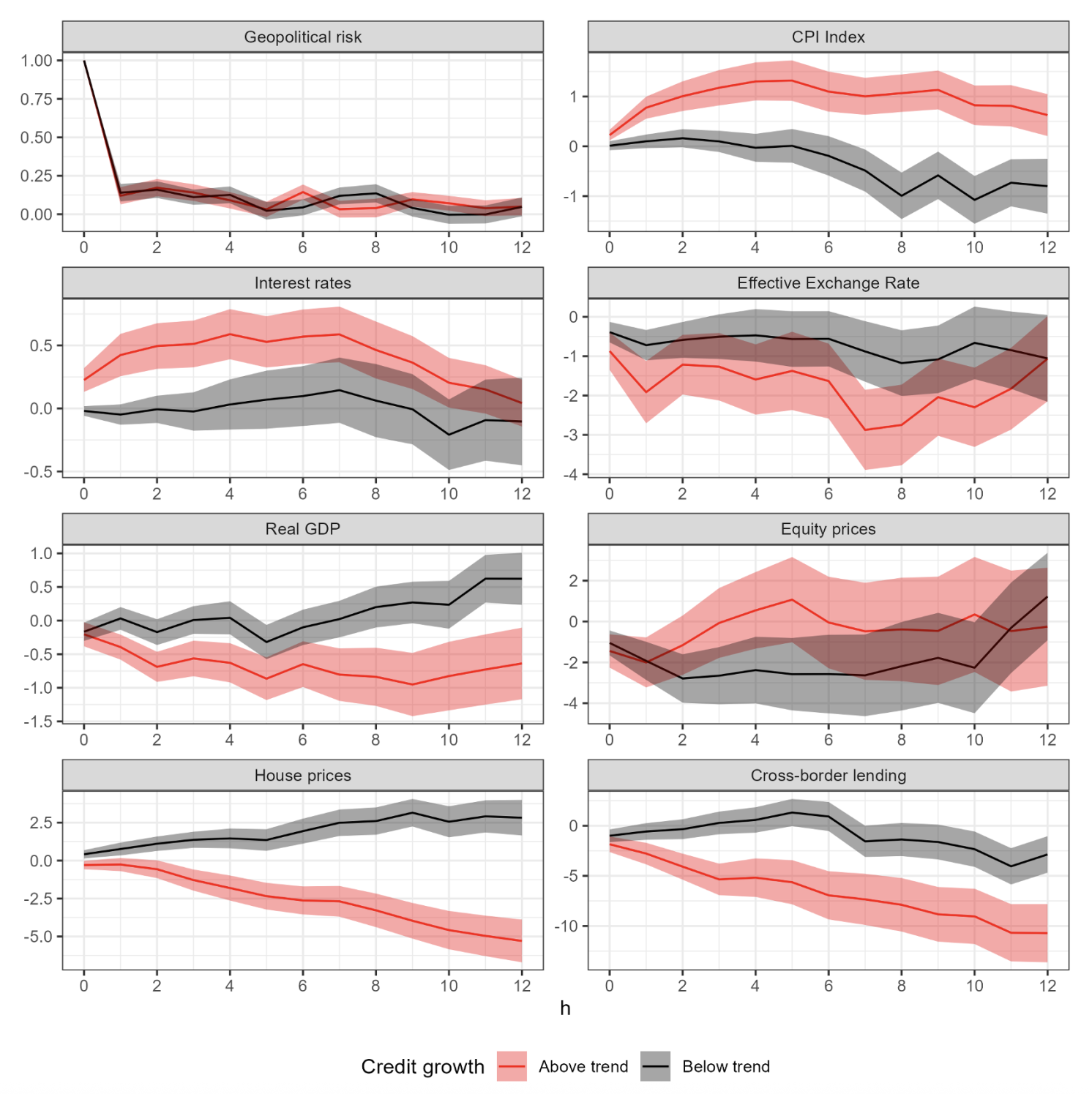
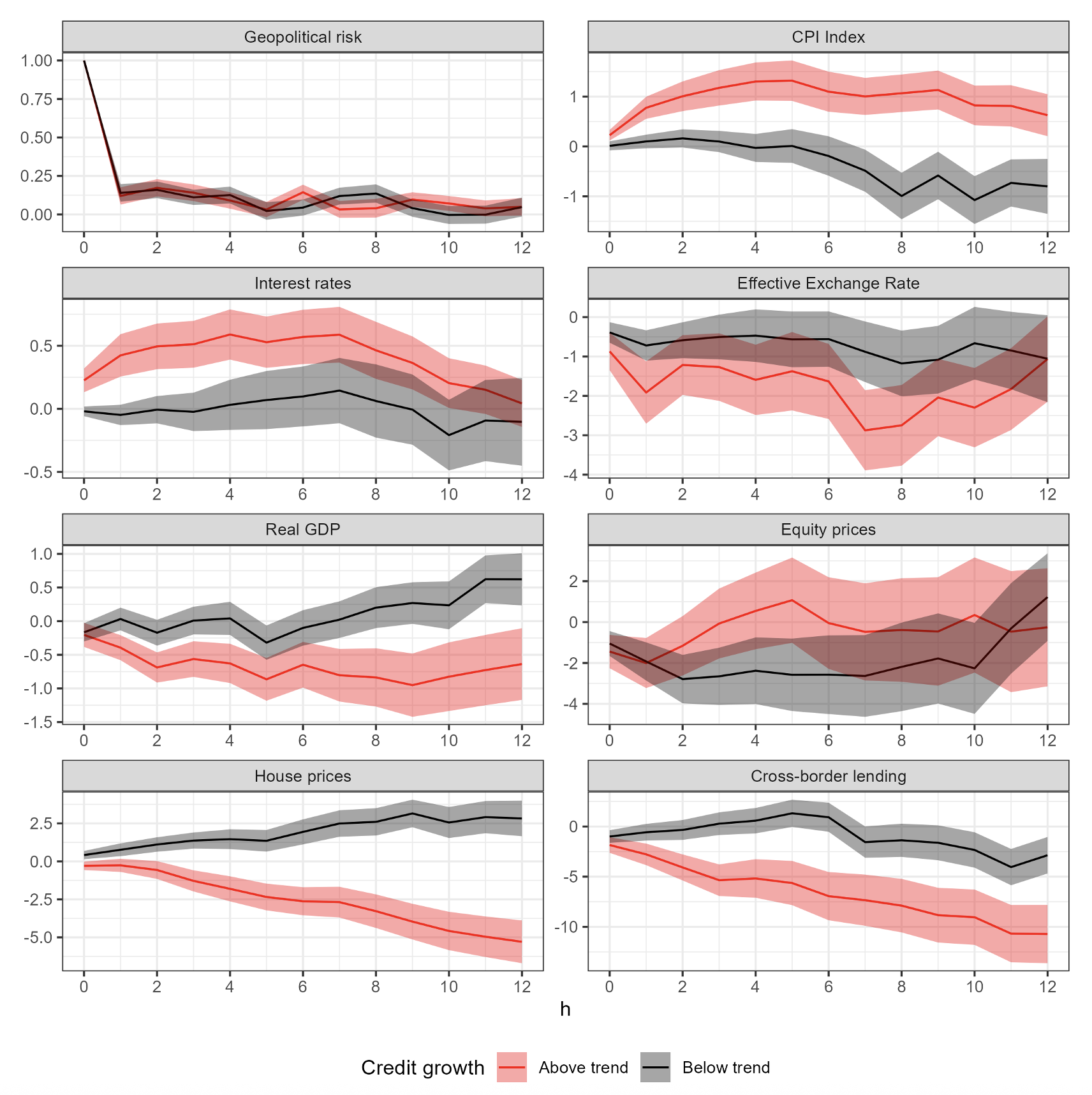
To understand the wider implications, we complement the firm-level analysis with country-level evidence. Using local projection methods, we find that increases in geopolitical risk reduce cross-border lending, depress GDP, weaken equity prices, and put downward pressure on exchange rates. At the same time, inflation tends to rise and monetary policy often becomes tighter.
The reduction in international credit is particularly severe in economies experiencing rapid credit growth (Figure 2), suggesting that geopolitical shocks interact with existing financial vulnerabilities. In other words, geopolitical tensions can amplify financial stability risks that are already present.
The evidence therefore points to a broader macro-financial transmission mechanism. Geopolitical risk affects firms directly, banks respond by adjusting lending, and these changes ultimately spill over into economic activity and financial conditions more broadly.
Figure 2 Aggregate impacts, credit growth heterogeneity
Implications for policymakers
The resurgence of geopolitical tensions is changing the landscape of international finance. Our evidence suggests that banks actively incorporate geopolitical considerations into lending decisions and that these decisions have meaningful consequences for credit allocation and economic activity.
These findings have three key implications for policymakers. First, geopolitical risk reshapes lending flows and may thus matter increasingly for financial stability. Monitoring geopolitical risks should therefore form part of macroeconomic surveillance. Second, strong bank balance sheets matter. Better-capitalised and more liquid banks appear more resilient to geopolitical shocks and are better able to maintain lending relationships during periods of heightened uncertainty. Third, geopolitical tensions may contribute to the gradual fragmentation of global financial markets. As banks shift exposures away from geopolitically non-aligned borrowers, international capital allocation may become increasingly shaped by politics as well as economics.
As geopolitical tensions, sanctions and strategic competition and become more prominent, banks are adjusting where they lend and to whom. Geopolitical risk is no longer just affecting trade and investment. It is changing the allocation of global credit, and increasingly doing so along geopolitical lines. Understanding these shifts will be essential for policymakers seeking to assess both financial stability risks and the future evolution of the global financial system.
Source : VOXeu