



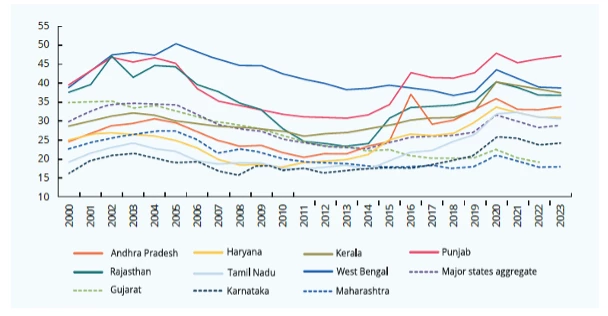
India’s states began adopting Fiscal Responsibility Laws (FRLs) in the mid 2000s to rein in deficits, put debt on a sustainable path, and restore fiscal credibility after years of rising imbalances. Numerical rules, especially the 3 percent of Gross State Domestic Product (GSDP) fiscal deficit ceiling became the North Star of India’s subnational fiscal framework. While economic growth was strong and broad-based, numerical fiscal rules delivered on their objective. By the early 2010s, India’s subnational finances looked markedly more disciplined than they had just a decade earlier. Yet almost 20 years later, some states still carry high, and in some cases rising, debt levels (Figure XX) despite operating under the same fiscal rules.
The evidence (from a recent background paper prepared by the World Bank at the request of the 16th Finance Commission of India) is unambiguous: fiscal rules have helped strengthen fiscal discipline. After states enacted FRLs, aggregate fiscal, revenue, and primary deficits declined significantly. But how this consolidation was achieved matters just as much. Much of the adjustment came through cuts in capital expenditure and development-related spending, rather than by reducing non-development recurrent expenditures for greater spending efficiency or by increasing public revenue mobilization. Across both rich and relatively poor states, public investment often served as a shock absorber during consolidation episodes. Hence, fiscal discipline was achieved at the expense of critical investments that would have contributed to long-term growth and development. Because capital spending typically has higher employment multipliers than recurrent spending, such consolidation choices may have also weakened job creation.
Figure XX: Debt levels have not converged across states over the last two decades
(total outstanding debt, percent of GSDP)
Same rules, very different outcomes
All states followed the same fiscal rules, but their debt paths have diverged sharply. Why? A deep dive into seven large states points to three explanations.
- First, contingent liabilities matter. In several states, rising debt was not driven by overspending but by the realization of large, previously hidden liabilities. The absorption in some states of power sector debt under the Ujwal DISCOM Assurance Yojana (UDAY), and in Punjab’s case, food procurement liabilities, led to large one-off increases in debt stocks that permanently worsened fiscal positions.
- Second, off-budget borrowing weakens discipline. A few states repeatedly exceeded borrowing limits through public enterprises and special purpose vehicles. These liabilities, serviced by state budgets but excluded from headline deficit measures, allowed states to essentially circumvent the fiscal rules.
- Third, rigid spending constrains adjustment. High salary bills, inefficient subsidies, pension obligations, and interest payments leave little room for maneuver. When shocks hit, borrowing increases because spending cannot easily adjust. Over time, this rigidity crowds out public investment, reinforces low growth-high debt dynamics, and weakens job creation.
In theory, markets should reward fiscal prudence and penalize excess borrowing through higher interest rates. In practice, this mechanism is weak in India. Borrowing costs for states demonstrate little correlation with debt levels or fiscal performance. Market participants assume that the states’ debt obligation will be honored by the central government in case of default. This implicit sovereign backing, coupled with coordinated issuance of state development loans, means that highly indebted states often borrow at a similar cost as fiscally stronger peers.
Lessons from abroad: flexibility matters
India’s experience is not unique. Other federal countries and the EU have grappled with similar challenges and offer useful lessons. Brazil’s experience with its FRLshows that strict, enforceable fiscal rules can help restore discipline, but if structural spending pressures are not addressed simultaneously then fiscal pressures eventually reemerge. Mexico’s Ley de Disciplina Financiera de las Entidades Federativas y los Municipios (LDFEFM) demonstrates how a flexible framework, using a transparent “traffic light” system that links borrowing limits to fiscal health, can help manage subnational debt more effectively. The European Union’s revised Stability and Growth Pact highlights the tradeoff between flexibility and complexity. Tailored rules improve realism but can undermine transparency and compliance if taken too far. The key takeaway is that one-size-fits-all fiscal rules rarely work well in heterogeneous federations.
From uniform limits to smarter discipline
To enhance the current subnational fiscal framework, the paper proposes different fiscal deficit targets (different borrowing limits) based on states’ fiscal positions, complemented by institutional and structural reforms.
- A risk-based framework. The paper proposes a risk-based borrowing framework, drawing on Mexico’s traffic-light system, that adjusts the amount states can borrow based on their fiscal strength. Rather than applying a uniform borrowing limit, annual borrowing space would depend on a small number of transparent indicators—such as total debt, interest payments, and the operating balance, which captures a state’s ability to cover recurrent expenditures with revenue receipts. This design helps protect public capital spending, supports employment-intensive infrastructure, and encourages private investment and job creation. At the same time, access to higher borrowing limits would be conditional on improving operating balances, creating incentives to curb inefficient spending. Highly indebted states would face tighter limits and clearer adjustment paths, while fiscally stronger states would gain greater room to invest. Overall, the approach can accelerate debt reduction and strengthen fiscal discipline by automatically tightening borrowing when states deviate from their adjustment paths, making slippages more visible and politically costly.
- Institutional and structural reforms. Dynamic fiscal rules, on their own, are not enough—they work best when supported by the right institutions and policies. To be effective, borrowing rules need to reflect real fiscal risks, protect investment, and be enforced in ways that encourage compliance. This means improving accounting and reporting so that all liabilities, including off‑budget borrowing, are clearly disclosed. It also requires clear rules (“escape clauses”) to respond to shocks such as economic downturns, and stronger systems to monitor and incentivize compliance. Importantly, the system should reward states that comply with the rules, rather than rely solely on penalties for those that do not. Over the medium term, structural reforms are also needed to make spending more flexible, especially by simplifying centrally sponsored schemes and improving the design of central transfers. Together, these reforms are critical for maintaining long‑term fiscal sustainability.
As India’s states confront growing demands for infrastructure, social spending, and climate resilience, the challenge is no longer just to limit borrowing. It is to use borrowing strategically, transparently, and sustainably. Adhering to fiscal rules reinforces macroeconomic stability, increases fiscal space to support employment-intensive public investment, and helps stimulate private-sector job creation. Moving beyond a uniform 3 percent fiscal deficit target toward smarter, differentiated fiscal rules and associated institutions that incentivize their effective implementation should be the next step in strengthening India’s fiscal federalism.
Source : World Bank