


Education is the pathway to jobs and the surest way out of poverty, empowering generations to drive economic growth. Yet, for many students, this promise is undermined by outdated teaching approaches and inadequate learning environments. Girls miss school when they are menstruating due to deficient restrooms or water and sanitation facilities. Heat and poor ventilation affect children’s ability to concentrate in class. Floods and cyclones are causing frequent school closures.
But it does not have to be this way. School sites can be transformed into enablers for learning and child wellbeing. A recent World Bank report highlights how well-designed learning environments in low- and middle-income countries can transform education.
A new framework to help countries design learning environments
School designs have remained largely unchanged. Yet a growing body of evidence about the “learning environment as a third teacher” suggests that well-designed spaces are key to enhance contemporary teaching methods and support educators effectively. For example, recent studies by the World Bank, Salford University, and the University of Melbourne indicate that flexible learning environments are associated with better student outcomes in mathematics and science (as measured by TIMSS 2019), as well as with positive impacts on collaboration and creativity skills.
Figure 1: The RIGHT+ PLE Framework: 6 Factors
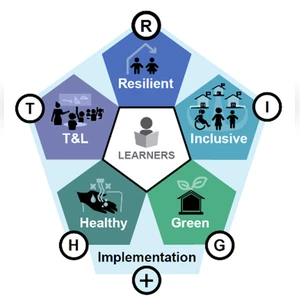
The RIGHT+ framework highlights the need for physical learning environments to be Resilient, Inclusive, Green, Healthy, and Teaching- and Learning-Conducive, and its effective implementation (+). It responds to the global learning crisis and aims to address the increasing frequency of natural disasters and extreme weather events that negatively affect education. RIGHT+ is adaptable to different contexts, encouraging local solutions and community-driven proposals, rather than offering a one-size-fits-all approach. For example:
- Building resilient schools by complying with building codes and choosing school locations that are less subject to natural hazards. In the Philippines, efforts are underway to make schools safer from natural disasters, while Peru and Türkiye are strengthening buildings to withstand earthquakes.
- Promoting inclusive schools with well-mapped networks, gender-friendly water, sanitation and hygiene (WASH) facilities, and accessible spaces. Colombia improved access by optimizing school travel routes, Angola focused on creating welcoming school spaces for girls, and Honduras reconstructed schools with universal design features like ramps and accessible toilets.
- Ensuring green schools by focusing on energy and water efficiency, waste management, and using sustainable construction materials. In Romania, Burundi, India, and Burkina Faso, schools are adopting eco-friendly practices like rainwater collection, solar panels, and green building materials such as clay and bamboo.
- Creating healthy environments through provision of basic utilities like water, sanitation, and electricity, along with adequate lighting, ventilation, and well-maintained buildings. In Malawi, projects are improving water and sanitation in schools, and in Tanzania, cool roofs are being used to keep classrooms comfortable.
- Fostering teaching- and learning-conducive environments that are adaptable and well-equipped to accommodate evolving pedagogies, as seen in Tajikistan’s national framework for education development. Ensure classrooms have adequate capacity, information and communication technology (ICT) resources, and teaching materials, while also optimizing spaces to offer stimulating experiences and meaningful choices for all users. In Uruguay and Chile, schools are embracing technology and creative spaces to make learning more engaging.
- Achieving effective implementation (+) of infrastructure investments by leveraging data-driven decision making to strengthen capacity building and stakeholder engagement. Uruguay co-designed learning spaces with architects and educators, while Pakistan leveraged diverse data and machine learning to prioritize resilient education reconstruction.
Any of these six factors may serve as an entry point to build better schools, and altogether these factors can help enable innovative and engaging teaching and learning, ultimately leading countries to stronger human capital development and better preparedness of students to the evolving labor market.
Source : World Bank