



Policymakers are asking whether generative AI is reshaping labour demand, and the literature has found mixed results so far. This column links Denmark’s official IT-use survey to monthly employer–employee records and compares firms that started using AI in 2023 with those that did not. Early adopters fall behind their own pre-adoption employment trend. The decline is most visible in AI-exposed jobs and among new hires, and only significant among small firms. The results indicate that AI is affecting the labour market, even though the effect is not visible in the aggregate statistics.
The early evidence on AI and employment has so far been mixed. Given the large potential impact of AI on the economy, these early indicators are still helpful, even if their signal-to-noise ratio is low.
Aggregate labour-market data and most firm surveys show little sign of AI-driven job losses. Firm surveys find adoption widespread but shallow, with small near-term employment effects (Aldasoro et al. 2026, Baslandze et al. 2026, Bencivelli et al. 2026, Falck and Nagengast 2026). Danish worker-level evidence finds effects close to zero (Humlum and Vestergaard 2025), while broader firm-data surveys reach a similar conclusion (Yotzov et al. 2026).
A new trend, however, has begun to emerge: workers at the start of their careers in AI-exposed jobs are falling behind in several settings (Brynjolfsson, Chandar and Chen 2025, Tucker 2026, Westby, Sasser Modestino and Cheng 2025). Other work cautions that this aggregate decline in exposed jobs could pre-date the public release of ChatGPT (Frank et al. 2026) and thus be driven by alternative factors. The question remains: if AI is changing firms’ demand for entry-level work, why do the aggregates seem unaffected?
This column brings high-frequency Danish firm- and worker-level register evidence to that question. Our study looks at whether a firm that starts using AI subsequently departs from the employment path it was already following (Bonin et al. 2026). Our findings reveal a narrow, persistent firm-level effect: small adopters fall behind their own trend, and the most significant shortfall occurs where hiring typically brings young workers into AI-exposed roles.
Tracking adopters in the Danish registers
Our study takes place in Denmark, which is characterised by fluid labour markets and high AI adoption: the share of surveyed firms reporting some AI use rose from 15% in 2023 to 59% in 2026, and most of that increase came from generative AI tools for writing text and code. Taken together, these facts imply that if there are employment effects from AI adoption, Denmark would be one of the first countries where they materialise. Denmark is also ideal due to its rich administrative data and a unique linkable firm-level survey, which allows us to measure these effects.
Our primary data source is Statistics Denmark’s official, EU-harmonised IT-use survey, which covers private, non-financial firms with at least 10 employees. Eurostat dropped the AI questions from the EU survey in 2022, while Statistics Denmark kept asking them. That continuity, combined with the survey’s large panel component, allows us to identify first-time adoption in 2023.
We link the survey to Denmark’s monthly employer–employee registers, recording every wage payment in the country. Each month, we compare first-time adopters with firms in the same three-digit industry that report no AI use, measuring each firm’s employment relative to its own pre-existing employment path, projected using the firm-specific trend from 2020–2021. Naturally, adoption is non-random and adopters and non-adopters are self-selected groups: our estimates are comparisons, not clean causal effects, as adoption and employment adjustments are likely decided jointly. Note also that many of the comparison firms start using AI themselves during 2024 and 2025. That makes the estimated gaps, if anything, conservative.
Adopters fall behind their own trend
Before 2023, employment at future adopters moves in line with employment at firms that report no AI use. This includes 2022, which was deliberately held out of the trend fit, serving as an out-of-sample check. Once adoption begins, the gap opens gradually. By the end of 2024, employment at adopting firms is about 6% below their own trend compared to non-adopters. By September 2025, the last month in our data, it is about 9% below.
This does not mean that adopters are contracting in absolute terms. They continue to grow, albeit more slowly than the path implied by their pre-adoption trend compared with non-adopters. This slowdown is more difficult to spot in aggregate numbers: a firm that grows but hires more slowly affects aggregate employment much less than layoffs do. An effect like this might build for some time before it reaches the headline numbers.
There is nothing special about the 2023 timing. We study a second cohort—2024 adopters, compared to 2024 non-adopters—and find that first-time adopters in 2024 trace the same path one year later, reaching about 7.5% below trend by late 2025. This rules out that the employment effects are driven by an aggregate event that occurred in 2023.
Figure 1 Employment at AI adopters relative to their own pre-adoption trend
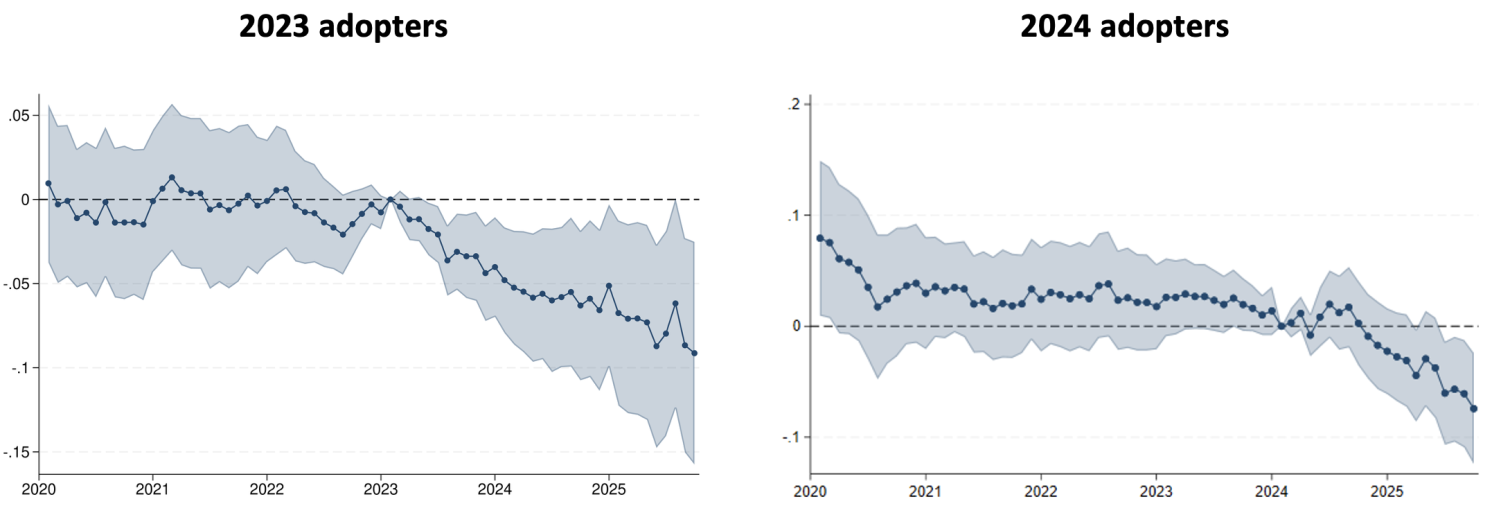
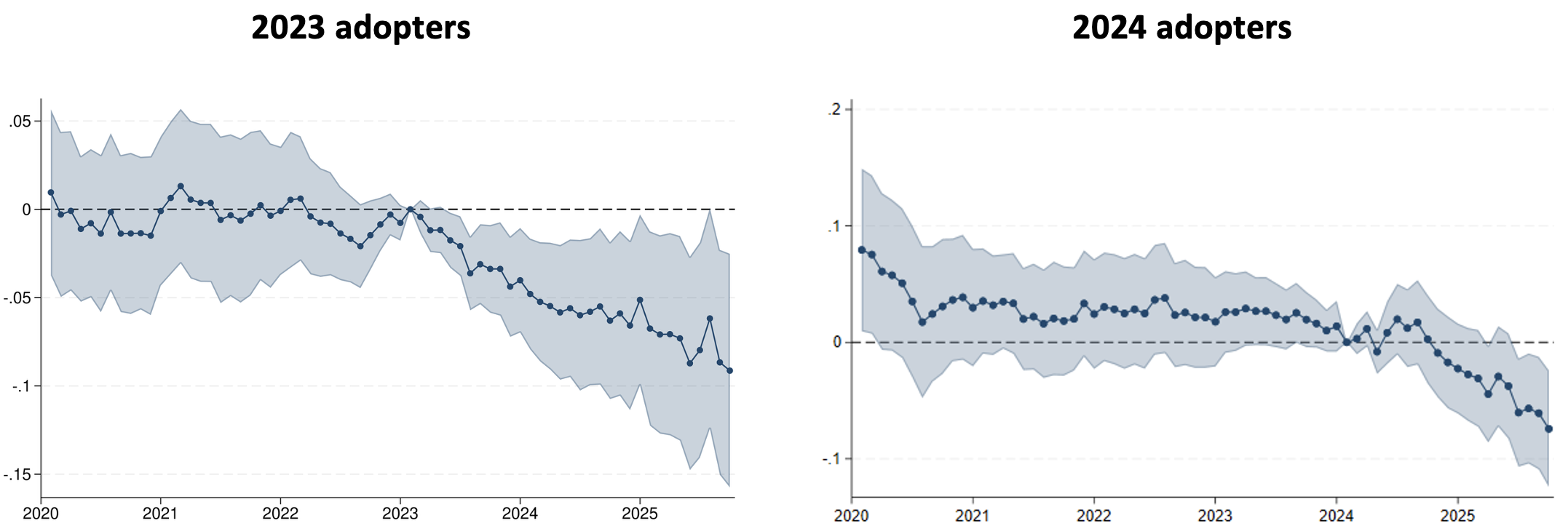
Note: Log employment (full-time equivalents) of firms first using AI in 2023 (left panel) or 2024 (right panel), relative to firms reporting no AI use, each measured against a firm-specific linear trend; within three-digit industry × month. Left panel: trend estimated on 2020–2021, so 2022 is out of sample; indexed to January 2023. Right panel: first-time 2024 adopters compared with firms reporting no AI use through 2024; trend estimated on 2021–2022; indexed to January 2024. Shaded areas are 95% confidence bands. The vertical axis is in log points (−0.1 ≈ −10%). Survey-weighted.
Source: Bonin et al. (2026).
Where the adjustment shows up
The employment shortfall is not evenly spread across jobs. Occupations in the top quartile of the Felten, Raj and Seamans (2023) exposure index fall about 27% below trend by late 2025, compared with about 12% for other occupations. The decline is concentrated among workers under 30 and among the university-educated.
In the working paper, we show that the adjustment runs through reduced hiring, not layoffs. The stock of recently hired workers shrinks steadily, while long-tenured workers are retained, if anything, for longer. This pattern fits the early-career evidence from the United States: firms can change who enters without dismissing those already in post (Brynjolfsson, Chandar and Chen 2025, Tucker 2026). This mechanism is likely to be even stronger in other countries where labour-market regulation is less flexible.
Overall, young graduates are the most affected group. However, this is not because they are directly targeted by AI-adopting firms. Instead, this happens because they are more likely to work in occupations that are highly exposed to AI.
Figure 2 Employment by occupational AI exposure, relative to trend
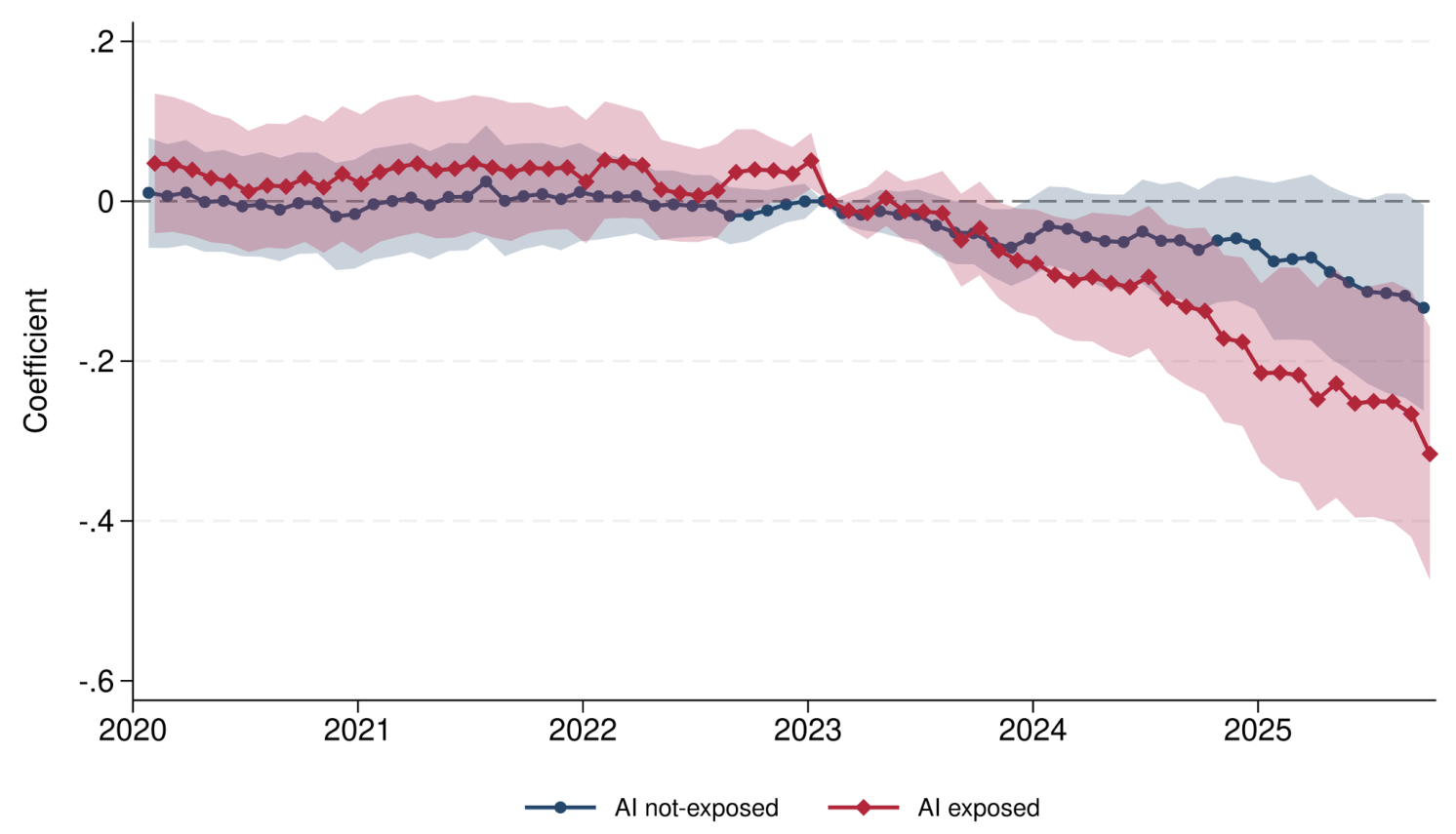
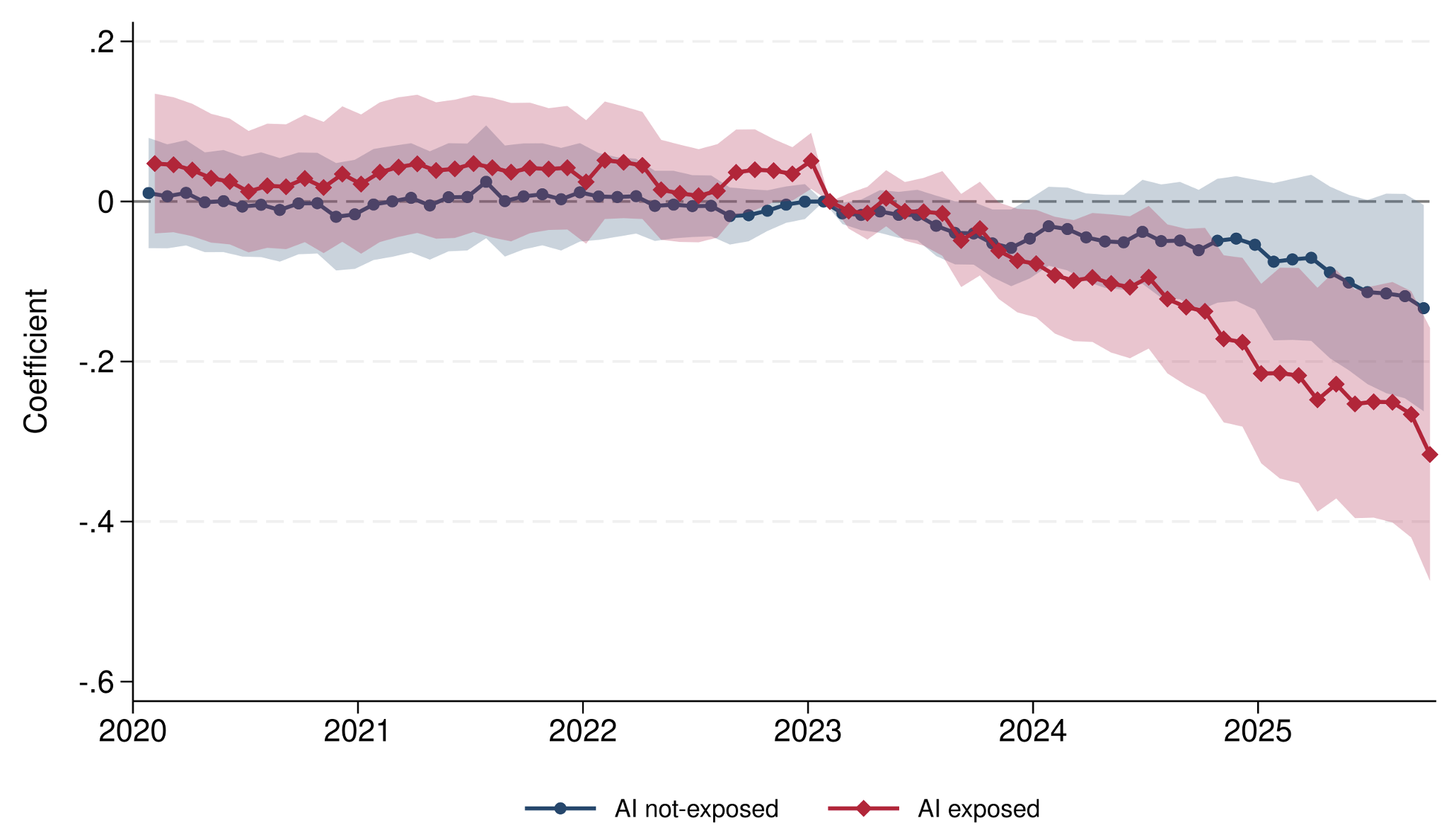
Note: As Figure 1, splitting each firm’s employment into occupations in the top quartile of the Felten, Raj and Seamans (2023) generative-AI exposure index (‘AI exposed’) and the rest (‘not exposed’). The vertical axis is in log points (−0.1 ≈ −10%). Shaded areas are 95% confidence bands. Survey-weighted.
Source: Bonin et al. (2026).
It is the small firms that shrink
The average conceals an important size divide. Among 2023 adopters with fewer than 100 full-time employees, employment is about 16% below trend by late 2025. Among adopters with 100 or more employees there is no decline at all, and if anything a small, statistically insignificant rise. The small-firm result is not the work of a few collapsing businesses. Their fast-growing adopters expand much like fast-growing non-adopters, so the gap must sit at the median and below.
These results are in apparent tension: large firms are much more likely to adopt AI, yet it is the small adopters that shrink. Our ongoing work suggests that this is because financial constraints are more likely to bind for small firms: small firms that invest in AI implementation might simply have fewer resources left to spend on employees. Indeed, the shortfall in employment is concentrated among small firms that were already highly leveraged prior to their adoption of AI.
Figure 3 Employment at 2023 AI adopters by firm size, relative to trend
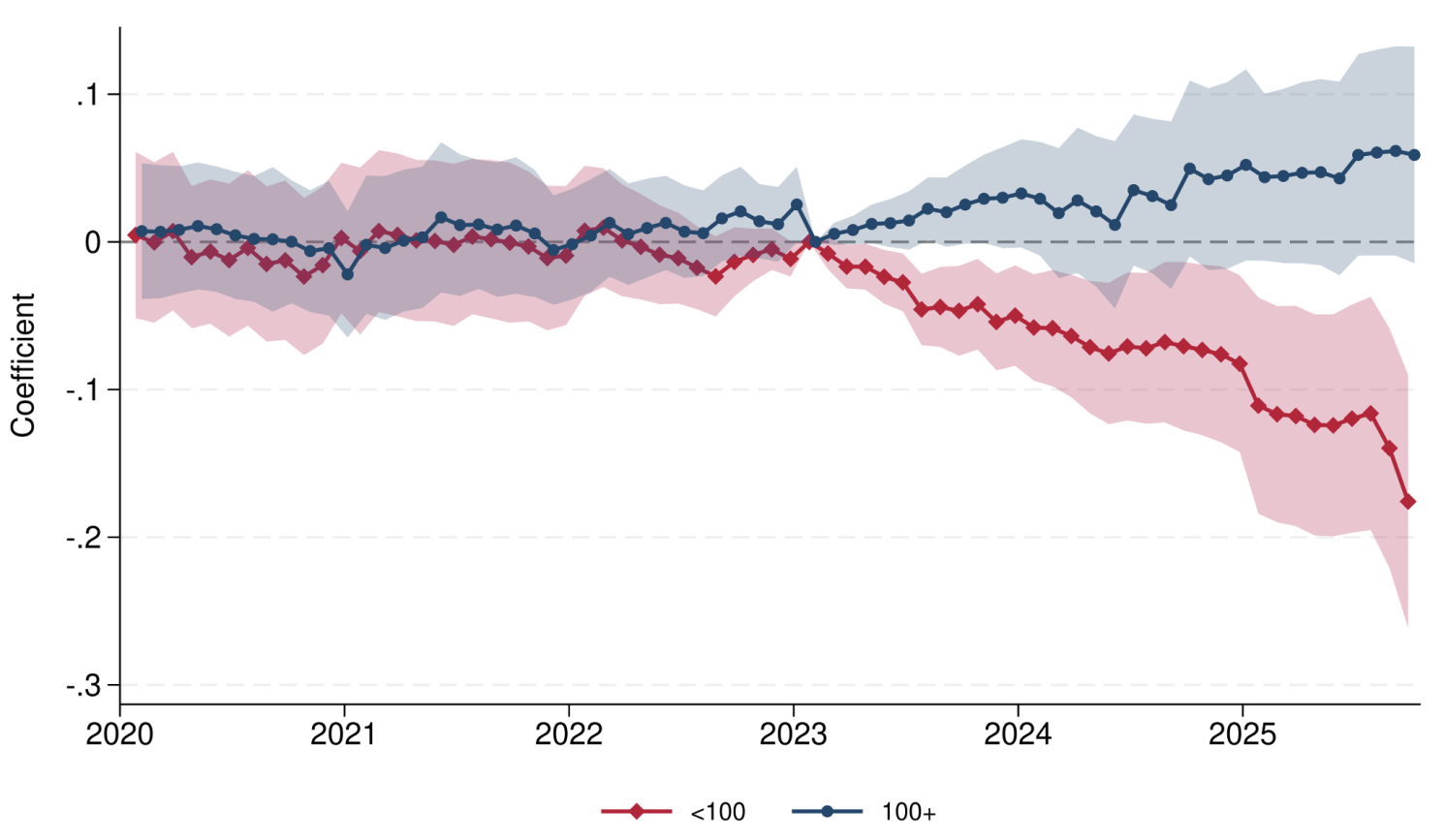
Note: As Figure 1, splitting 2023 adopters by size measured before adoption: fewer than 100 versus 100 or more full-time employees. The vertical axis is in log points (−0.1 ≈ −10%). Shaded areas are 95% confidence bands. Survey-weighted.
Source: Bonin et al. (2026).
Why the aggregates stay quiet
For now, the aggregate effect remains small. The small firms that first adopted AI in 2023 employ less than 2% of all workers in Denmark, so even a 16% shortfall among them works out at only a few tenths of a percent of total employment, spread across more than two years. Aggregate or industry-level data cannot detect an effect that small. Without monthly administrative data, the signal would not be visible at all.
We also find that AI-exposed industries shed employment relative to trend. The majority of the industry-level effect is, however, not driven by the firms that we identify as AI adopters: AI-exposed sectors such as information technology happen to have more firms that are shrinking than other sectors.
Denmark’s flexicurity model makes it an unusually smooth case. Low firing costs, high job churn, generous unemployment insurance and active labour-market policy mean that a firm that stops hiring need not lay anyone off. In less fluid labour markets, the impact might be larger.
Policy implications
In Denmark, AI primarily slows down hiring in smaller firms and affects the hiring prospects of labour-market entrants. Policymakers should thus turn to hiring and labour-market entry to monitor its impact, since aggregate employment and unemployment show no detectable effect so far. Statistical offices need to keep asking firms about AI use and link the answers to administrative registers at high frequency. Our comparison of first-time adopters is possible only because Statistics Denmark kept asking these questions. Naturally, now that most firms use AI to some extent, questions need to be reframed to better capture the intensive margin.
Finally, the evidence is early and noisy, but it comes from 2023 adopters, when the potential of generative AI was still quite limited. That employment effects are already visible among this group of firms could be seen as a signal of potential challenges for the labour market in the upcoming years, as the technology matures. Our education systems are challenged to train young labour-market entrants for the new jobs that will arise. As for workers already in the labour force, active labour-market policies such as occupational retraining can help smooth the transition to a new future.
Source : VOXeu