



Counting the number of people living in extreme poverty — on less than $3 a day — is only part of the picture. We also need to understand who they are, where they live, and how their circumstances have changed.
A new paper using household surveys from 154 economies, covering 96 percent of the world’s population, examines the characteristics of people living in extreme poverty from 2003 to 2024. Although extreme poverty has declined worldwide, it is increasingly concentrated in Sub-Saharan Africa, fragile economies, rural communities, younger populations, and people with limited education. Advances in urbanization and education — both strongly associated with poverty reduction in East and South Asia—have produced much smaller gains in Sub-Saharan Africa.
Global extreme poverty is increasingly concentrated
The world has made substantial progress in reducing extreme poverty, but that progress has slowed over the past decade.
As the number of people living in extreme poverty has declined, those who remain are increasingly concentrated in rural areas, among younger people and those without formal education, and across clusters of neighboring high-poverty regions. Extreme poverty is therefore becoming more entrenched in fewer places, which are also the places where progress in reducing poverty has mostly stalled over the last decade. Figure 1 shows this growing geographic concentration and the limited progress in poverty reduction in many of these areas.
Figure 1. Extreme poverty is increasingly concentrated in fewer subnational regions
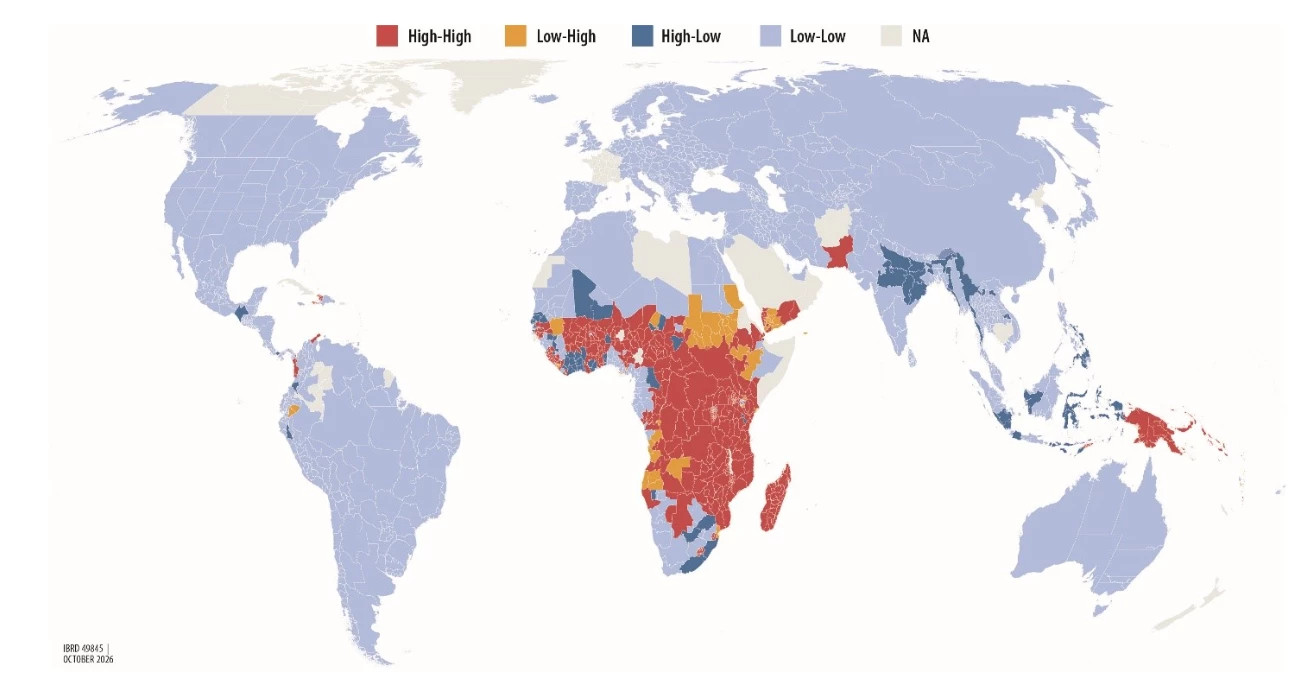
Source: Global Subnational Atlas of Poverty (GSAP) data, September 2026 vintage.
Note: The figure shows subnational regions with high (>30%) or low (<30%) extreme poverty in 2013 and 2024. High-High reports regions that had greater than 30% poverty in both years and low-low implies they had less than 30% poverty in both years.
Education and urbanization no longer are strongly correlated with poverty reduction
The link between poverty reduction and broader social change varies considerably across periods and regions.
From 2003 to 2013, countries that became more urban raised their education levels and reduced the number of dependents relative to working-age adults. These factors generally cut extreme poverty faster. East Asia drove much of this pattern: on average, each percentage-point increase in the share of people with more than primary education or in the urban population was associated with about a 10-percentage-point decline in extreme poverty (Figure 2). In South Asia, this relationship strengthened after 2013. From 2013 to 2024, each percentage-point increase in education or urbanization was associated, on average, with a decline in poverty of more than 10 percentage points.
Sub-Saharan Africa made comparable gains in education and urbanization to those in South Asia, yet poverty declined very little. In the region, each percentage-point increase in educational attainment or urbanization was associated with a poverty reduction of less than one percentage point in the first period and only slightly above one percentage point in the second. Education and urban residence remain linked to higher living standards, but progress in these areas alone does not automatically reduce poverty.
Figure 2. Poverty has responded less to education and urbanization in Sub-Saharan Africa
What this means
The global decline in extreme poverty over the past two decades is a major achievement, yet the remaining challenge is increasingly concentrated and difficult to overcome.
Many of the world’s poorest people now live in places where limited education, rural isolation, weak economic opportunities, fragility, and environmental risks overlap. Moreover, factors traditionally associated with poverty reduction are only weakly linked to progress in the areas where poverty is most concentrated.
It is important therefore to understand not only whether education and cities have expanded, but whether these changes have created productive jobs and broadly shared gains in household well-being.
The findings presented here, and in the paper, show associations and do not establish that any single factor causes poverty to rise or fall. Nevertheless, they reveal sharp differences within countries and identify clusters of neighboring areas where poverty remains persistently high. Considered alongside evidence on economic growth, the distribution of its benefits, productivity, employment, and workers’ movement across sectors, the results help identify where broader economic and social progress has not reached the poorest people. Policies should therefore pair investments in people and places with stronger economic opportunities, target persistent high-poverty clusters and communities facing multiple risks, and improve data collection to better understand why poverty trends are diverging. Further insights and a more comprehensive analysis of global poverty and prosperity can be found in the Poverty, Prosperity, and Planet.
Source : World Bank