


More than half of the European Union’s natural gas imports are burned to keep buildings warm, with the heating and cooling of buildings using fossil fuels responsible for 12 percent of the bloc’s greenhouse gas emissions in 2024. Both the gas import bill and emissions could be reduced if the installation of heat pumps in EU buildings were ramped up. Europe has a strong manufacturing capacity and innovation base for producing heat pumps, which are beneficial for the climate, energy security, affordability and European jobs.
However, heat pumps cost more to buy and install than gas boilers: up to five times more, depending on the country (Toleikyte et al, 2024). Because a heat pump is about three times as efficient as a boiler, it is cheaper to run only if electricity costs less than about three times as much as gas. In 2025, this cost ratio was 1.9 in France but 3.2 in Germany, meaning the extra cost of a heat pump is recouped in about three years in France but 13 years in Germany (LCP Delta, 2025).
In July 2026, the European Commission published an Electrification Action Plan (European Commission, 2026), with a goal of making electricity cheaper relative to gas, including through tax reform. In relation to heat pumps, the Commission said it would explore a “clean heat market mechanism” to narrow “the upfront cost difference for heat pumps”. At the time of writing, no further details have been offered on how such a system might work.
In this analysis, we propose basic principles for such a scheme. We draw inspiration from the EU’s carbon dioxide emission standards for new cars, which have spurred sales of electric vehicles. We also look at lessons from what we regard as an unsuccessful attempt by the United Kingdom to introduce a heating market mechanism and draw on a comprehensive analysis of options by Agora Energiewende (2025). We begin with a brief overview of the market for heat pumps in the EU, then discuss how to design a scheme based on the efficiency of heating appliances as a useful benchmark. Finally, we set out three arguments on the benefits of such a system.
Heat pump roll-out in Europe
Despite their relatively higher cost, EU sales of heat pumps have grown since 2019, reaching 28 percent of sales of water-based heating systems in 2025 (Figure 1). Sales jumped in 2022 and 2023 during the European energy crisis and have since fallen back slightly. Heat pumps make up 97 percent of heating sales in Sweden and 70 percent in Denmark. In Germany, heat pumps outsold gas boilers for the first time in 2025, comprising 48 percent of all sales.
About half (53 percent) of Europeans heat their homes with self-contained systems, 27 percent use central heating shared by their building and 13 percent are connected to district heating networks (Eurostat, 2026). Across this building stock, approximately 68 million gas and 18 million oil boilers are installed, compared to around 11 million hydronic heat pumps. Thus, about one in ten heating systems are heat pumps, many of which serve several households (in apartment blocks, for example).
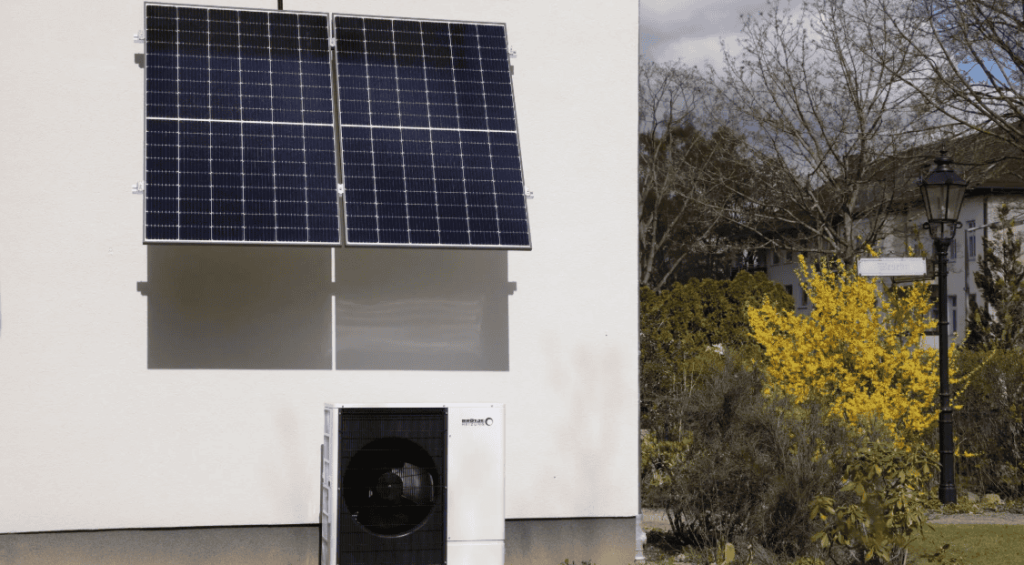
Rather than generating heat – like a boiler does by burning fuel – a heat pump extracts heat from outside air and transfers it indoors for space and water heating. This makes heat pumps remarkably efficient. One unit of electricity delivers around three units of heat. By comparison, an efficient gas or oil boiler typically delivers around 0.9 units of heat per unit of energy consumed. The heat-pump efficiency gain could cut heating bills by up to 60 percent (European Commission, 2026).
Designing a heating efficiency standard
The scheme’s aim would be for the share of heat pumps in overall heating sales to increase steadily from about 30 percent today (see Figure 1). This could be achieved by setting heat pump sales quotas that tighten each year for the companies that manufacture and sell heating systems. Companies that fail to meet their quotas would be fined proportionately to how far from the target they are. Companies that sell more heat pumps than required, including companies that manufacture only heat pumps, would generate credits that can be sold to lagging firms.
In April 2025, the UK launched a Clean Heat Market Mechanism, which requires manufacturers to sell specified numbers of heat pumps relative to gas boilers, with a £500 fine for each unit below the target. Early evidence suggests that manufacturers that sell both technologies have responded by discounting heat pumps to meet the target, rather than by purchasing credits from other manufacturers (Agora Energiewende, 2025). This suggests that an EU scheme must set ambitious targets and sufficiently high fines. If the target is not ambitious enough, demand does not increase, and the result is to shift sales away from heat-pump-only manufacturers to those that also sell boilers.
A second lesson from the UK scheme is how to define what counts towards the target. Heat pumps come in different shapes and sizes, with varying efficiencies. The UK scheme covers only hydronic heat pumps, excluding air-to-air units. Instead of listing technologies in scope, an EU scheme should be based on appliance energy efficiency.
Heating appliances sold in the EU are already rated for energy efficiency. These ratings could provide the basis for manufacturer-wide efficiency standards, tightened annually. More-efficient heat pumps would contribute more towards the quota than less-efficient units, while hybrid units would contribute less. Manufacturers exceeding their quotas would generate credits that can be sold to those falling short. The approach would be similar to EU vehicle emissions standards, under which annual fleet-wide carbon dioxide emissions targets are applied to carmakers.
A complication is that heating appliances differ in their capacities and uses. While hydronic heat pumps typically provide enough heat for a whole home, air-to-air units often serve individual rooms, and multiple units can be installed in single homes. Air-to-air units are also used for cooling; excluding them, as the UK scheme does, is not appropriate. However, counting them in full would be disproportionate. A fractional credit could be applied based on rated heating capacity and estimated potential to displace fossil-fuel heating.
Evaluating Europe’s need for a heating efficiency standard
Boosting heat pump sales is uncontroversial as a way to cut emissions and gas imports. Heat pumps are the most cost-effective technology to decarbonise heating at scale (Rosenow, 2022). Heating efficiency standards, as proposed above, should offer three main benefits.
Argument 1: Lowering the upfront cost
Most households face borrowing or spending constraints. Upfront rather than lifecycle costs weigh substantially more on decision-making when purchasing energy technologies such as solar panels or heat pumps (De Groote and Verboven, 2019; ICF, 2024).
EU policy on heat pumps focuses currently on reducing their running costs. The European Commission’s Electrification Action Plan asks countries to bring household electricity prices to no more than 2.5 times the price of gas by 2030, mainly by cutting taxes and levies on electricity (European Commission, 2026). In addition, from 2028, a carbon price will be put on fuels used for heating in the EU. This will improve the investment case for heat pumps, though the carbon price would need to be very high in certain markets. In Germany, a carbon price of around €350 per tonne of CO2 would be needed to repay a heat pump’s extra cost within ten years. That is more than twice the roughly €150 per tonne analysts expect by 2030.
A heating efficiency standard would complement these policies by creating a direct financial incentive for manufacturers to compete aggressively to make heat pumps more affordable. Each additional heat pump sold would help manufacturers meet their obligations and avoid fines or the cost of purchasing credits. Manufacturers could also pass some of the cost of compliance onto gas boiler sales. Over time, a larger and more predictable heat pump market should also reduce costs by providing investment certainty for production, distribution and financing models.
Argument 2: Motivating installers
Household decisions on what kind of heating unit to adopt depend heavily on advice from installers. Gas boilers have been the incumbent option for decades. Shifting to heat pumps requires overcoming path dependence.
One in four heating systems in the EU is replaced only following a breakdown (Energy Systems Catapult, 2026). Heat pumps are then often not a practical alternative, not least because there is a relative shortage of specialists trained in heat pump installation (LCP Delta, 2025; HPA UK, 2024).
Boiler manufacturers incentivise installers, much as carmakers set sales targets and bonuses for their dealers. Most installers are trained and certified in academies primarily funded by boiler manufacturers (Toleikyte et al, 2024). Manufacturer loyalty schemes pay installers for each boiler fitted; Ideal Heating, for example, pays £20 to £55 per boiler registered.
A heating efficiency standard would push manufacturers to invest in commercial loyalty schemes for efficient installations, giving installers an incentive to recommend heat pumps. Following the introduction of the UK Clean Heat Market Mechanism, manufacturer Worcester Bosch began paying installers £500 for each heat pump fitted, matching the £500 fine per missing heat pump.
Argument 3: A predictable path for producers
EU factories have a manufacturing capacity of 7.7 million heat pumps per year, but sold only two million units in 2024 (Volt et al, 2025). The sector employed about 80,000 people in the EU in 2023, and Europe accounts for almost half of global heat pump patent families (inventions patented in one or more countries) filed since 2000 (Bruegel, 2026). Steady demand would help European producers fill idle capacity and reduce costs.
National subsidies in Europe have boosted heat-pump take-up, but have also been stop-start. Sales of air-to-water heat pumps fell by 35 percent in Italy in 2024 when a tax credit covering up to 110 percent of renovation costs ended. Austria saw a sales dip of 17 percent in 2025 after federal grants for replacing fossil heating systems expired (EHPA, 2025a; EHPA, 2026). A clear annual trajectory would provide manufacturers with more certainty about demand.
Source : Bruegel