



Public debt is at or near record highs across the OECD, increasing the pressure on governments to restore fiscal sustainability over time. This column draws on new cross-country evidence showing that the output costs of fiscal consolidation are modest and short-lived on average, and that lasting scars are hard to detect. But averages conceal a critical asymmetry: consolidations launched in high-debt environments are markedly more contractionary, and in more than half of the episodes in the sample the debt ratio was still higher three years after consolidation. Initial fiscal conditions matter more for outcomes than the choice between spending cuts and tax increases.
General government gross debt in the OECD area is around 112% of GDP, more than 40 percentage points above its pre-2008 average, while ageing, defence and climate commitments continue to add to spending pressures (OECD 2026, IMF 2026). Consolidation needs are sizeable in most advanced economies, motivating policy discussions about what fiscal tightening does to the economy.
The debate has long been organised around separate questions. One literature asks how much output is lost in the short run and finds that multipliers are larger in recessions and when monetary policy cannot offset the tightening (Auerbach and Gorodnichenko 2012, House et al. 2020). A second literature asks whether consolidation leaves permanent marks on productive capacity through lower public investment, weaker capital accumulation and hysteresis in labour markets (Fatás and Summers 2018). A third asks whether tightening can be self-defeating, raising rather than lowering the debt-to-GDP ratio because the denominator falls faster than the numerator (Attinasi and Metelli 2017, Castro et al. 2015).
These questions are rarely answered together, and that separation matters for policy. A government deciding when and how to consolidate needs to know not only the size of the immediate hit to activity, but also whether the adjustment leaves the economy structurally poorer, and whether it delivers the debt reduction it was designed to achieve. In a new paper (de Mello and Jalles 2026a), we address the three questions within a single empirical framework for a panel of advanced, emerging-market and low-income economies over 1970-2024.
Identifying consolidation without the narrative record
Identification is the central difficulty. Fiscal policy responds to the cycle, so raw changes in the cyclically adjusted primary balance (CAPB) partly reflect economic conditions rather than discretionary decisions. Narrative datasets solve this by reconstructing the policy record, but they exist for a limited set of countries and years (DeVries et al. 2011, Adler et al. 2024).
We use a three-layer strategy designed to travel across a wide cross-section. First, the primary balance is cyclically adjusted, and a fiscal reaction function is estimated in which the CAPB responds to lagged debt and to slow-moving structural controls; its residual is our measure of unanticipated consolidation. Alternatively, discrete and persistent consolidation episodes are dated using a multiple structural break procedure. Effects are then estimated with local projections for short-run dynamics, augmented with leads of the shock to allow for anticipation, and with panel dynamic OLS and an error-correction model for long-run relationships.
The episodes so identified look plausible. High-income economies account for the largest number, while upper-middle-income economies have the largest average adjustment, at about 2.5 percentage points of GDP. Expenditure-based and mixed packages together make up over 90% of episodes; purely tax-based adjustments are rare. Growth typically falls sharply before consolidation starts, from about 3.4% three years ahead of the episode, and then stabilises, underscoring that consolidation episodes often occur against a backdrop of prior economic weakness.
Short-run costs are real but fade
Our baseline local projections indicate that a one-percentage-point consolidation shock lowers the level of real GDP per capita on impact and keeps it below baseline for about two years, after which the loss steadily shrinks. By the third year the estimated response is effectively zero, and point estimates turn mildly positive thereafter.
The long-run picture is less settled than the impulse responses alone would suggest. Dynamic OLS estimates point to a small negative association between consolidation and the long-run level of output, on the order of 1% to 1.3% of GDP per percentage point of adjustment, and the error-correction term is negative and highly significant. But these estimates are sensitive to how consolidation is measured: the negative coefficient is strongest when all positive CAPB changes are treated as shocks and disappears when narrative episodes are used.
Taken together, the evidence of temporary demand-side costs is far stronger than that of permanent supply-side scarring.
When does consolidation reduce debt?
Whether consolidation improves debt dynamics is a separate question. In debt-dynamics regressions the coefficient on consolidation is negative at different horizons and grows in absolute size over time, consistent with tightening lowering the debt ratio; the interaction with lagged growth is insignificant, so the average relationship does not appear to depend much on initial cyclical conditions. The estimates are not statistically precise, however, and the confidence bands around the conditional marginal effect include zero throughout.
The episode-level count is more sobering. Among consolidations for which three-year debt outcomes are observable, 290 episodes, or 56% of the sample, saw the debt-to-GDP ratio rise within three years, against 228 debt-reducing episodes. Debt outcomes following consolidation therefore vary considerably across episodes, reflecting, among other factors, the interest-growth differential and initial economic conditions.
Debt levels, not instruments, drive the differences
Estimating the local projections separately for economies entering consolidation with high and low public debt, measured relative to the median lagged debt ratio among consolidation observations, produces two very different trajectories (Figure 1).
Where initial debt is low, the output response hovers near zero and becomes mildly positive after three years. Where initial debt is high, output falls on impact and stays below baseline within a five-year horizon, with no sign of recovery. Interaction regressions confirm the pattern: the coefficient on the shock itself, which captures the low-debt case, is small and insignificant at every horizon, while the interaction with high debt is consistently negative and significant through the second year.
One possible mechanism is intuitive. Heavily indebted economies may face tighter financing conditions, higher risk premia and less room to cushion adjustment with other policy instruments, so a given tightening may bite harder and for longer. It is also precisely in these economies that consolidation is least avoidable, which is the uncomfortable core of the result.
Figure 1 Output effects of fiscal consolidation under high and low public debt
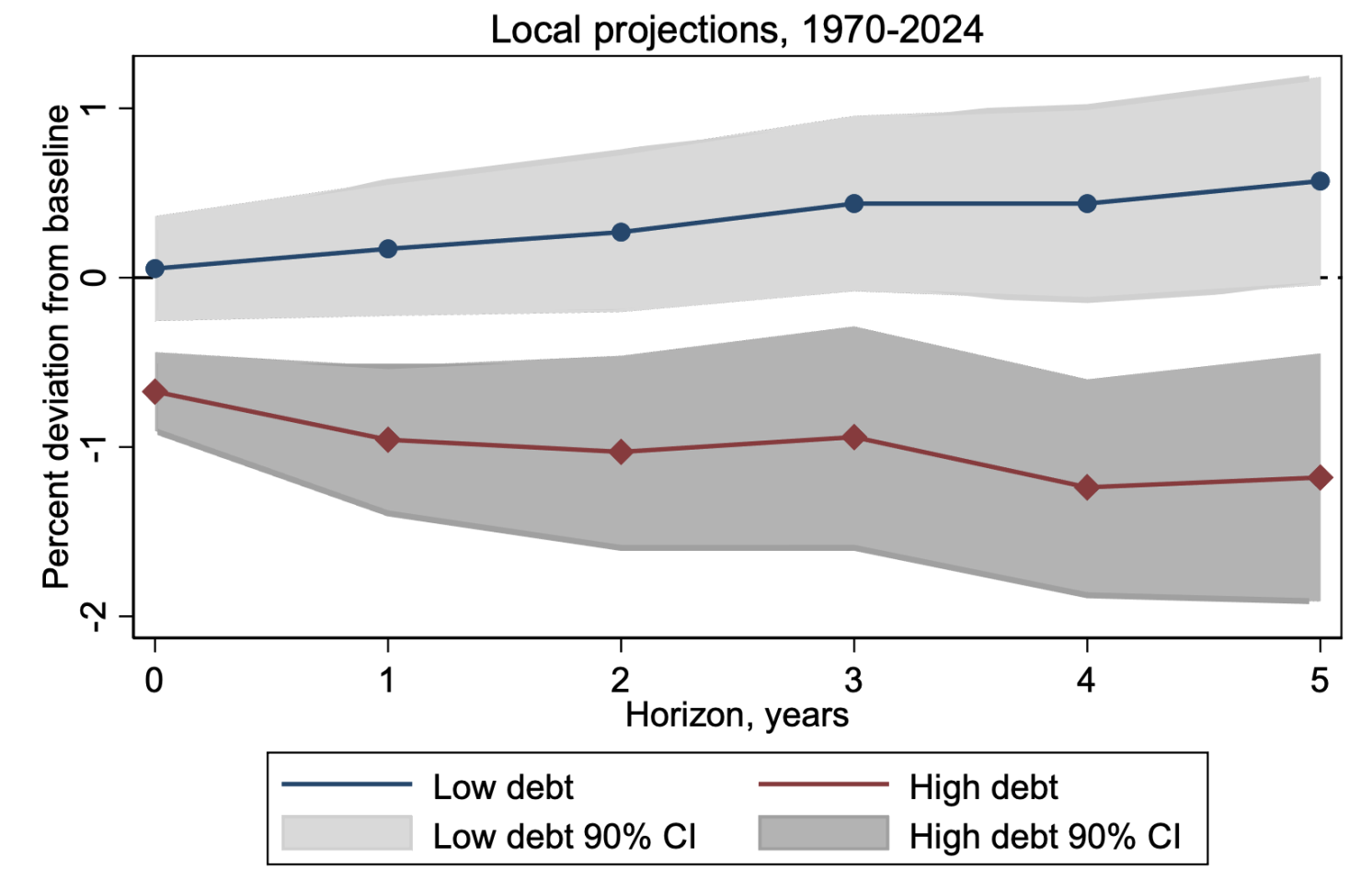
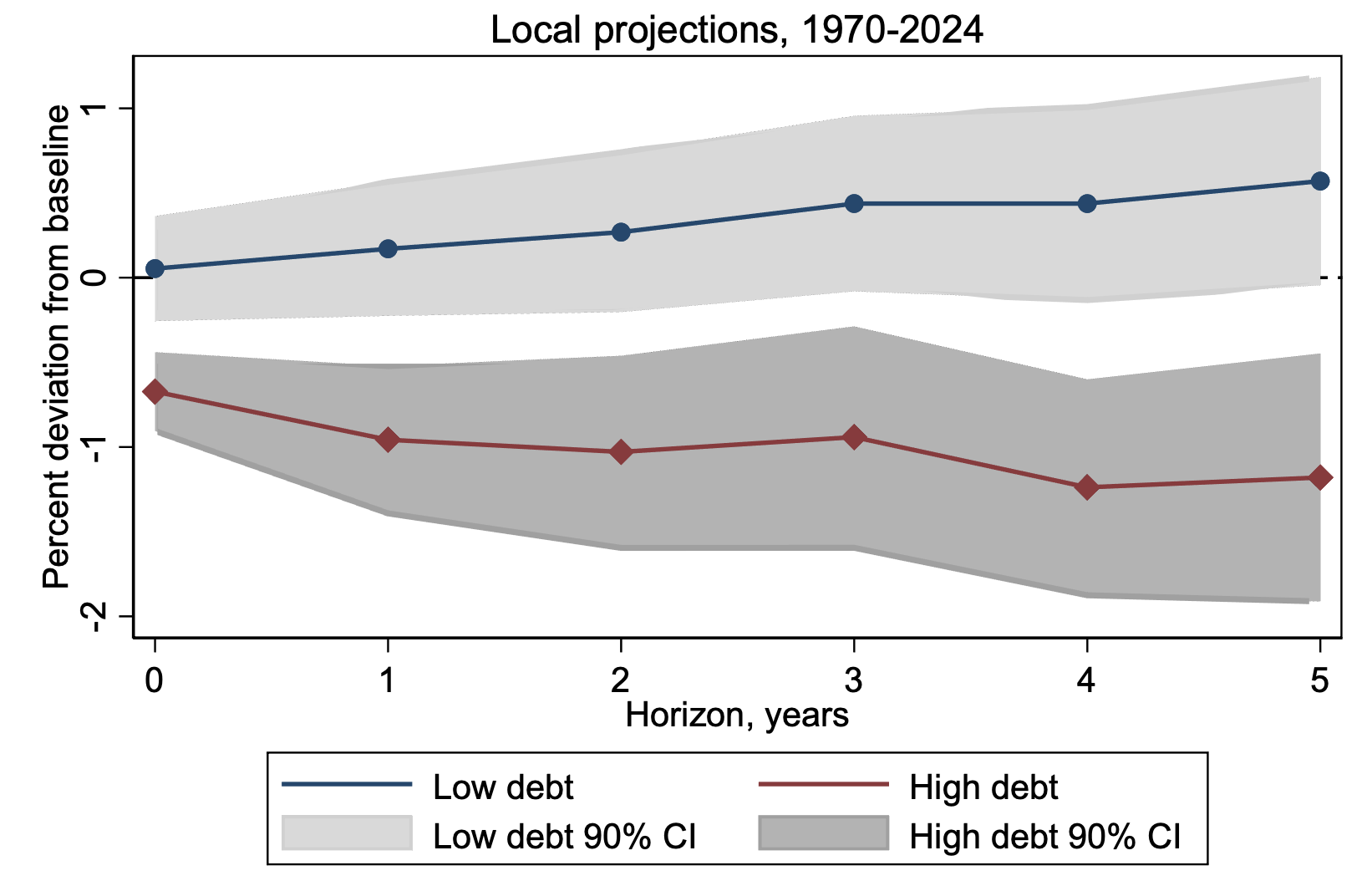
Notes: Estimated impulse response of real GDP per capita to a one-percentage-point fiscal consolidation shock, shown separately for countries with high and low initial public debt. High debt is defined relative to the median lagged debt-to-GDP ratio among consolidation observations. The vertical axis measures the cumulative percentage deviation of real GDP per capita from its pre-shock level; shaded areas are 90% confidence intervals based on Driscoll-Kraay standard errors. Sample period: 1970-2024.
Source: de Mello and Jalles (2026a).
Impulse responses estimated separately for spending-based and tax-based episodes differ in their point estimates, with tax-based adjustments looking somewhat more favourable over the horizon, but the confidence bands overlap so heavily that no difference can be identified. That is a departure from the classic finding that expenditure-based adjustments are the more growth-friendly option (Alesina and Perotti 1997, Alesina et al. 2019), and it should be read as an absence of statistical resolution rather than as a refutation. The substantive point is comparative: initial fiscal conditions explain more of the heterogeneity in consolidation outcomes than the instrument mix does.
Implications for future adjustment
Three lessons follow for governments preparing to tighten. First, the short-run output cost of consolidation is not the binding argument against it. Losses are modest, they dissipate within about three years, and the evidence for permanent damage to productive capacity is weak.
Second, timing and initial conditions dominate. Because consolidation is substantially more contractionary when debt is already elevated, the results strengthen the case for rebuilding fiscal buffers before debt reaches those levels. This complements our earlier finding that rigid spending structures, and large public wage bills in particular, reduce the likelihood of consolidation and push adjustment towards cuts in public investment (de Mello and Jalles 2026b).
Third, consolidation is neither the costless virtue of the expansionary-austerity literature nor the self-defeating trap of its critics. It is a policy whose payoff depends on when it is undertaken and how much fiscal room remains, and the evidence suggests that this room is best created well before it is needed.
Source : VOXeu