



In a green transition, workers will have to move from polluting, carbon-intensive sectors to other sectors and firms. To shed light on adjustment costs for workers in the green transition, this column uses German administrative data to estimate the cost of involuntary job displacement for workers in high-carbon-intensity sectors. Such workers face larger earnings and wage losses than workers displaced in other sectors. Production processes in carbon-intensive sectors are also regionally concentrated and involve specific occupations and tasks with higher firm-wage premia, reducing worker options for finding jobs with similar skill requirements and pay.
Recent research suggests that reducing carbon emissions may have a limited effect on aggregate employment but will require substantial reallocation of labour and capital between sectors (Lawrence 2024, Hanson 2023, Bickmann et al. 2025). Given global efforts to reduce carbon emissions, workers will have to move from polluting, carbon-intensive sectors to newly created jobs in other sectors and firms. These transitions due to structural change can entail significant adjustment costs for workers (Autor et al. 2014, Walker 2013). While survey evidence shows that the prospects of job loss undermine support for climate-change mitigation policies (Dechezleprêtre et al. 2025), little is known about individual-level adjustment costs for workers displaced in carbon-intensive sectors.
The German economy provides a particularly suitable setting for studying job displacement effects in carbon-intensive sectors
In a recent paper, we contribute to this discussion by using German administrative data from 1992 to 2020 to better understand the cost of job displacement for workers in high carbon-intensity sectors (Barreto et al. 2026). The German economy provides a particularly suitable setting, as it has been one of the leading countries in climate-change mitigation efforts over the last three decades. While, for example, CO2 emissions increased by 2% in the US between 1990 and 2019, they declined by 33% in Germany (OECD 2026). Over the same period, employment in high-carbon-intensity sectors has declined markedly (Figure 1), encompassing both manufacturing and non-manufacturing activities and occurring in both East and West Germany. At the same time, other structural changes – most notably due to international trade or automation – have had more limited effects on manufacturing employment and job displacement in Germany since the 1990s (Dauth et al. 2014, 2021).
Figure 1 Employment trends in high- and low-carbon-intensity sectors in Germany
Employment, 1993=100
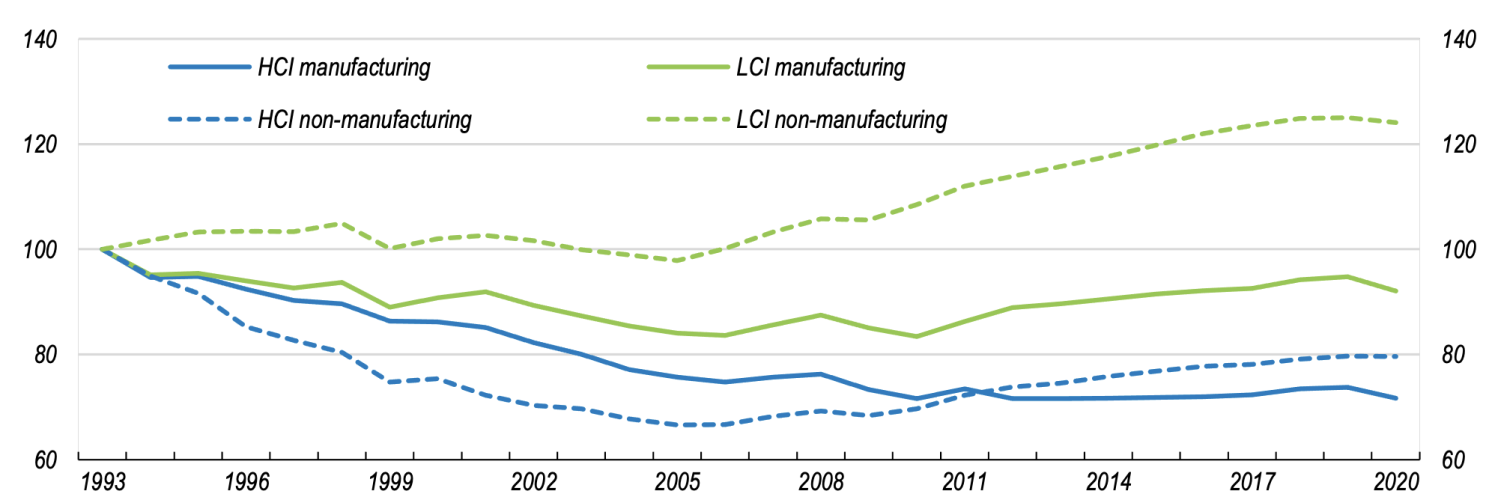
Notes: High-carbon-intensity (HCI) sectors are defined as the top-two deciles of the sectoral carbon-intensity distribution, while all remaining sectors are classified as low-carbon-intensity (LCI) sectors.
Source: IAB Nuernberg, Integrated Employment Biographies dataset, authors’ calculations.
We define high-carbon-intensity sectors as the top-two deciles of the sectoral carbon-intensity distribution, which together account for about 81% of total CO2 emissions in Germany over our sample period. The high-carbon-intensity sectors are characterised by intensive use of fossil fuels and comprise energy-intensive manufacturing, energy production, mining, and transport services.
With the exception of transport services, their production technologies are highly capital-intensive and activity is concentrated in specific regions, reflecting the uneven spatial distribution of fossil energy resources and other key inputs (e.g. metal or other minerals), and agglomeration economies, that is, the co-location of upstream and downstream activities to reduce transport costs and generate positive production spillover effects (Kahn and Mansur 2013, Glaeser et al. 2015). These regions often specialise in a narrow range of activities, making them more exposed to industry-specific shocks and potentially limiting outside options for displaced workers (Hanson 2023).
Employment in high-carbon-intensity sectors has declined in many local labour markets since the early 1990s (Figure 2). However, the spatial distribution of high-carbon-intensity activities and employment has remained similar, indicating a strong path-dependence in their location.
Figure 2 Share of high-carbon-intensity workers in total employment (by local labour market)
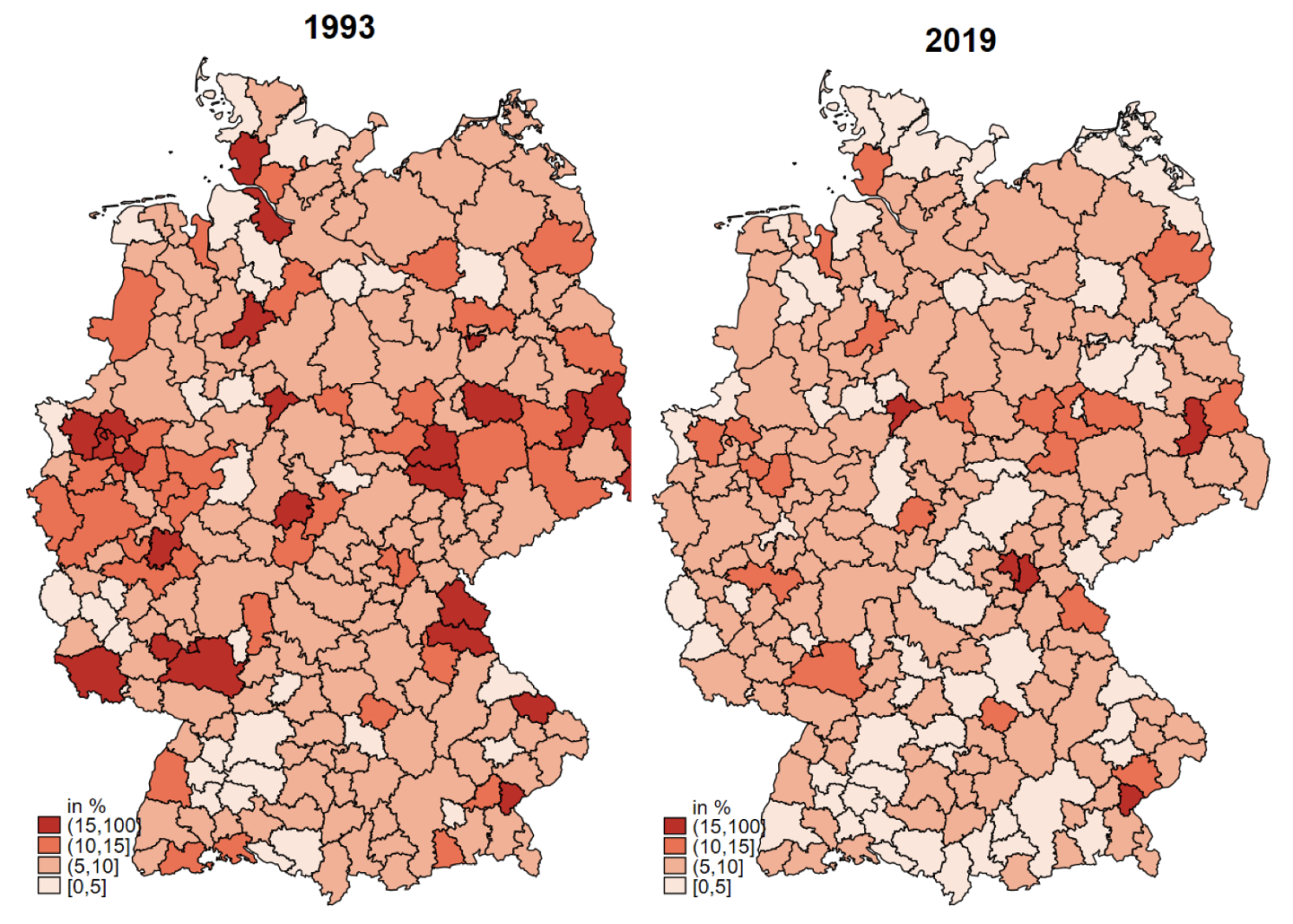
Note: The map shows 223 local labour market regions as constructed by the Federal Institute for Research on Building, Urban Affairs and Spatial Development.
Source: IAB Nuernberg, Integrated Employment Biographies dataset, authors’ calculations.
To estimate the cost of job loss for workers in high-carbon-intensity sectors and all other sectors, we use administrative labour market data coupled with data on mass layoffs and compare labour market outcomes of displaced and non-displaced workers before and after a mass layoff event. Within sectors, we use a two-step matching procedure to pair each displaced worker with a non-displaced worker with similar individual characteristics and pre-displacement trends in outcomes (Jacobson et al. 1993).
Focusing the analysis on displacements during mass layoff events allows us to identify the causal impact of involuntary job separations, as mass layoffs can be assumed to be exogenous to individual characteristics of the worker (Jacobson et al. 1993, Schmieder et al. 2023).
We then compare average displacement costs between high- and low-carbon-intensity sectors and use an Oaxaca-Blinder decomposition to understand whether differences in displacement costs across sectors are driven by differences in worker and job characteristics or by differences in how these characteristics affect earnings losses.
Workers displaced from high-carbon-intensity sectors face larger and more persistent earnings losses
Our results show that workers displaced from high-carbon-intensity sectors have experienced (on average) higher and more persistent earnings and wage losses than workers displaced in other sectors (Figure 3). This is mainly due to human capital specificity, the regional clustering of high-carbon-intensity activities, and higher firm-wage premia.
Figure 3 Changes in earnings relative to pre-displacement average by sector (in %)
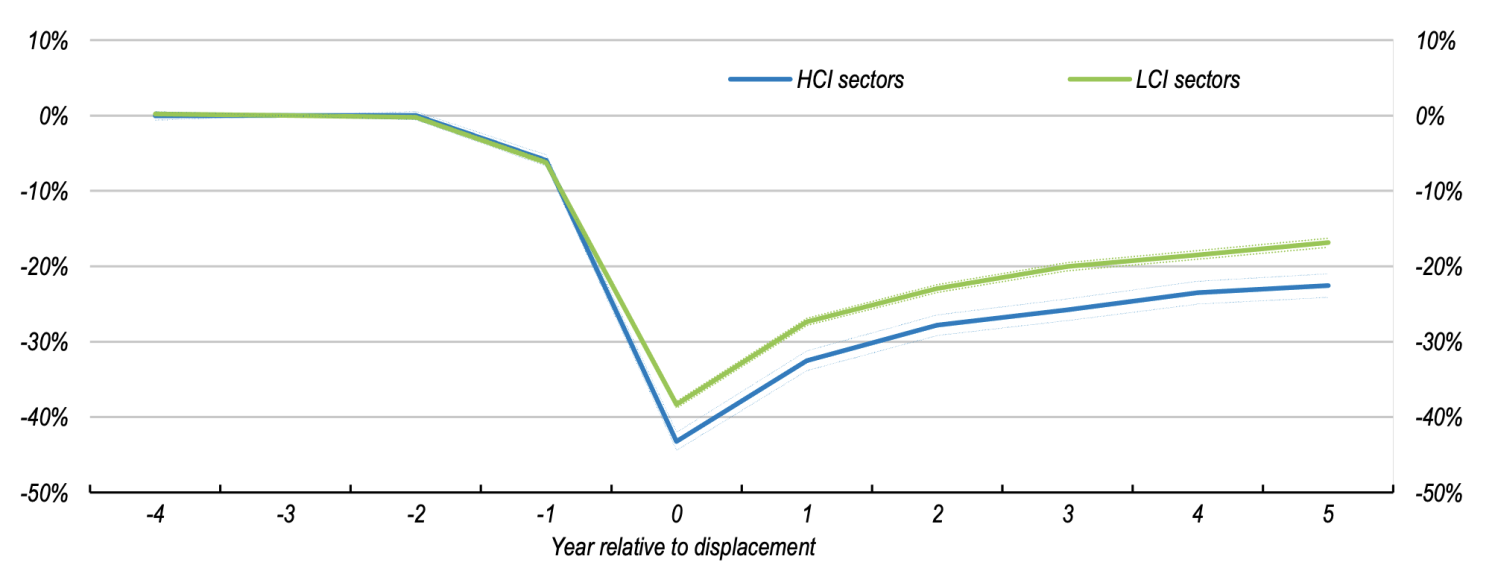
Note: Thin lines correspond to 95% confidence intervals based on standard errors clustered at the worker level.
Using time-varying measures of task-content at the detailed occupation level, we construct an individual-level index of job opportunities in local labour markets, capturing jobs with similar skill requirements to the pre-displacement job (Macaluso 2025). Our results indicate that fewer outside options for jobs with similar skill requirements are a main factor for higher displacement costs in high-carbon-intensity sectors. Displaced high-carbon-intensity workers must move to other occupations with different skill requirements, which reduces their wages due to the imperfect portability of occupation-specific human capital (Kambourov and Manovskii 2009, Gathmann and Schönberg 2010).
Our findings also indicate that the concentration of high-carbon-intensity activities in specific firms and regions, which specialise in a narrow set of activities, reduces outside options in terms of employers, implying lower post-displacement wages (Dodini et al. 2024). Moreover, possibly related to a historically strong presence of unions in capital-intensive high-carbon-intensity sectors (Jäger et al. 2022), the firm-wage premia are on average higher in high-carbon-intensity sectors, leading to higher displacement costs as workers transition to firms operating in other sectors (Schmieder et al. 2023).
A key question is to what extent our estimates generalise beyond mass layoffs and Germany. Using an alternative method to identify involuntary job separations, based on the timing of receiving unemployment insurance, we show that our results also apply to more gradual transitions. This signals that adjustment costs could remain significant in a future green transition, even if they are characterised by fewer mass layoffs.
Our findings are also consistent with evidence from other countries. Applying a similar empirical approach, OECD (2024) documents higher and more persistent earnings losses among workers displaced from high-carbon-intensity sectors compared to workers displaced from low-carbon-intensity sectors in 14 OECD countries. They find that this is mainly due to differences in observable job characteristics between high- and low-carbon-intensity sectors.
Finally, we also show that our results are not exclusively driven by a secular decline in manufacturing employment, as the gap in displacement costs between high- and low-carbon-intensity sectors is even more pronounced for non-manufacturing sectors.
Conclusions
As higher displacement costs in high-carbon-intensity sectors are mainly due to occupation-specific human capital and limited outside options, there is an important role for policy to reduce adjustment costs for workers during the green transition. Targeted vocational education and training, for example, could help displaced workers from high-carbon-intensity sectors move into well-paid occupations with different skill requirements in expanding sectors and firms (Card et al. 2018).
Moreover, those new opportunities are often found outside one’s local labour market, indicating the need to support regional mobility. In our sample, displaced workers who were more mobile and moved to new jobs outside their local labour markets had lower displacement costs.
However, due to adverse agglomeration effects and the decline in consumer demand, a mass transition of displaced workers to other local labour markets would also deepen the hardship for the stayers (Hanson 2023). Therefore, a primary challenge for policymakers is to find the right balance between support policies that target individuals and those trying to address region-level development challenges.
Source : VOXeu