



Emerging markets are vulnerable to sudden shifts in investor sentiment, which can lead to pressure on exchange rates and financing conditions. Using panel evidence from 23 emerging markets, this column shows that the sensitivity of portfolio flows to global shocks has weakened since the Global Crisis. However, sensitivity varies widely across countries. Countries with more independent central banks and lower levels of public debt experience lower portfolio outflows during periods of global financial stress. The results highlight that although emerging markets cannot control global factors, they can influence their resilience to these shocks.
Recent episodes of financial market turbulence have once again highlighted the vulnerability of emerging markets (EMs) to sudden shifts in global investor sentiment. When global risk rises, capital often flees rapidly, putting pressure on exchange rates, financing conditions, and sovereign borrowing costs.
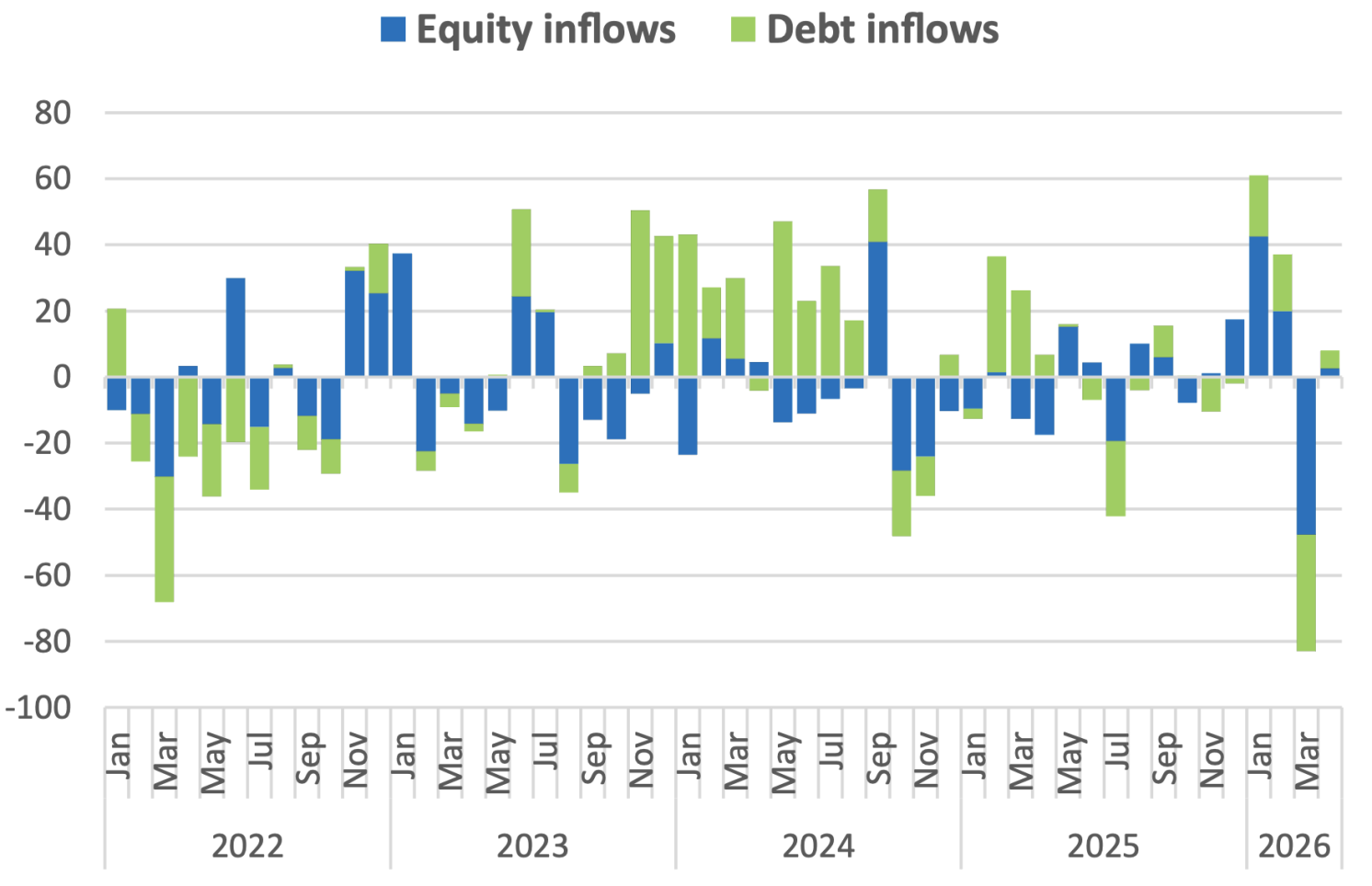
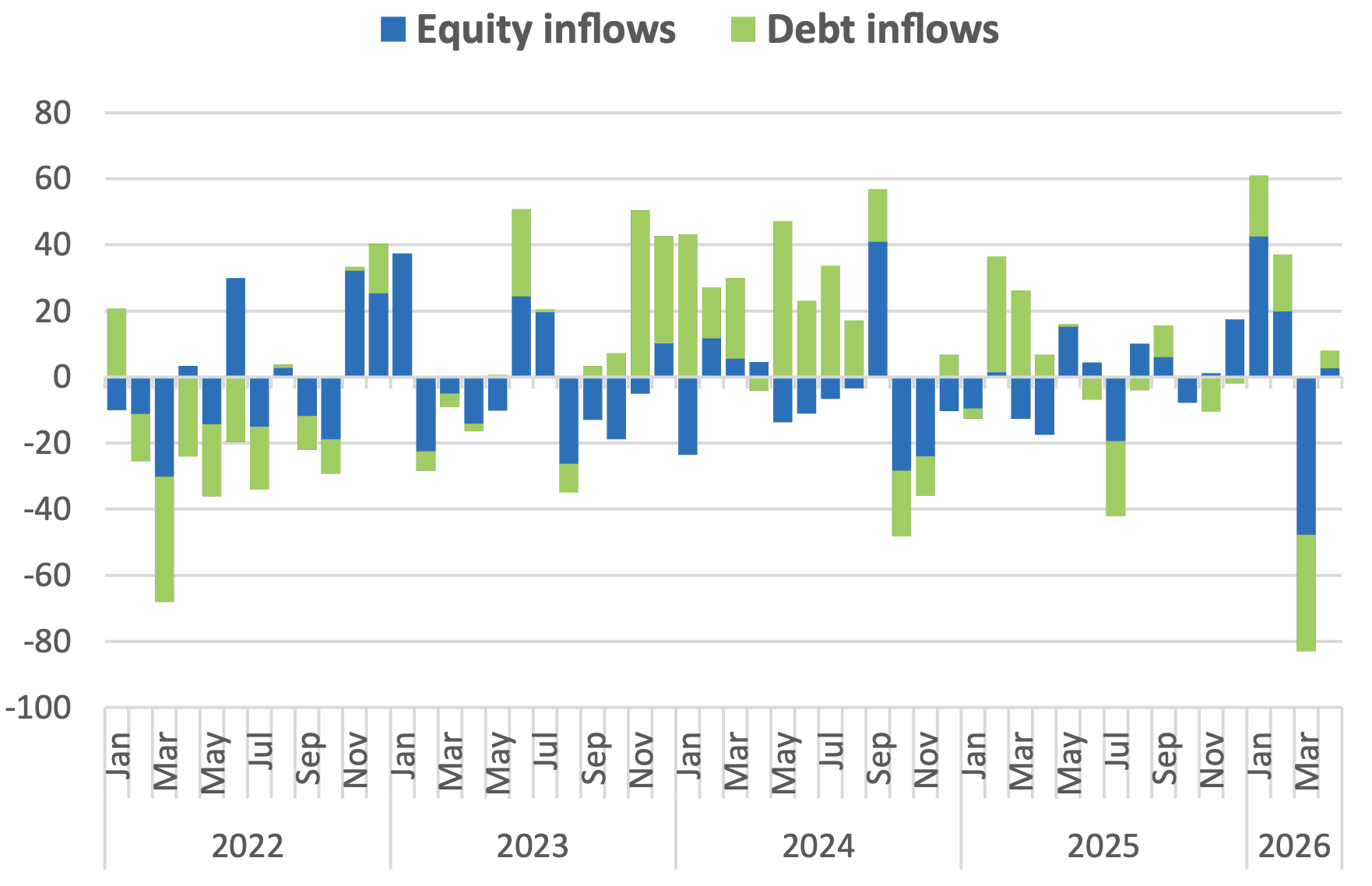
March 2026 provides a striking example. As the war in Iran unfolded, foreign investors sold $82 billion of emerging-market portfolio assets in a single month, a record in recent years according to the latest OECD data (Figure 1).
Figure 1 Monthly portfolio inflows to emerging markets (in billion US dollars)
Source: OECD Monthly Capital Flow dataset.
Note: Covers 25 emerging markets. Equity flows not available for China in April 2026. See De Crescenzio and Lepers (2025) and OECD Monthly Capital Flow dataset for full data description and coverage.
Yet these numbers mask considerable cross-country heterogeneity. While some emerging markets have experienced pronounced exchange-rate pressures, widening sovereign spreads, and portfolio reversals, others have maintained stable financing conditions and continued to attract foreign capital. Why do countries exposed to the same global financial shocks experience such different outcomes?
This question lies at the heart of some of the most important debates in international finance. Since the seminal work by Hélène Rey (2013) on the existence of a global financial cycle, a large body of research has explored its impact on emerging markets, even under flexible exchange-rate regimes. In turn, the debate evolved from asking whether the global financial cycle exists to asking why some countries appear substantially more resilient to it than others (e.g. Bolhuis et al. 2025).
Recent OECD analysis (OECD 2024) contributes to this debate by 1) testing systematically how the sensitivity of capital flows to emerging markets has evolved since the Global Crisis, and 2) asking what structural policy features explain why some emerging markets proved far more insulated from global shocks than others, for instance during the 2022-2023 Fed tightening cycle. Drawing on panel evidence for 23 emerging markets over the period 2010–2023, we find that global factors – including risk aversion, uncertainty, US dollar movements, commodity prices, and, increasingly, geopolitical risk – remain powerful drivers of portfolio flows. However, the transmission of these shocks depends critically on domestic policy frameworks.
Global shocks still matter, but emerging market resilience has strengthened
We find that, across all specifications, all global factors are robustly and significantly associated with lower portfolio inflows: whether it is higher risk aversion, US dollar appreciation against a broad advanced economy currency index, risk-off conditions, commodity price declines, or higher uncertainty.
Crucially, this sensitivity appears largely confined to portfolio investment. The same set of global factors shows no statistically significant association with FDI inflows in the post-Global Crisis period. Banking flows show partial sensitivity – to uncertainty and commodity prices – but not to risk aversion or US dollar movements.
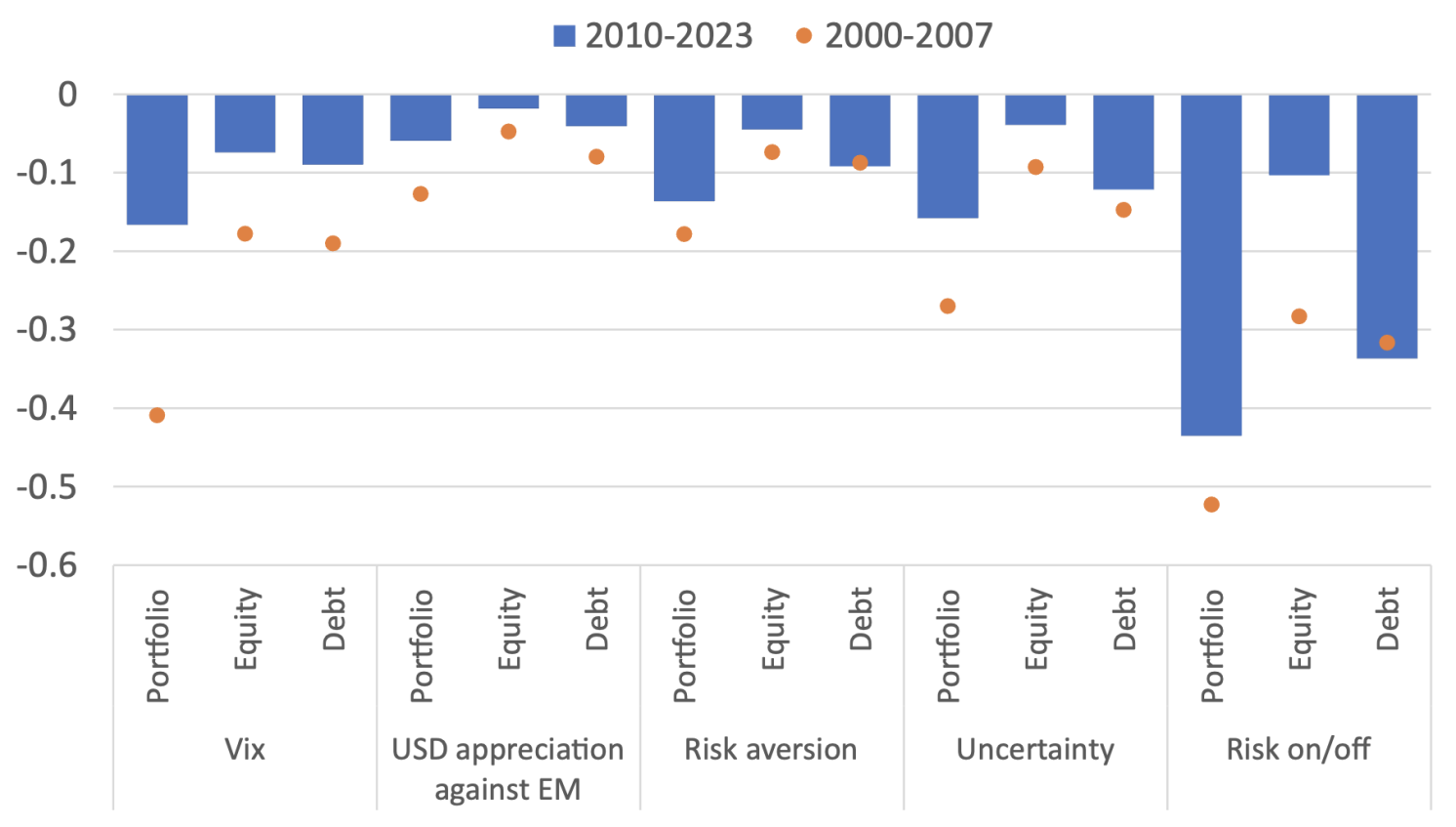
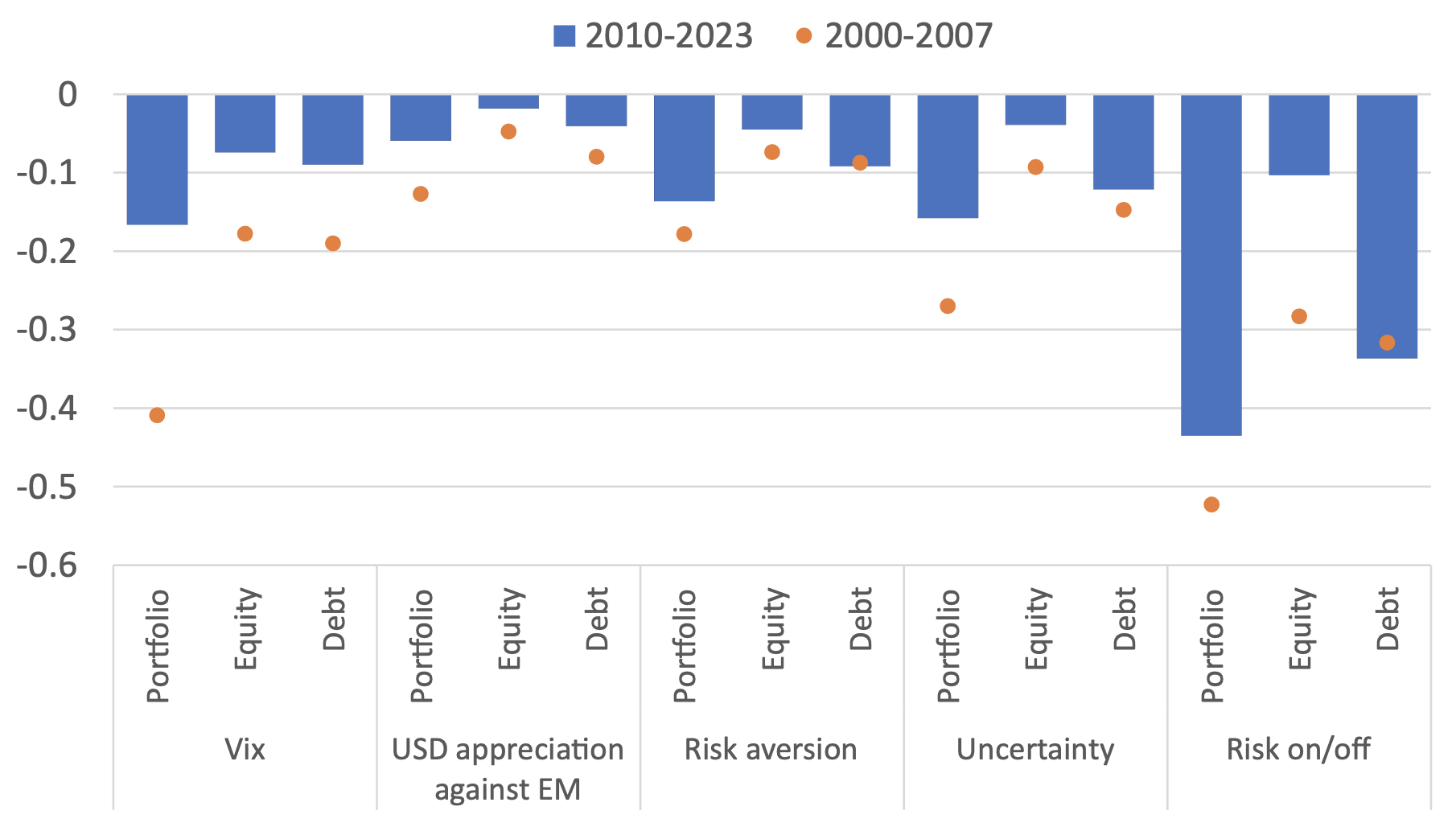
A striking result, however, is that emerging markets have become less sensitive to global shocks since the Global Crisis. Comparing the pre-Global Crisis period (2000-2007) with the post-Global Crisis period (2010-2023), estimated coefficients are materially smaller in the post-Global Crisis period for all five global factors tested, for both equity and debt inflows (Figure 2). Portfolio equity inflows are generally less sensitive than debt inflows to global shocks in both periods.
Figure 2 Sensitivity of emerging market portfolio inflows to global shocks pre- and post-Global Crisis
Source: OECD (2024).
Note: Coefficients from quarterly panel regressions of portfolio inflows to GDP on different global factors separately in the 2000q1-2007q4 and 2010q1-2023q4 periods. Sample of 23 emerging markets.
Geopolitical risk is now a distinct driver of capital flows
An important extension of the standard framework is the explicit inclusion of geopolitical risk as a distinct global factor. The analysis shows that both global and country-specific geopolitical risk are significant negative drivers of portfolio inflows in the post-Global Crisis period, with the effect concentrated in debt flows and intensifying markedly since February 2022.
Fund-level evidence confirms this pattern. International equity and bond funds reduce their exposure to countries experiencing elevated geopolitical risk, with bond investors displaying even greater sensitivity. These findings suggest that geopolitical risk is not merely another manifestation of broader investor risk aversion. Rather, it operates as a separate and increasingly important channel influencing international capital allocation. Unlike other global factors, country-specific geopolitical risk also affects FDI inflows, indicating that geopolitical considerations are also increasingly shaping long-term investment decisions.
What makes some emerging markets more resilient?
Although aggregate resilience has improved since the Global Crisis, the gains are far from uniform. Country-level estimates reveal substantial differences in sensitivity to global shocks across emerging markets. This heterogeneity raises a natural question: which policy frameworks help explain these differences? In particular, we test three key dimensions of emerging market policy frameworks: 1) central bank independence, 2) fiscal discipline, and 3) macroprudential policy use.
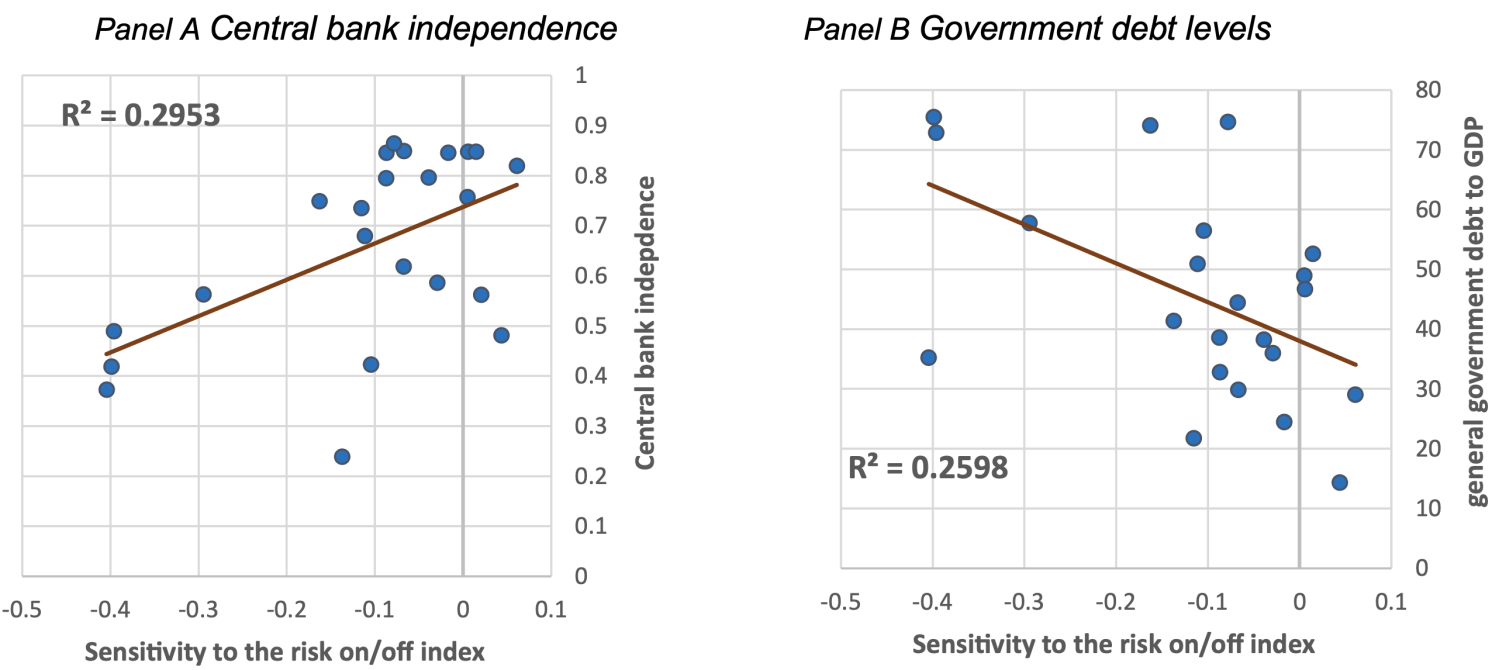
Figure 3 Cross-sectional relationship between structural policy features and the sensitivity of emerging market equity inflows to risk-on/risk-off shocks
Source: OECD (2024).
Note: Cross-sectional relationship between central bank independence or general government debt to GDP (vertical axis – panel a or b) and the sensitivity of emerging market equity inflows to the risk on/risk off from Chari et al. (2025). Regressions are restricted to 2010q1-2023q4. Central bank independence is averaged in the post-Global Crisis period (2010-2023). Sample of 23 emerging markets.
Central bank independence (CBI) emerges as the most robust structural determinant of reduced portfolio flow sensitivity (Figure 3a). In panel specifications, the interaction between CBI and each global risk factor is positive and statistically significant for equity inflows, confirming that more independent central banks are associated with smaller outflows when global risk rises. This effect is most pronounced at the lower tail of the flow distribution — the 25th percentile quantile regression results show consistently stronger significance than ordinary least squares (OLS) regressions — indicating that CBI provides the greatest stabilising benefit precisely during periods of acute market stress. This is in line with recent evidence by Kalemli-Ozcan and Unsal (2023) regarding central bank credibility.
Government debt levels constitute the second robust structural determinant (Figure 3b). Interaction terms between debt-to-GDP ratios and global risk factors are negative and statistically significant in multiple specifications. Investors appear particularly sensitive to debt sustainability concerns during periods of stress, when uncertainty about future inflation, taxation, or refinancing risks becomes more salient. The effect is concentrated at the lower tail of the distribution, indicating that high debt tends to amplify vulnerabilities precisely during the most severe episodes of market turbulence.
By contrast, we find limited evidence that macroprudential tightening directly reduces portfolio-flow volatility: cumulative measures of macroprudential tightening show limited cross-sectional or panel correlation with portfolio flow sensitivity. While previous research has shown that macroprudential policy mitigates the ‘capital flow-credit nexus’, i.e. the sensitivity of emerging market household and corporate credit growth to capital inflows (Carvalho et al. 2025) as well as the resilience of GDP to global shocks (Bergant et al. 2023), its effect on portfolio-flow sensitivity itself appears more modest. One explanation is the growing role of non-bank financial institutions in intermediating international portfolio flows. Traditional macroprudential tools have largely focused on banks, whereas bond and equity flows are increasingly driven by investors operating outside the banking system. The higher exposure of non-bank bond investors may in turn increase capital flow volatility (Chari et al. 2022). Policy discussions around the regulation of non-bank financial institutions (NBFIs) and the possibility of macroprudential policy beyond banking, notably at the Financial Stability Board (FSB), would help in this respect.
Conclusion
Evidence from our analysis shows that, overall, emerging markets have become significantly less sensitive to global financial shocks since the Global Crisis, and much of this improved resilience is associated with stronger monetary institutions and sounder fiscal positions.
In particular, countries with more independent central banks and lower levels of public debt experience substantially smaller portfolio outflows during periods of global financial stress, whereas macroprudential policies appear to play a more limited role in insulating portfolio flows.
Recent OECD research suggests that global financial conditions remain the dominant driver of portfolio investment, but policy frameworks determine how strongly those shocks are transmitted: in other words, emerging markets cannot control the global financial cycle, but they can substantially influence their vulnerability to it and increase their resilience.
Source : VOXeu