


Of the estimated 244 million firms in Africa, 232 million (95%) are own-account businesses consisting of only the owner, and a further 7.7 million (3.1%) have fewer than five employees. A key policy objective is to increase the number of high-growth firms that hire workers and expand beyond this micro size. Business plan competitions have become one popular policy tool for this purpose. They aim to identify entrepreneurs with the ability to grow a larger firm, and then award grants to overcome capital constraints on this growth. I previously worked on evaluating the YouWin! business plan competition in Nigeria, which had a multi-stage selection process and gave winning entrepreneurs an average of US$50,000 each. This found large and sustained increases in job creation, leading Chris Blattman to ask whether it was one of the most effective development programs in history.
But $50,000 is a lot of money, and while business plan competitions have become increasingly popular, there is a lot of uncertainty about how much to give potential entrepreneurs. Amounts range from under $1,000 to more than $100,000 in different sub-Saharan African competitions. How much you should give depends on what you think the shape of the production function looks like. Under the standard concave production function, there is diminishing returns to capital, and it would be better to give many small grants than a small number of large grants. But if high-growth investment opportunities are lumpy (e.g. buying a big machine), if you don’t give entrepreneurs a big grant, they may not be able to pursue them at all.
It is also not obvious how you should select the winners. There is already a lot of self-selection in who chooses to apply online, fill out details of a business plan idea, and provide the documentation required. It may then be hard to predict who will succeed beyond this, favoring a streamlined process on top of this that can get money to entrepreneurs faster and at lower cost. Alternatively, a multi-stage process requiring more detailed plans and using judges to score them may help focus resources on a pool of entrepreneurs with higher job creation potential.
Learning about returns to capital and selection through MbeleNaBiz
MbeleNaBiz (Swahili for “Moving Ahead with Business”) was a business plan competition in Kenya conducted as part of the Kenya Youth Employment and Opportunities Project (KYEOP). In a new working paper with Francisco Campos, Abla Safir, Celine Koffka, and Bilal Zia, we use two experiments embedded in this business plan competition to learn how bigger vs smaller grants compare, and how the process of identifying which entrepreneurs to support affects job creation.
The competition was for 18-35 year olds in Kenya, who applied with either an existing business they wanted to expand, or with a new business idea. There were over 12,000 applications. The initial proposals were ranked in terms of potential, with the bottom two groups (about 26%) screened out at this stage. Entrepreneurs were then randomly assigned to go through either a streamlined selection process (in which they had to submit a business plan online, and a random subset of those submitting chosen for a $9,000 grant), and a multi-stage selection process (in which they had to submit the plan online, these plans were scored by judges, and the top 750 overall randomly allocated to control, a $9,000 grant, or a $36,000 grant). So we then have the following 5 experimental groups:
· 250 firms in the control group for the streamlined experiment
· 250 firms that get $9,000 after the streamlined process
· 250 firms that are in the control group for the multi-stage experiment
· 250 firms that get $9,000 after a multi-stage process
· 250 firms that get $36,000 after the multi-stage process.
Comparing the treatment impacts of the two $9,000 grants allows us to see how impacts vary for the types of entrepreneurs chosen through these two different processes; comparing the $9,000 and $36,000 grants allows us to see whether giving four times the funding leads to more business success (and whether 4 times the money leads to more or less than 4 times the number of jobs).
Firms span a wide set of industries such as agriculture (e.g. poultry and livestock production, drip irrigation systems to enable multiple growing seasons); wholesale and retail trade (e.g. fashion, food, and cosmetics); ICT; and manufacturing (e.g. making alternative energy products from agricultural waste, grain milling, food processing).
What do we find?
The results from Kenya reaffirm that business plan competitions can be successful in generating large and lasting impacts on jobs and firm profitability. After three years, the winners of the $36K grants increased employment by more than 100%, sales by 69% and profits by 60% relative to the control group.
The larger grants generate more jobs in the short run (but still fewer on a per dollar basis), and by 3 years have impacts much more similar to the smaller multi-stage grant. Figure 1 below shows that initially those getting the $36K grant hire an additional 5 workers, whereas those with the $9K multi-stage hire half as many (2.6) more workers. But many of these hires in the firms getting large grants appear to be temporary, and we cannot reject that the 2.6 worker impact of the 36K grant after 3-years is equal to the 2.0 worker impact of the 9K multi-stage. We see that the streamlined selection also initially results in a 2.6 worker increase, but that these jobs do not appear to last, so that the longer-term impacts are much smaller from the streamlined grants.
Figure 1: The Grants Led to Jobs Being Created
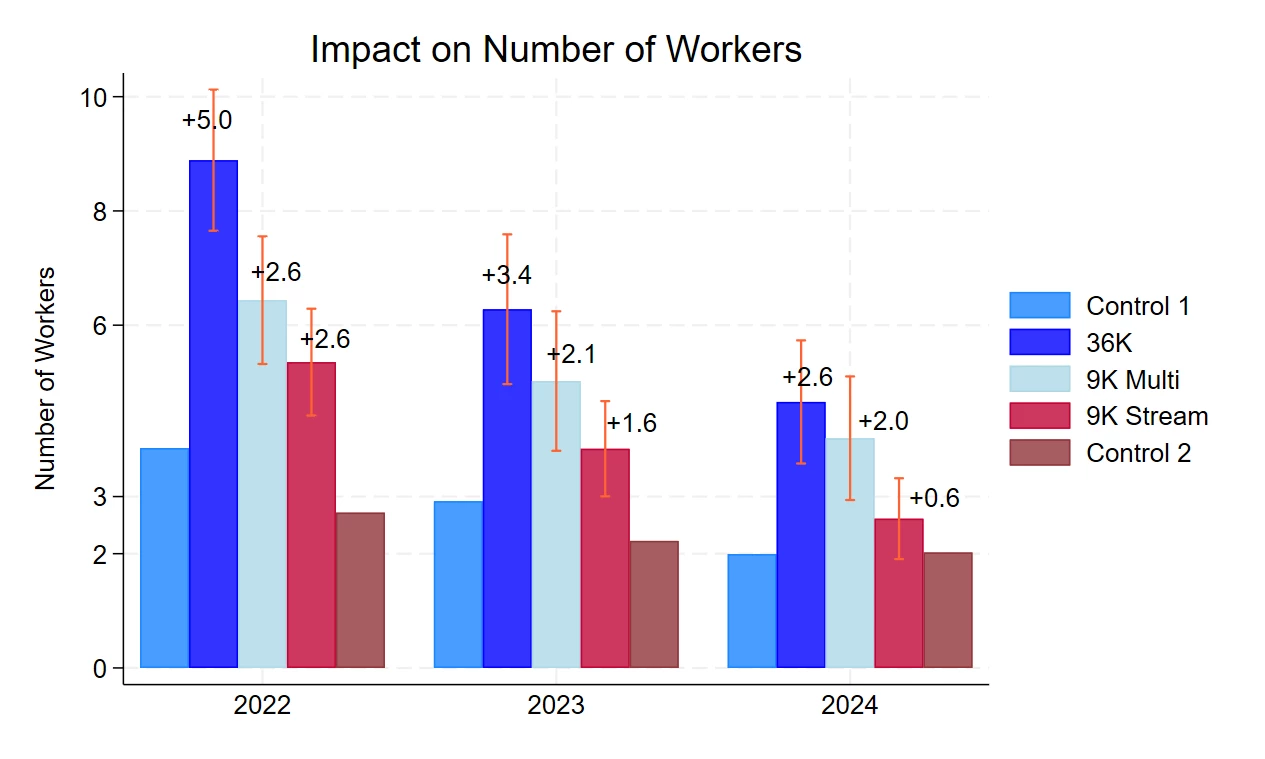
Note: Control 1 is the control group for the multiple stage experiment, Control 2 for the streamlined experiment.
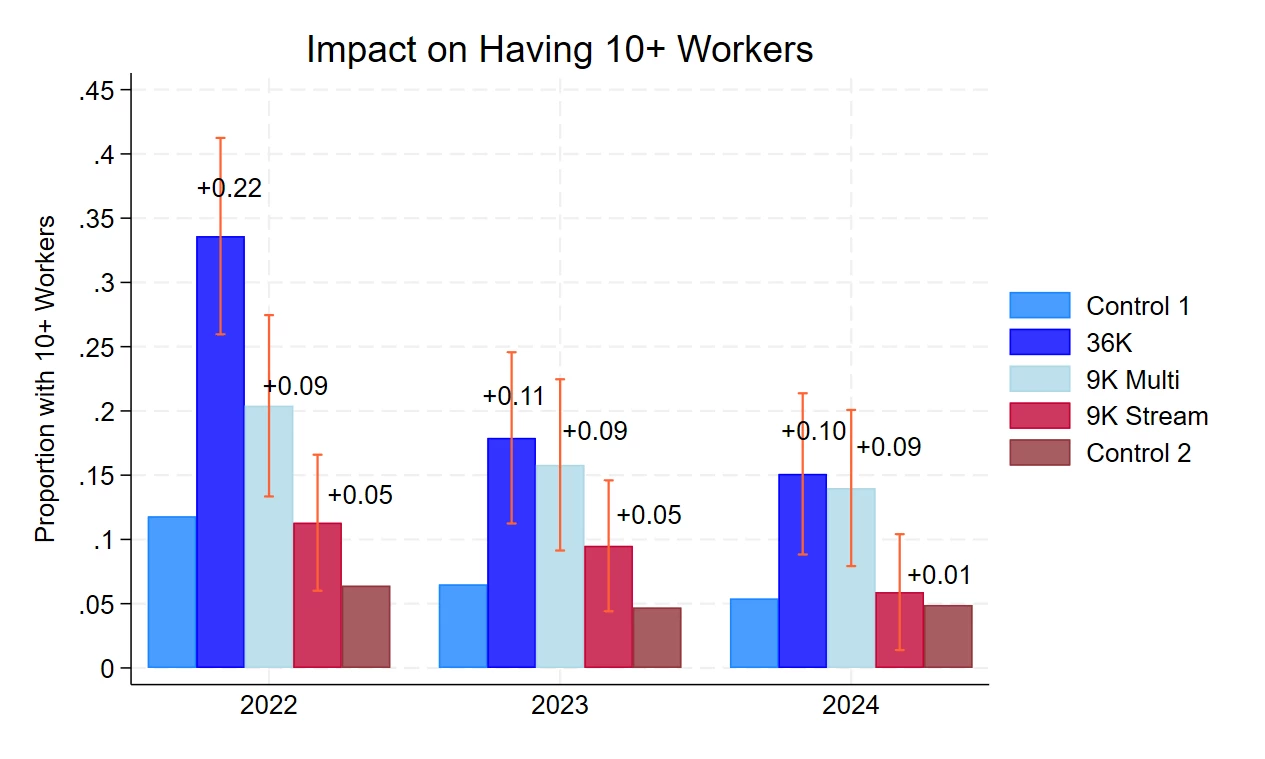
Recall how rare it is to get firms to having 10 or more workers in Sub-Saharan African countries (<2% of all firms). Figure 2 shows the larger grants led to a 22 percentage point increase in the likelihood of having 10 or more workers in the first year, twice that of the 9K multi-stage grant, but that after 3 years the impact is similar at 9-10 percentage points for both grants. Again the streamlined grant has smaller effects that do not persist.
Figure 2: The Competition Spurred the Generation of Firms with 10+ Workers
These increases in employment and firm size in the multi-stage grant firms are accompanied by sustained impacts on firm sales and profitability, whereas there is little impact on sales and profitability for the firms getting the streamlined grant. The 36K grant increases monthly sales by $982 (69%), and monthly profits by $211 (60%), while the 9K multi-stage grant increases sales by $839 and profits by $183. We cannot reject equality of these impacts, and can reject the impacts are four times as large for the bigger grant.
Why do we see these results?
The extent to which the 36K grant would deliver different results from the 9K grant depends on whether there are indivisible investments that this larger grant allows to be financed. We see that instead the two grants tended to be spent proportionally on similar items. The 36K group spent a lot of their grant on short-term inputs like rent, raw materials, and worker salaries. This temporarily increased firm size, but did not generate much more in profits than with the 9K multi-stage grant, and so over time they shrank their scale back. Likewise, the winners of the streamlined 9K grants also purchased inputs and hired workers, but weren’t able to sustain higher sales, and so don’t stay much bigger than the control group.
This suggests that selection matters a lot- the top firms making through the multi-stage selection process have more ability to grow than the applicants in the streamlined process (who have already done a lot of self-selection into applying online, have had the bottom tail screened out, and have self-selected into submitting a business plan). But conditional on getting into the winning group of the multi-stage competition, it does not seem that 36K helps firms a lot more than 9K does. Note that in Nigeria I found that conditional on getting to a semi-final round, it was really difficult for either judges or machine learning models to predict which firms would grow most. But here it does seem that while judges may not be able to predict well which specific firms will do best from among top candidates, they are able to identify a pool of high-potential firms that have a higher impact of grants.
Key policy take-aways
1. There are entrepreneurs out there who have the ability to grow bigger firms, and who just seem to lack capital. Finding ways to identify and support these high growth entrepreneurs then is important for generating jobs.
2. Design can matter a lot for how many jobs are created. Ex-ante it was not obvious what the right amount of money was to give, or whether the extra time and logistics of the multi-stage process were worth it. We calculate that the $13.5 million spent on the grants yielded 1,313 jobs remaining after 3 years from the 750 firms supported. But if the 36K grants were split into 9K grants, and they were all given to firms like the average multi-stage winner, 3,042 jobs could have been generated with the same money.
Source : World Bank