


Tokenised finance has moved from the margins of crypto markets to the centre of the policy agenda. Central banks, regulators, and market participants are debating how far it could reshape the issuance, trading, and settlement of securities, including what this would mean for financial markets and monetary policy. This column argues that while tokenisation offers considerable promise — including near-instant settlement, round-the-clock operations, and higher velocity of liquidity and collateral — the transition to a tokenised world will not be frictionless. The coexistence of 24/7 on-chain systems with traditional off-chain infrastructures could create new challenges for market functioning and monetary policy implementation.
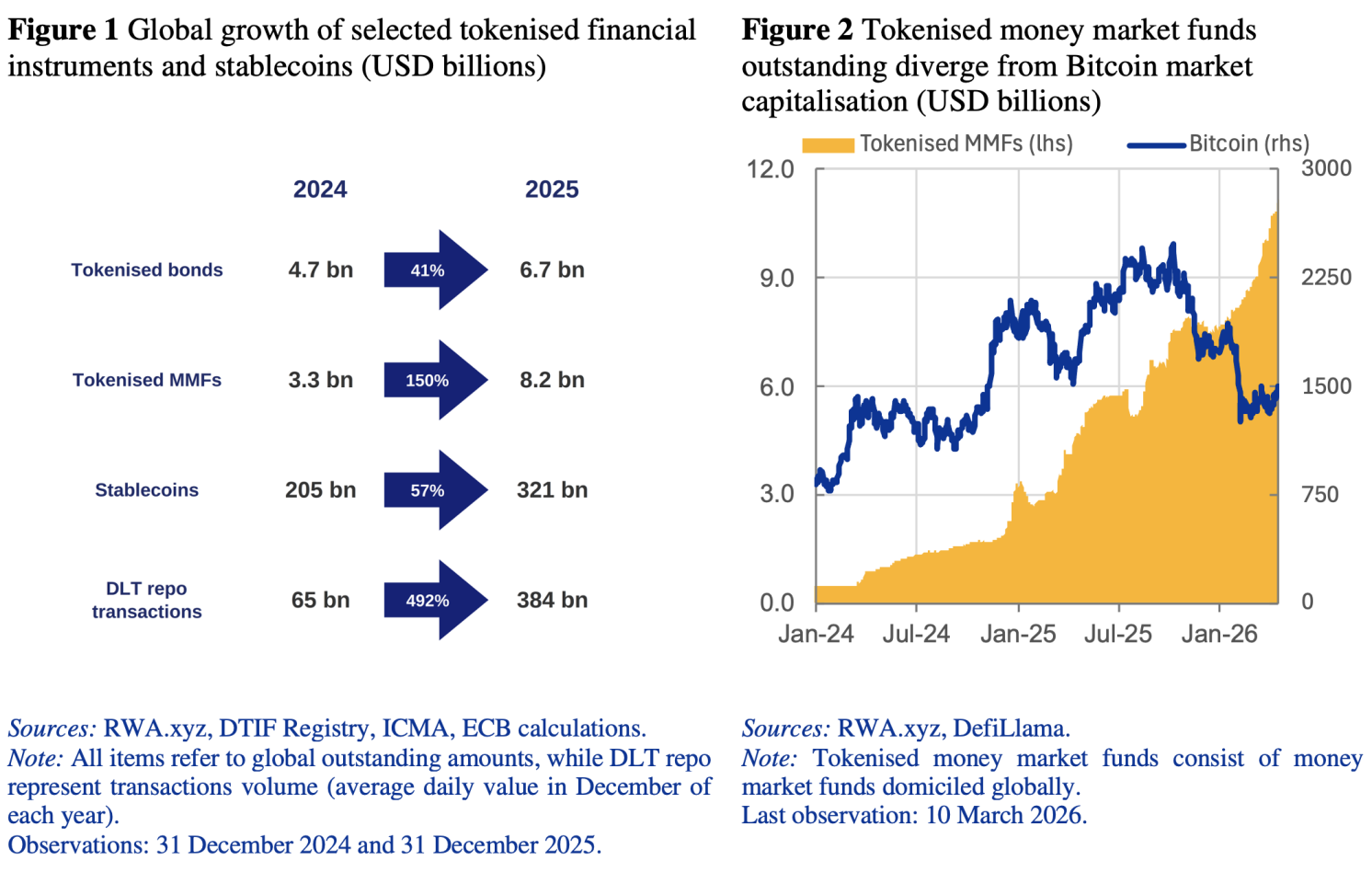
Distributed ledger technology (DLT) applications in finance have expanded rapidly from a near-zero base to concrete use cases in core markets. From its initial natively on-chain playground illustrated by decentralised finance (DeFi), tokenised finance is developing fast by bringing ‘real-world assets’ to the blockchain, i.e. relying on the tokenisation of traditional financial instruments (Figure 1) including central bank money and deposits. This column zooms in on the growth dynamics behind tokenised finance and its implications for the plumbing of financial markets, notably via the additional linkages it creates with conventional financial markets beyond those already established between stablecoins and money market instruments (Barthélemy et al. 2025, Ahmed and Aldasoro 2025, Altavilla et al. 2026).
Tokenised finance is transitioning from experimentation to early adoption
Tokenised finance offers perspectives to make finance more efficient, enabling it to operate around the clock and centralising the full lifecycle of financial instruments on digital ledgers, instead of relying on multiple systems that currently require information to be transmitted, verified, and reconciled. Transactions may be programmed in smart contracts and settled atomically, i.e. with cash and asset legs either settled together or not at all, hence reducing settlement risk (Cipollone 2026).
Collateral mobility is arguably one of the most promising use cases for tokenisation, with the intent to improve trading, settlement, and post-trade processing of repo transactions. It makes possible the near-instant transfer of securities on a 24/7 basis across time zones and therefore enhances both collateral mobility and liquidity management relative to repo on traditional rails, reducing the need for buffers. According to the International Capital Market Association (ICMA), the average daily turnover in distributed ledger technology repo had reached about $370 billion per day in the last months of 2025 (ICMA 2026).
Among real-world assets, tokenised money market funds (TMMFs) stand out as one of the fastest-growing segments (Born et al. 2026). Driven by large institutional asset managers alongside digital-native entrants, they currently bring on-chain around $10 billion (€8.8 billion). Tokenised money market funds offer a regulatory-compliant, yield-bearing tokenised instrument that can serve both liquidity and collateral management purposes (Aquilina et al. 2025). The growth of these institutional use cases may also help explain why since mid-2025 the outstanding amount of tokenised money market funds has decoupled from Bitcoin’s price dynamics (Figure 2), suggesting tokenised finance follows its own dynamic, distinct from the boom-and-bust cycles of crypto assets.
The coexistence of tokenised and traditional rails will create new market functioning challenges
Despite this momentum, tokenised markets remain very small relative to global capital markets. A sample of market participants surveyed by the Eurosystem (banks, institutional investors, and debt management offices) expects that it could take five to ten years for tokenised solutions to become dominant for issuance, settlement, and trading (ECB BMCG 2026). This partly reflects that, so far, adoption has been held back by mutually reinforcing barriers (Madouros 2026). These include the absence of a widely adopted tokenised cash settlement asset, on-ramp/off-ramp funding costs related to fragmentation, still-thin secondary market liquidity of tokenised securities, and limited interoperability across distributed ledger technology platforms, as well as legal uncertainty and a lack of international standards. Should these barriers be overcome, adoption could accelerate. Recent industry projections suggest that the coexistence of 24/7 tokenised markets and traditional infrastructures is likely to be a lasting feature, impacting the market plumbing during this transition phase, before a new steady state is found.
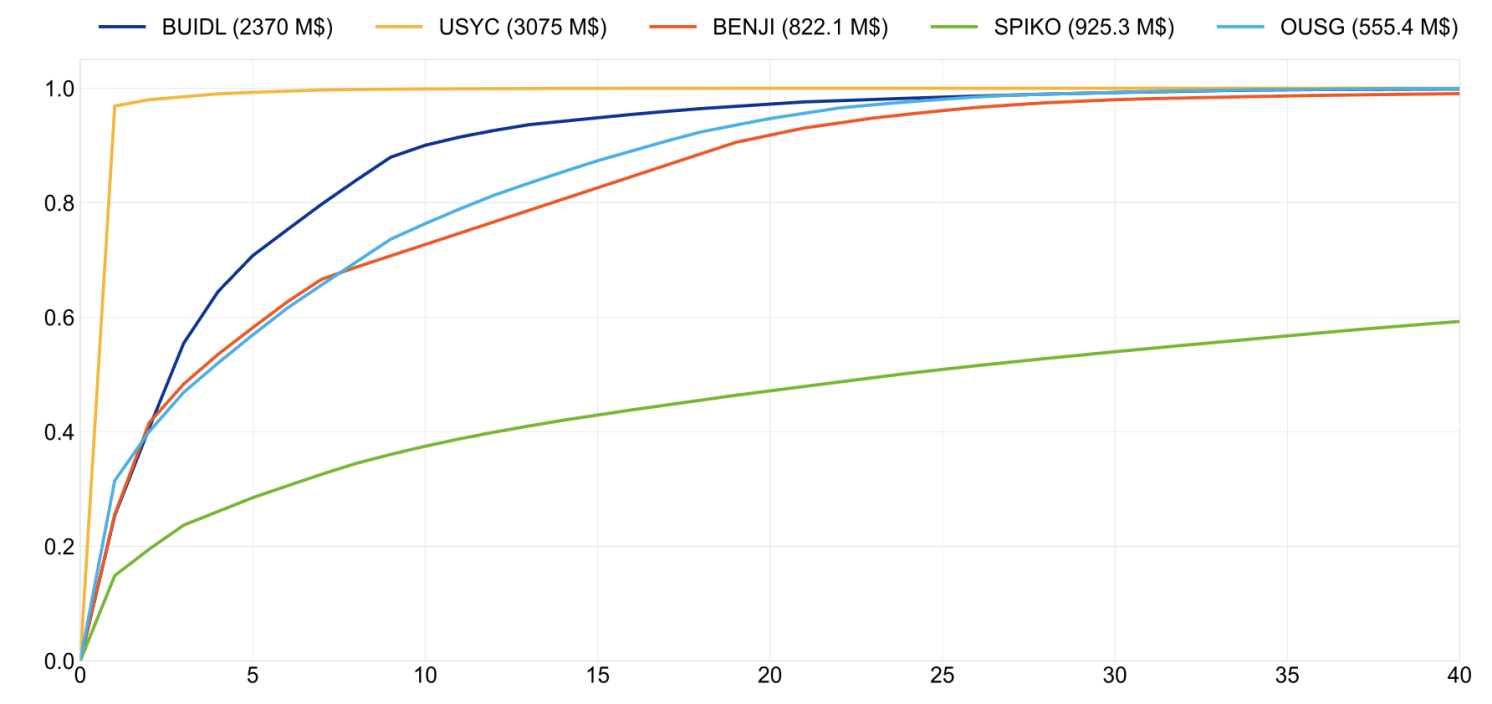
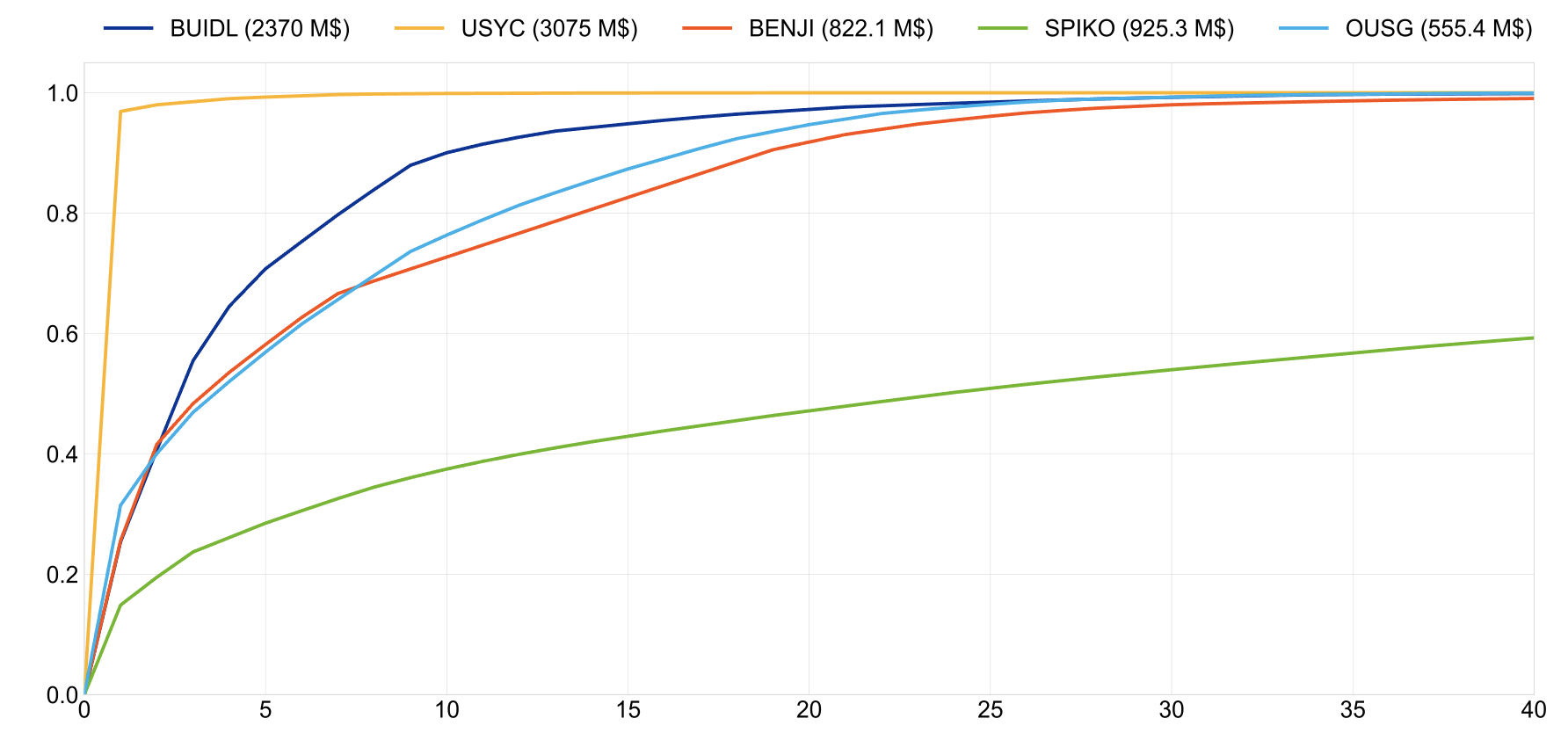
Reflecting the nascent status of tokenisation and the lack of interoperability, but possibly also more structural frictions, tokenised markets exhibit at this stage considerable fragmentation across protocols and blockchains, which leads to frequent violations of no-arbitrage conditions (Shin 2026). Additionally, new tokenised instruments like tokenised money market funds exhibit extreme concentration in their ownership: for instance, as of June 2026, the top five largest wallet addresses in the $2.37 billion BUIDL tokenised money market fund hold 70% of the fund’s shares (Figure 3).
Figure 3 Concentration of tokenised money market fund investors – Lorenz curves
(x-axis: number of wallet addresses ranked by holding size; y-axis: share of total holdings; legend: market capitalisation)
Sources: RWA.xyz, ECB calculations.
Note: Analysis based on wallet-level data. BUIDL: BlackRock USD Institutional Digital Liquidity Fund ; USYC: Circle USYC; OUSG: Ondo Short-Term US Government Bond Fund; BENJI: Franklin OnChain U.S. Government Money Fund, SPIKO: Spiko EU T-Bills Money Market Fund. Last observation: 17 June 2026.
In the long run and as it scales, tokenisation should support financial market liquidity, including in segments where currently low issuance and limited investor participation still hold back adoption, for instance in tokenised bonds (ECB BMCG 2026). For some time, however, the current state of frictions may impair price formation and arbitrage both within tokenised markets and between tokenised and traditional ones.
Tokenised finance may also expose traditional money markets to greater volatility and shocks. Stablecoin issuers are already significant holders of US Treasury bills, and a nascent literature has found a measurable price impact on their yields, especially in periods of market stress (Ahmed and Aldasoro 2025). Understanding how investors react to shocks and substitute between tokenised and traditional instruments matters for price impact, financial stability, and monetary policy transmission (Schnabel 2026a).
Implications for monetary policy implementation: Rate controllability and demand for reserves
Monetary policy implementation relies on the controllability of a range of short-term interest rates. Against this background, the proliferation of different forms of remuneration in ‘money-like’ tokenised instruments warrants monitoring. While existing regulations (both the Markets in Crypto-Assets Regulation (MiCAR) in the EU and the US GENIUS Act) prohibit stablecoin issuers from paying interest directly to token holders, tokenised finance offers a wide range of remuneration alternatives, via rewards, staking, or yield-bearing instruments such as tokenised money market funds.
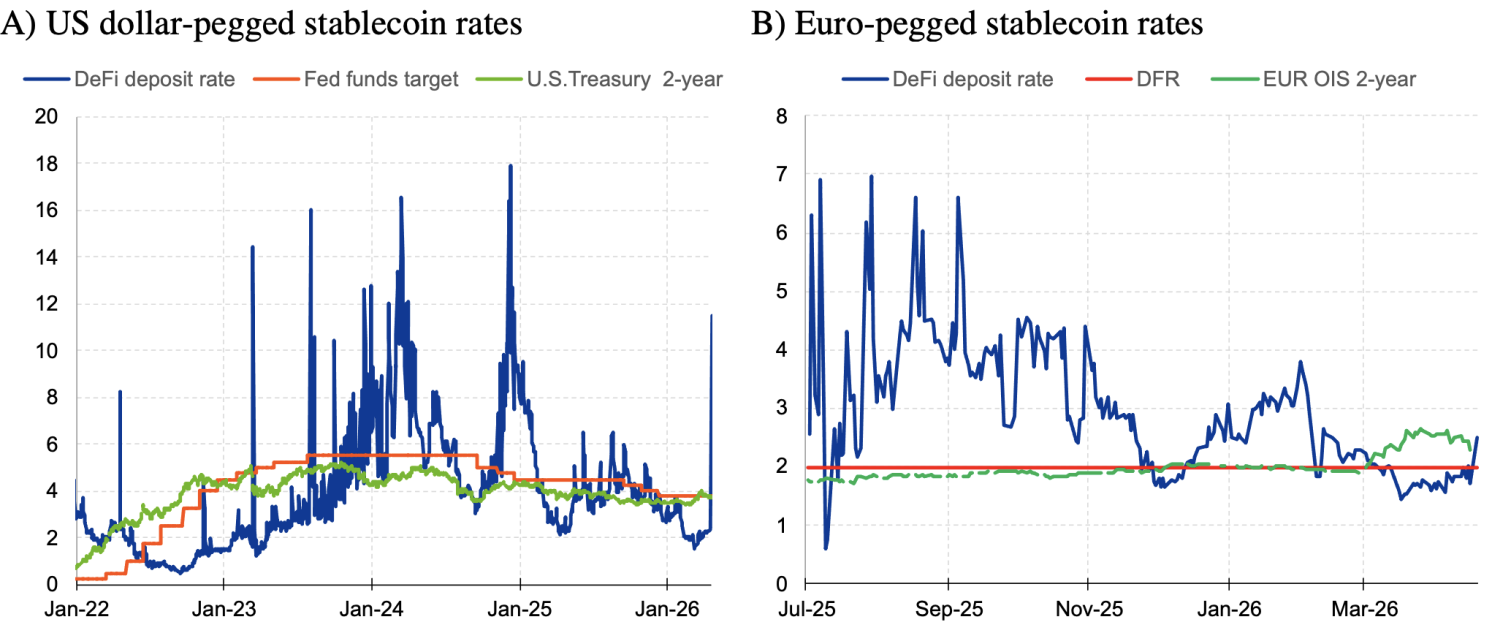
The extent to which these returns remain anchored to monetary policy rates currently varies across tokenised finance segments and instruments. Rates on tokenised money market funds and tokenised versions of existing fixed-income instruments have generally moved in line with money market and policy rates. In contrast, the most striking example of disconnect is the interest rates earned on stablecoins in decentralised finance lending protocols, where fiat-pegged stablecoins can be lent against crypto collateral, with no anchor to central bank policy rates. In a recent ECB working paper, Barbon et al. (2026) show that, over the past five years, decentralised finance interest rates on US dollar-pegged stablecoins have been highly volatile and have repeatedly switched between being well above and below the Federal Reserve’s policy rate. For euro-denominated stablecoins, the divergence from the ECB’s deposit facility rate has followed a very similar pattern (Figure 4).
This persistent disconnect in decentralised finance reflects fundamental limits to arbitrage: transferring funds between decentralised finance and traditional money markets is costly and subject to tax and Know Your Customer (KYC) requirements, and stablecoins are not convertible at par with reserves. To the extent that borrowers in decentralised finance are using the protocols to build leverage, decentralised finance rates also reflect the boom-and-bust cycle in appetite for crypto assets and different types of risks, something most often unrelated to monetary policy. Decentralised finance remains small relative to conventional money markets, but it illustrates the potential broader challenges for rate controllability if tokenised finance, associated with the use of stablecoins in wholesale financial markets, scales up but market segmentation and limits to arbitrage persist.
Figure 4 Decentralised finance interest rates of stablecoins and short-term interest rates (percentage)
Sources: Aavescan, Bloomberg, Barbon et al. (2026).
Notes: The figure displays the time-series evolution of the volume-weighted average DeFi deposit rate for the USDC, USDT, and DAI in Aave v2/v3 compared to Fed funds target, SOFR, and two-year US Treasury yield (Panel A), and EURC stablecoin in Aave v3, compared to the DFR, the GC Pooling overnight repo rate, and the two-year OIS (Panel B). It starts with the introduction of EURC in July 2025 in the lending protocol. Last observation: 20 April 2026.
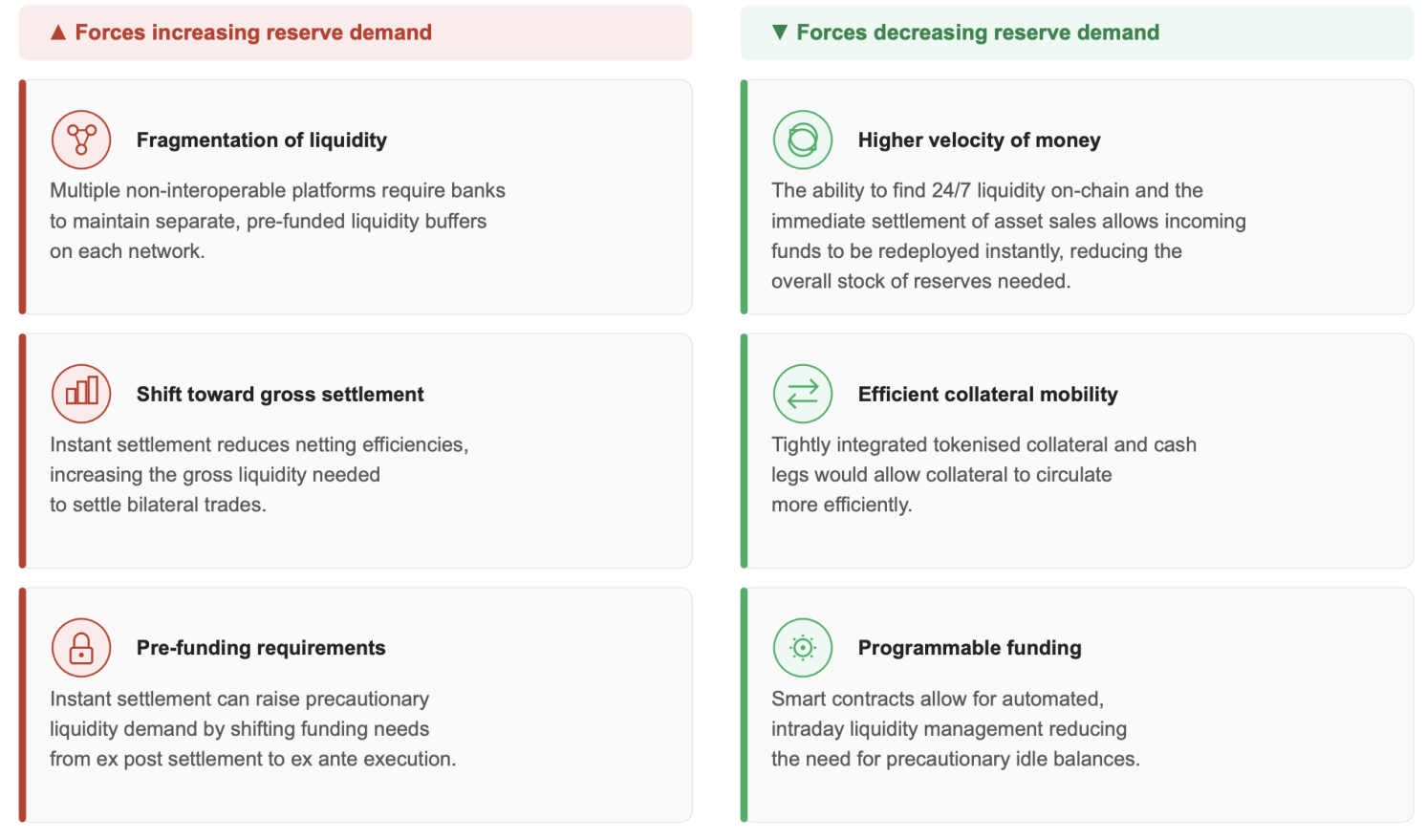
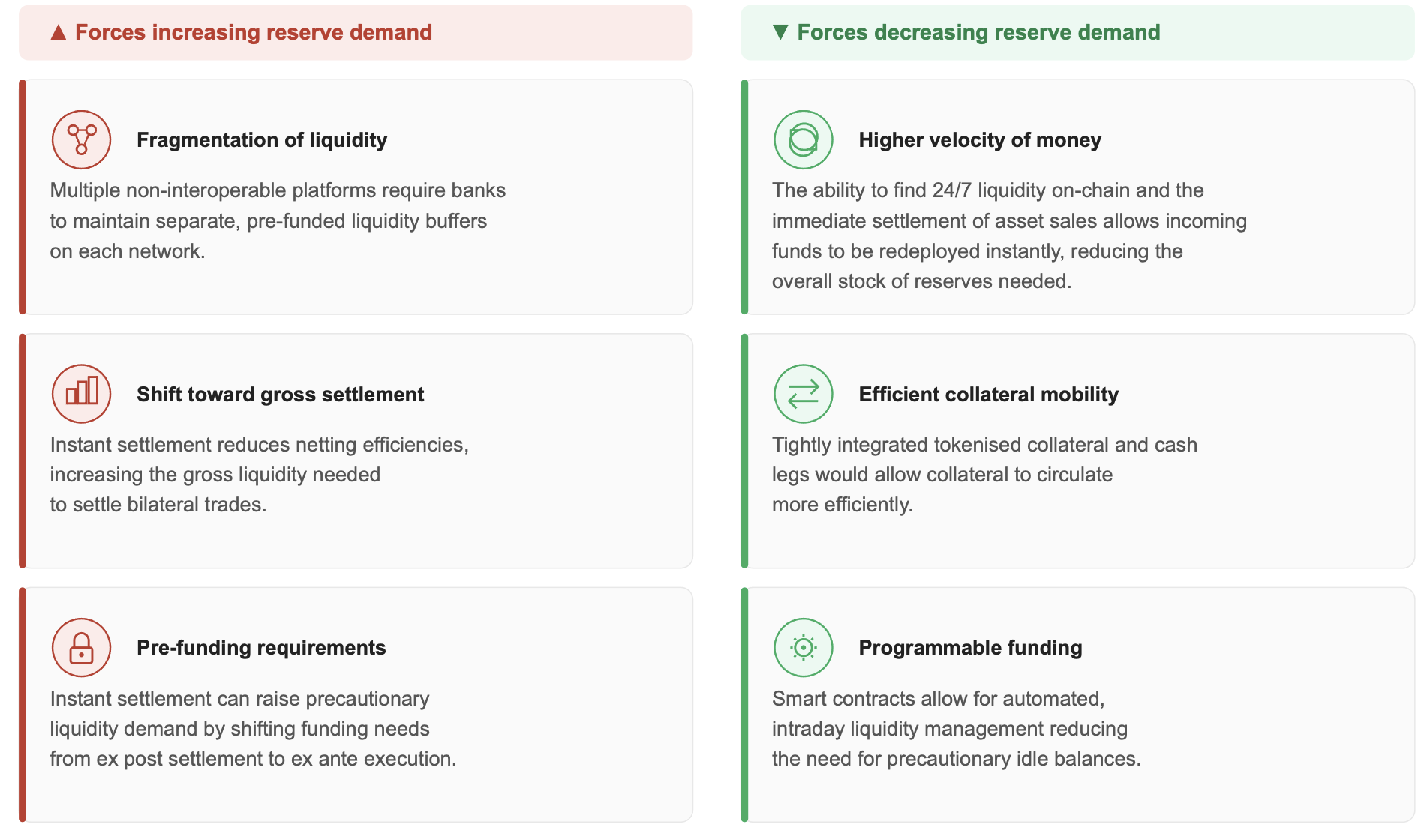
The widespread adoption of tokenised finance is also likely to affect banks’ demand for central bank reserves, although the aggregate net effect remains uncertain. On the one hand, if repo transactions can settle within seconds, 24/7, banks could manage liquidity needs more dynamically and hold lower precautionary reserves. Programmability could allow a smooth and efficient re-use of liquidity and collateral in multiple and sequential streams of pre-programmed transactions. On the other hand, settling everything instantly could mean less netting, requiring banks to pre-fund cash positions and pre-position collateral continuously, especially in the absence of deferred netting mechanisms that economise on reserves in traditional payment systems (Duffie et al. 2026) (Figure 5). A plausible scenario is one in which reserve demand rises during the transition phase – as fragmentation and pre-funding constraints dominate – before declining as interoperability and efficiency gains take hold. More broadly, the net impact will also depend on how central bank liquidity facilities evolve in a tokenised ecosystem.
Figure 5 Potential drivers of reserve demand under tokenised finance
Achieving a technology-neutral monetary policy implementation
As tokenised finance grows, central banks must ensure that monetary policy implementation remains effective. Their operational frameworks might need to adapt to stay technology neutral, so that the same asset receives the same treatment whether it sits on distributed ledger technology or on traditional rails.
The Eurosystem has started moving in this direction and has accepted, since March 2026, marketable assets issued in central securities depositories using distributed ledger technology as eligible collateral for Eurosystem credit operations. It will also explore whether, how, and under what criteria assets issued using distributed ledger technology and not represented in eligible securities settlement systems could in the future become eligible and be mobilised as Eurosystem collateral.
More broadly, tokenised financial markets can only scale safely if they can settle in central bank money, which is the safest, most trusted, and most scalable cash settlement asset for wholesale transactions. Put simply, if markets move on-chain, central banks must move with them (Duffie 2026, Schnabel 2026b). Making tokenised central bank reserves available would also modernise monetary policy implementation, collateral management, and liquidity provision, thereby fostering financial stability.
In the Eurosystem, the launch of Pontes on 21 September 2026 enables wholesale transactions in tokenised assets to be settled in central bank money. Beyond Pontes, the Appia initiative aims to shape the development of a European tokenised financial ecosystem in which central bank money continues to play a central role, with a blueprint to be delivered by 2028 (Vlassopoulos 2025). Another enabler for the tokenised finance ecosystem is the availability of sovereign and supranational securities in tokenised form, whether issued directly on a blockchain or created by tokenising existing securities. Tokenised safe assets, combined with tokenised central bank money, would provide the anchor around which use cases and private-sector issuance can develop. Central banks can help steer the path towards better markets by providing tokenised central bank money as well as supporting technology neutrality in their operational frameworks.
Source : VOXeu