


Every year, the world adds floor space equivalent to a city the size of Paris roughly every five days. Most of that construction happens in countries facing steep combinations of climate risk and rapid urban growth, and much of it is governed, in principle, by building regulations. Whether those regulations exist, what topics they cover, and whether they are enforced determines whether buildings are safe, disaster-resilient, energy-efficient, and accessible, or whether they lock in decades of risk.
The challenge has been that nobody could see the global picture clearly. Building regulatory systems — codes, planning rules, energy standards, inspection regimes — have been studied in fragments, across different reports, methodologies, and country samples. A policymaker wanting to understand their country’s regulatory status and learn from peer experiences had to stitch together scattered documents never designed to be read side by side.
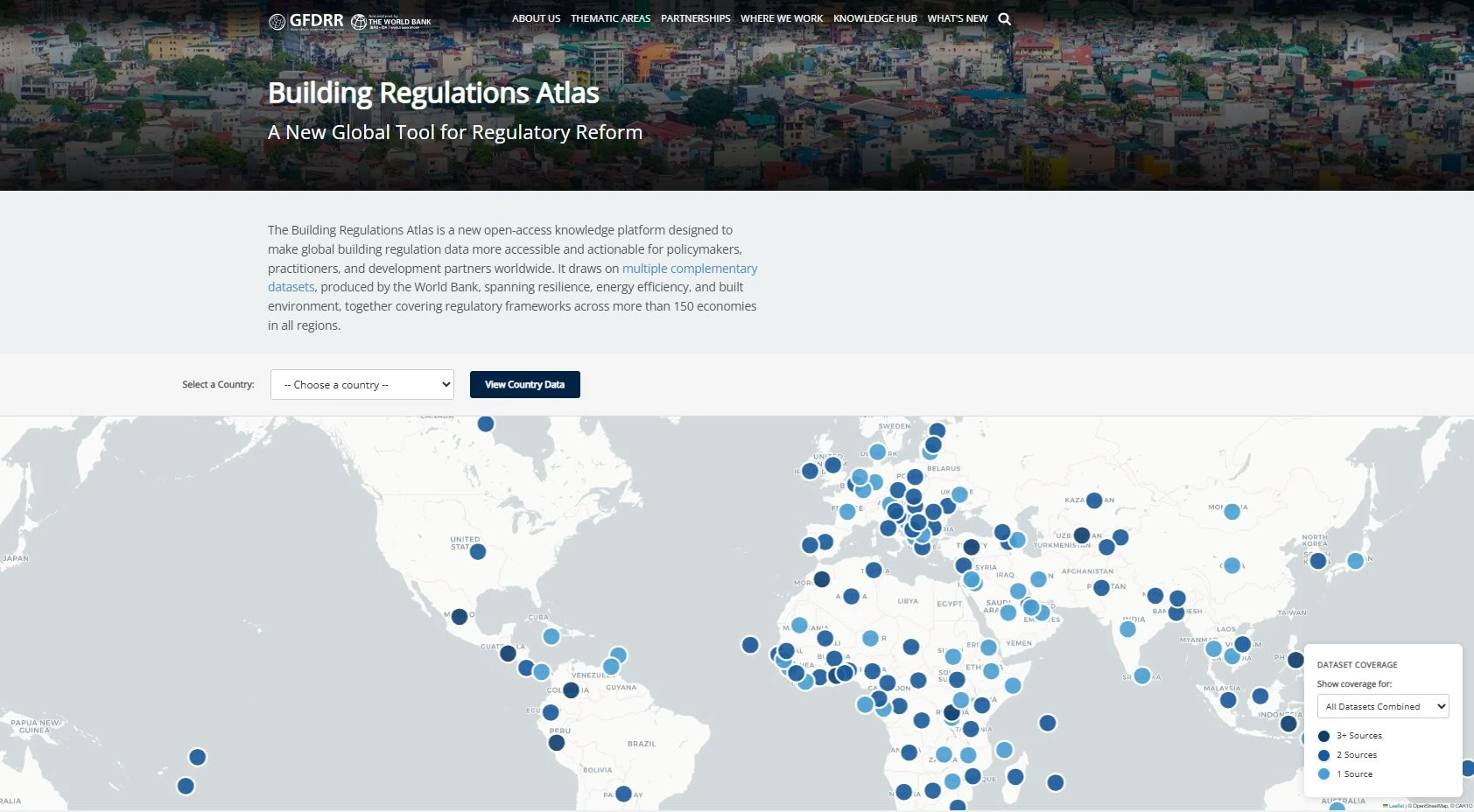
The Building Regulations Atlas is the World Bank Group’s answer to that challenge: a free, open, interactive, web-based tool that consolidates building regulatory data across 152 economies into a single map and a consistent set of country profiles.
The case for a global baseline
Building regulations are a niche topic, yet one of the most critical policy instruments for urban resilience and business environment. When a country seeks to improve its regulations, approval processes, or compliance capacity, it needs to know where it stands, what gaps exist, and where reforms can have the greatest impact. Consolidated data benchmarked against global good practices has rarely been available in one place. The Building Regulations Atlas changes that, offering countries a powerful tool to navigate their own reform journey.
Inside the Atlas
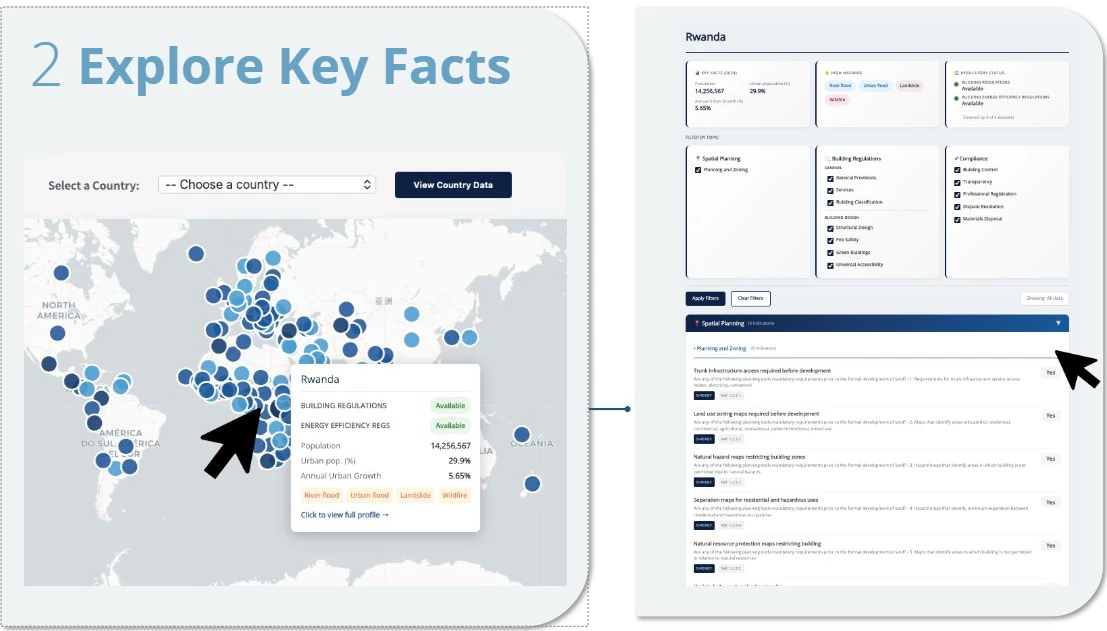
The Atlas organizes 373 indicators across three regulatory pillars that mirror the building value chain:
- Spatial Planning — zoning rules governing where building is permitted, accounting for land use, hazard maps, and environmental impacts.
- Building Regulations — the technical core of regulatory instruments, spanning structural design, fire safety, green buildings, and universal accessibility.
- Compliance Mechanisms — the foundational systems that ensure rules on paper are applied in practice: building control and inspection, professional registration, transparency, and dispute resolution.
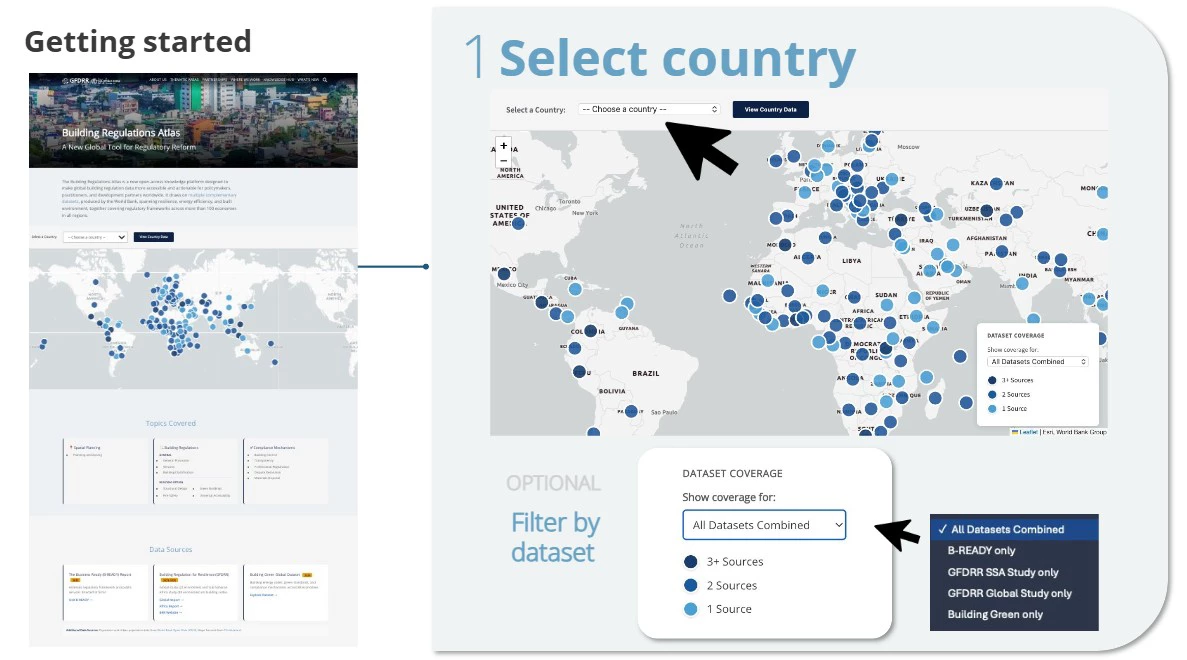
The Atlas draws on four complementary, methodologically rigorous datasets produced by the World Bank Group — including the two analytical reports produced by the Global Facility for Disaster Reduction and Recovery’s (GFDRR) Building Regulation for Resilience thematic area, (Global and Sub-Saharan Africa regional), the Business Ready 2025 report, and the Building Green Global Dataset 2025 — each traceable to its original source. Coverage varies by economy; the map itself signals how thoroughly each country has been studied, distinguishing those covered by one, two, or three or more sources.
Turning data into action
As a benchmarking and diagnostic tool, the Atlas helps countries understand the status of their own regulatory framework, learn from regional peers or aspirational comparators, identify critical reform areas, and translate findings into a clear roadmap for action.
As a way to establish a regulatory baseline quickly, it turns what once required a bespoke review into a matter of minutes, helping target deeper analysis where gaps are clear, and providing a shared, citable reference for framing technical assistance. Country data can be exported directly, feeding into existing analytical work rather than replacing it.
The World Bank Group stands ready to support countries taking initial steps through policy dialogues, stakeholder consultations, and technical and financial resources, and working toward a built environment that is safer, greener, and more inclusive.
Built to grow
The Atlas is designed to grow: new economies, refreshed datasets, and added indicators can be incorporated over time, deepening coverage without fragmenting it. Its underlying aim is simple: to make the global state of building regulation visible, and actionable.
Explore the Building Regulations Atlas. For more on the underlying work, see Business Ready, the Building Regulation for Resilience program, and the Building Green Global Dataset.
This work was supported by Global Facility for Disaster Recovery and Reduction, and its Japan – World Bank Program for Mainstreaming Disaster Risk Management.
Source : World Bank