


Nearly 1 in 5 people globally are at high risk from climate hazards, living in areas exposed to extreme weather with limited capacity to recover from its impacts. Extreme weather events are on the rise, disrupting lives, damaging infrastructure, destroying jobs, and threatening development gains. But not everyone is equally affected. Those in the most exposed areas, especially people with limited resources, bear the greatest burden and need action most urgently.
Can we identify who they are, where they live, which hazards they face, and what they need to become more resilient? In this post, we introduce a new indicator designed to answer exactly these questions. This new World Bank Group Scorecard Vision indicator will improve accountability by tracking progress toward a more resilient world.
Who is exposed and vulnerable to climate hazards?
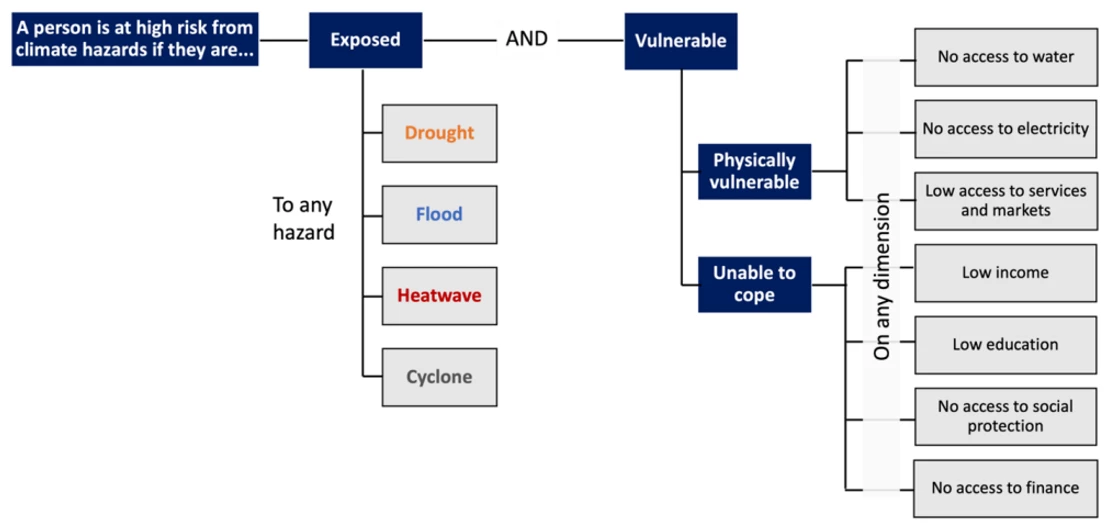
Unlike other methods that quantify climate risk by modelling probabilistic economic losses (e.g., CDRI’s GIRI) or calculating a country level index from various sub indicators (e.g., ND-GAIN), our indicator takes a people-centered approach. It identifies the population at high risk based on both exposure — whether people live in areas exposed to severe droughts, floods, heatwaves, and cyclones — and vulnerability — the propensity of these people to be adversely affected when an extreme event occurs (Figure 1). Vulnerability is assessed based on seven dimensions: income, education, access to finance, social protection, access to electricity and water, and access to services and markets. Importantly, these vulnerabilities reflect structural inequalities and deprivations that are development challenges, not only resilience challenges; but they nevertheless magnify the impact of climate hazards. Though everybody faces some level of risk from extreme weather events, we focus on extreme vulnerability with this indicator — in a parallel with the extreme poverty indicator — so our thresholds are voluntarily low, to identify the people who are the least able to manage and recover from climate shocks.
This approach allows for a detailed, granular understanding of risk that captures disparities within and across countries and communities. A person is considered “at high risk” if they live in a hazard-prone area and are highly vulnerable on at least one of the dimensions we consider.
Figure 1. Identifying people at high risk from climate hazards
One in five people are at high risk from climate hazards today
The results of the indicator are stark: globally, over 4.5 billion people — more than half of the world’s population — are expected to encounter at least one major climate hazard within their lifetimes (Figure 2). This result confirms that the challenge is not to prepare for if a climate occurs, not for when it occurs.
Figure 2. Exposure hotspots exist in every region
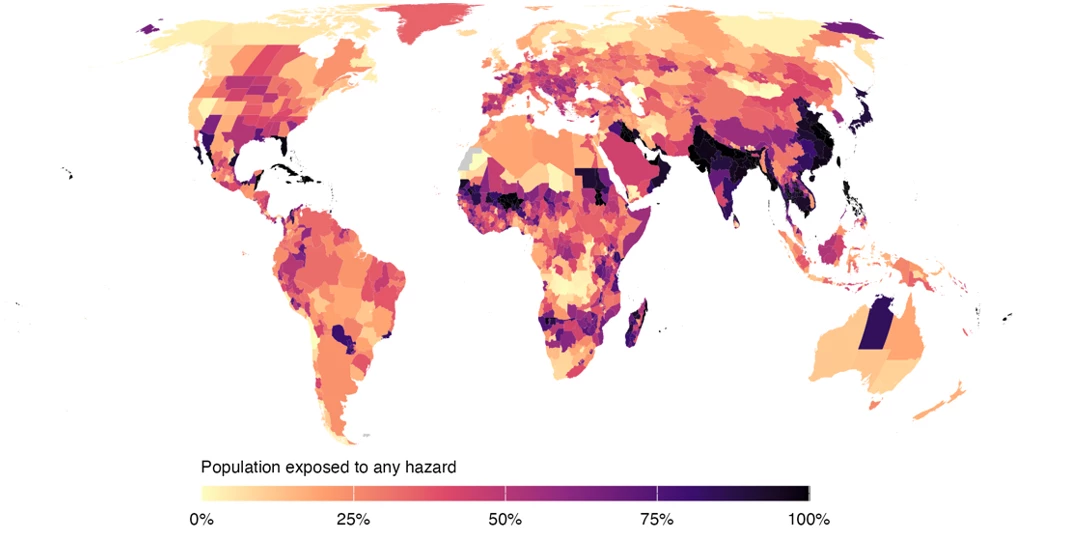
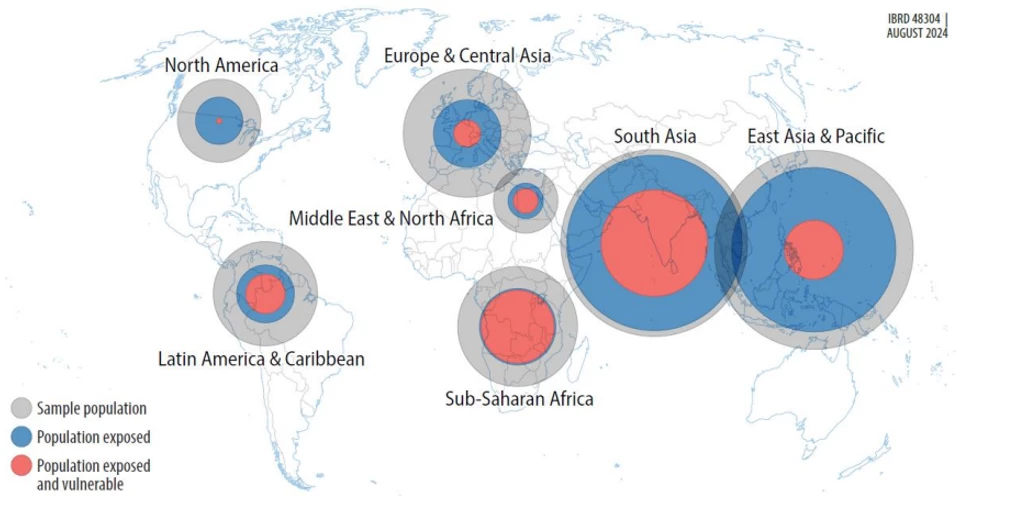
Even more striking, especially considering our focus on extreme levels of vulnerability, is the fact that nearly 1 in 5 people globally are at high risk. This corresponds to 1.2 billion people in countries with complete data, or 1.5 billion if we extrapolate to the global population.These people are both likely to experience an extreme event and highly vulnerable, meaning they would struggle to recover from its impacts. Globally, more people are exposed to heatwaves than to the other hazards considered. However, results indicate most of the rural population are exposed to agricultural droughts, and often vulnerable on more than one dimension. Vulnerability is especially high in Sub-Saharan Africa, with 90 percent of the population highly vulnerable in at least one dimension. While exposure rates are higher in South and East Asia, vulnerability is lower, thanks to improved social protection and financial inclusion.
Figure 3. Almost all those exposed in Sub-Saharan Africa are also vulnerable
Improving people’s resilience to climate hazards is possible
Since 2010, global progress has been mixed (Figure 4). While the proportion of people at high risk has decreased from 1 in 3 people to 1 in 5 people, the absolute number of exposed individuals increased by 461 million. This trend highlights the urgent need for policies that go beyond managing exposure and address the root causes of vulnerability.
This indicator underscores a fundamental truth: climate impacts are not felt equally, not all risks are due to climate change alone, and vulnerability to climate shocks is often connected to broader vulnerabilities and development deprivations. By accounting not only for those exposed to hazards but also for vulnerability, this metric helps policymakers target support where it is needed most. And by counting people at risk, the indicator is a useful complement to alternatives that measure assets or value at risk, which mostly represent the losses experienced by wealthier people.
This indicator also emphasizes the urgent need for policies that address root causes of vulnerability — and the indicator’s own findings point to where those efforts should be concentrated:
- In Sub-Saharan Africa, where vulnerability is near-universal among the exposed, the most binding constraints are income poverty, limited access to finance, and weak social protection systems, policies that expand social safety nets, broaden financial inclusion, and raise household incomes are therefore the highest-priority levers.
- In South and East Asia, where exposure is high but vulnerability has been reduced through improvements in social protection and financial inclusion, the priority shifts toward sustaining and deepening those gains while investing in infrastructure and access to services and markets — the dimensions where gaps remain largest.
Effective adaptation strategies must be tailored to these specific vulnerabilities rather than applied uniformly. The World Bank’s Adaptation and Resilience Flagship Report — Rising to the Challenge provides a roadmap for crafting policies that address both immediate risks and long-term resilience.
Source : World Bank