


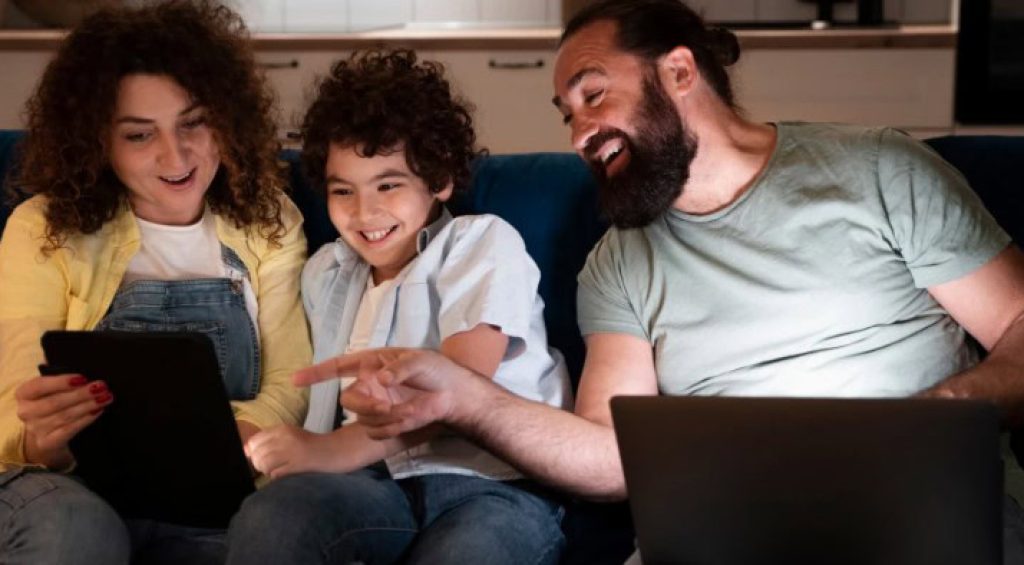
Sixteen billion. That’s how many times the popular children’s song Baby Shark has been viewed on YouTube. That’s more than twice the world’s population—and here’s what’s truly striking: 5 of the 10 most-viewed videos in YouTube’s history are content for young children. Not Bad Bunny. Not Taylor Swift. But baby sharks and buses with spinning wheels. These numbers reveal something important: early childhood is being reshaped by screens, long before Instagram or TikTok enter the picture.
Jonathan Haidt, a psychologist at New York University, recently published The Anxious Generation, documenting what he calls the “rewiring of childhood.” His argument: between 2010 and 2015, when smartphones became widespread, something began to break down. Rates of depression and anxiety among adolescents surged. More research is needed to understand the mechanisms behind this trend, but governments are reacting with concern: seventy-nine countries have already banned cell phone use in schools.
If all this is about teenagers, what about children ages 0 to 5—those who don’t yet have social media accounts but already spend hours on YouTube or with a smartphone?
That is what we set out to explore in the report Screen Time in Early Childhood Education, launched on the occasion of International Education Day. The conversation we had that day made it clear that this is not a closed debate—but there are already actions that must be taken.
The World Health Organization (WHO) recommends no more than one hour of screen time per day for children aged 2 to 5. In Malaysia, 91% of preschoolers exceed that limit. In Brazil, 69%. In China, 67%. In Colombia, 50%. This is a global issue. Why does it matter? Because during the first five years of life, the brain forms one million neural connections per second—and those connections are built through interaction: conversations, play, exploration. The question is not simply whether screens are “good” or “bad.” The question is: what are they replacing?
A meta-analysis by Madigan et al., covering 42 studies with 18,905 children, found a clear association: more screen time, less vocabulary. Children exposed to more than two hours per day are 2.3 times more likely to experience attention problems. And according to Akacem et al., blue light suppresses approximately 88% of melatonin in preschoolers, affecting their sleep.
Why do we end up handing them the phone?
Florencia López Boo, an early childhood expert at New York University, revealed that in Latin America and the Caribbean, only 15% of children ages 0 to 2 attend daycare, compared to 43% in OECD countries. Schedules don’t align with work hours, distances are long, and quality is uneven. Combined with growing access to smartphones, “this creates an explosive cocktail of screens on the bus, at home, and even in the stroller—a smartphone or tablet that becomes a babysitter,” she explained.
This is not just parents’ fault. Screens are designed to be irresistible. There is no way a wooden toy can compete with the algorithm of a digital platform.
What Works
Behavioral science offers clues. Every habit has three parts: cue, routine, and reward. The habit of placing a child in front of a screen: a restless child (cue), we hand over the tablet (routine), we get peace (reward). We cannot eliminate the cue or the reward. But we can change the routine by following these principles:
- Have alternatives ready (crayons in the bag).
- Design the environment (screens in the drawer, books on the table).
- Start small (one screen-free meal this week).
- Do it as a community.
Does it work? According to 16 controlled trials, dialogic reading—where the adult asks questions while reading—significantly improves expressive vocabulary. Statistically, the improvement is comparable to the difference between a child who says, “I want water,” and one who says, “Mom, I’m thirsty—can you give me some water?” It’s free, requires no technology, and works in any language.
What Authorities, Schools, and Parents Can Do
Claudia Lago, Chile’s Undersecretary of Early Childhood Education, put it clearly: responsibility lies with adults. “Children ages 0 to 6 do not choose whether to use screens. That is a decision made by the adult world.” This cannot rest solely on families.
Authorities must define clear, evidence-based guidelines and support parents with public campaigns that go beyond simple warnings—offering information about the consequences of excessive screen exposure and practical advice on managing children’s time.
For mothers, fathers, and caregivers, the message is not prohibition but balance: replace the automatic use of screens with gradual alternatives, create screen-free zones and moments, and remember that small, sustained changes work better than radical transformations. The report includes practical tools: a template to create a family plan, a screen-time assessment tool, and a guide to alternative activities organized by situation.
Educational institutions, for their part, can model healthy habits starting in preschool and guide families with simple, consistent messages. Educators are uniquely positioned to demonstrate concrete alternatives and create spaces where play and conversation are the norm.
At the same time, the digital industry must be regulated to limit practices that promote excessive use, such as endless autoplay and algorithms designed to keep children “hooked.”
Zero screens may not be realistic—but balance is. We are not going to remove Baby Shark from YouTube, but we can ensure it is not the only thing our children remember from their childhood.
Source : World Bank