

More than 50 years ago, Nobel laureate Theodore Schultz, a pioneer of human capital theory, offered an insight into what people need to weather the coming AI revolution.
Economists typically think in terms of static equilibria—states in which resources are optimally allocated and prices already reflect all relevant information. But real economies are never actually in equilibrium. They’re constantly bombarded with price, productivity, and technology shocks. In a seminal paper, Schultz argued that there is thus huge value in “the ability to deal successfully with economic disequilibria”—and what makes education valuable is that it builds this ability. Later work bore him out, showing that returns to schooling rise during periods of rapid technological change.
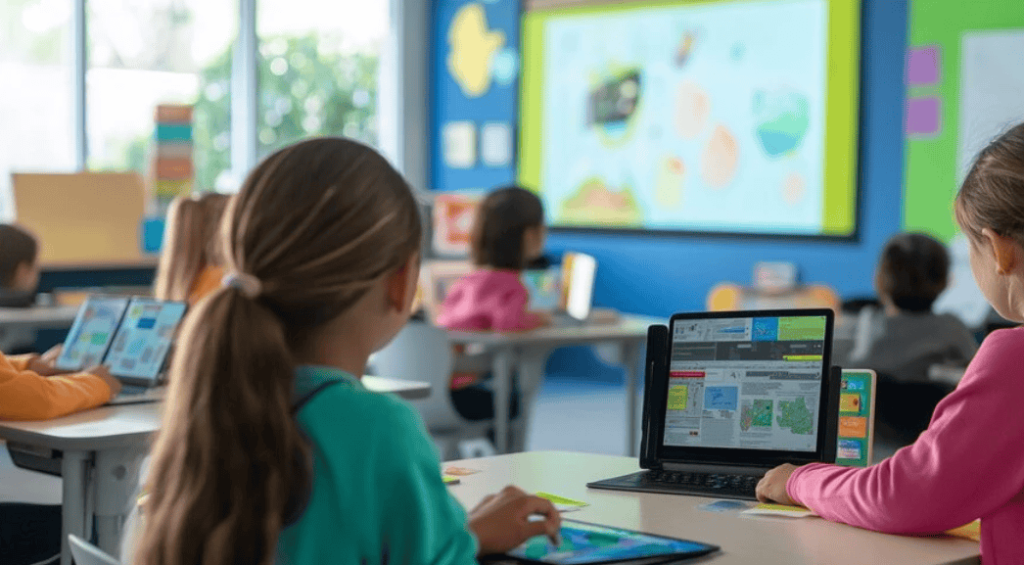
AI is now driving the fastest technological change in human history. Schultz’s work tells us that education can help people cope with the AI disequilibrium. But what kind of education?
We don’t know what specific skills the AI future will reward. The National Academies report Artificial Intelligence and the Future of Work remains one of my favorite pieces of writing on AI because it underlines the uncertainty, headlining the message that “It is impossible to predict exactly the nature of the coming changes in AI and all their effects on the economy and society.”
We can say that AI will almost certainly accelerate the pace of task obsolescence. Already, skills like coding and language translation are worth less than they were a few years ago, and new skills, like the ability to use a large language model effectively, command a high premium. Which specialized skills will be needed 10 or 20 years down the line in a world we can barely foresee is anyone’s guess. But they won’t be the same skills as today. And while workers in developing countries are on average less exposed to AI (as my work and that of others shows), AI will generate new possibilities for those ready to seize them.
So, the most valuable asset in an AI-driven economy will not be any particular skill set but instead adaptability: the capacity to learn and adapt as the landscape shifts. As Yuval Noah Harari has said, “We don’t know what skills will be needed. So the most important skill is the skill to keep learning and keep changing throughout our lives … to keep reinventing ourselves ….” In the face of rapidly changing demand for skills, we will need to roll with multiple waves of change.
Can we measure adaptability? Psychologists have proposed various indicators, but until recently we lacked a population-level measure. The OECD has now published data from 30 countries on “adaptive problem solving,” defined as “the capacity to achieve one’s goals in a dynamic situation in which a method for solution is not immediately available.” The OECD motivates the measure by the fact that “new technologies and social systems grow increasingly complex and require individuals to quickly and flexibly adapt.”
I analyzed the OECD data and found that adaptive problem solving (APS) tracks very closely with literacy and numeracy (correlation coefficients of 0.81 and 0.84 respectively). In other words, to predict an individual’s APS ability, all you need to know is their level of numeracy and literacy. More surprisingly, other variables—age, education, employment, and country of residence—have almost no additional explanatory power. At the country level, APS is extremely correlated with the average of numeracy and literacy scores, as the figure below shows.
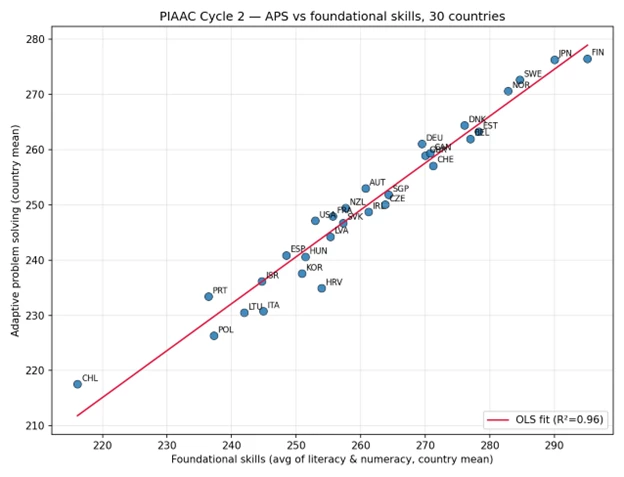
There are two ways to look at this finding. One possibility is that the high correlation reflects an underlying factor driving all three measures, e.g. this reflects general test-taking ability. Another is that there is an underlying causal relationship between the variables.
I suspect this represents at least in part a causal link—namely that literacy and numeracy provide the essential foundation for adaptability. Another way to look at the data is to see that essentially no one scores low on literacy and numeracy but high on adaptive problem solving. People who cannot fluently read and do basic math appear unequipped to adapt.
Unfortunately, vast numbers of people are leaving school without these basic skills. Seventy percent of 10-year-olds in low- and middle-income countries are unable to read and understand a simple text. As adults, they risk being left on the sidelines and will struggle to seize the job opportunities of the AI future.
This comes back to Schultz’s essential insight: education is the key to adjustment in a changing world. The skills AI will demand are impossible to pin down. But we can be sure that foundational skills—still in short supply in much of the world—will be essential. Consequently, as countries plan for how to prepare for the coming AI wave, building those skills must sit at the core of their strategies.
Source : World Bank