


1. Large gaps in internet access persist
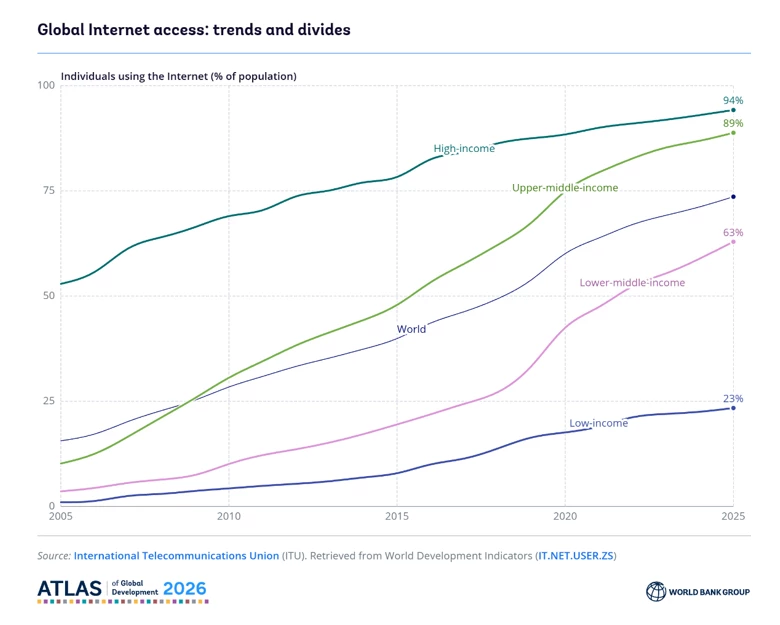
Global connectivity has expanded rapidly, from 16 percent to over 70 percent over just two decades. Still 2.2 billion people remain offline, and access remains deeply unequal across regions and income groups. In many high-income economies, internet use has become nearly universal. In contrast, less than a quarter of the population in low-income countries uses the internet.
These disparities matter because internet access increasingly shapes economic opportunity. Countries that lag in connectivity risk falling further behind in productivity, innovation, and human development.
2. Coverage does not automatically translate into connection
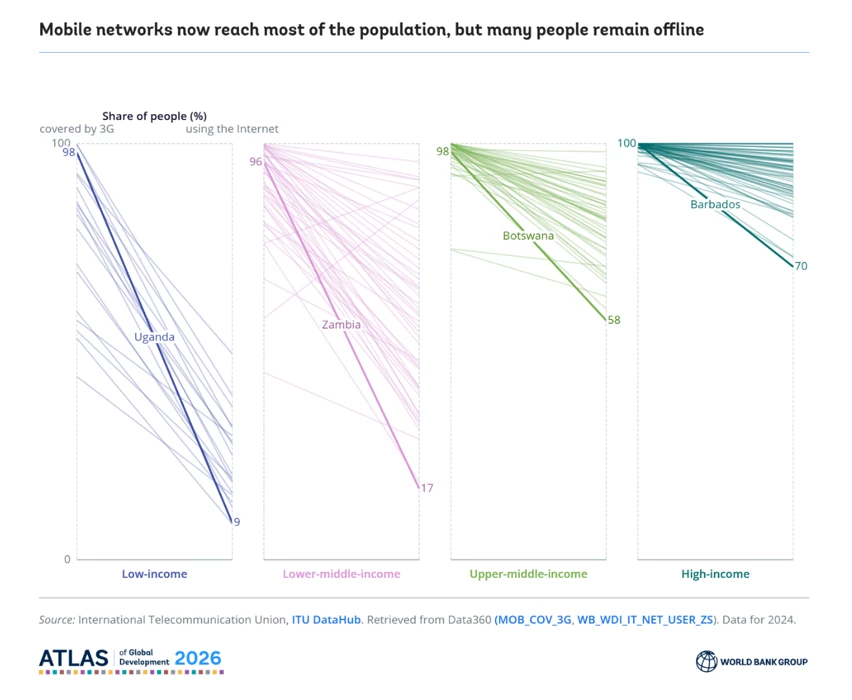
The Atlas highlights the large gap between network coverage and actual internet use.
Mobile broadband networks now reach most of the world’s population. Yet millions of people who live within coverage areas remain offline. Although over 90 percent of the global population is within reach of 3G and 4G networks, in some countries like Uganda or Zambia only a very small proportion of the population (9 percent and 17 percent) uses the internet.
This “usage gap” shows that infrastructure alone is not enough. Expanding network coverage remains essential, particularly in remote areas, but policymakers must also address the barriers that prevent people from going online once coverage is available. Understanding and closing this gap will be critical for achieving meaningful digital inclusion.
3. Devices, affordability, and skills remain major barriers
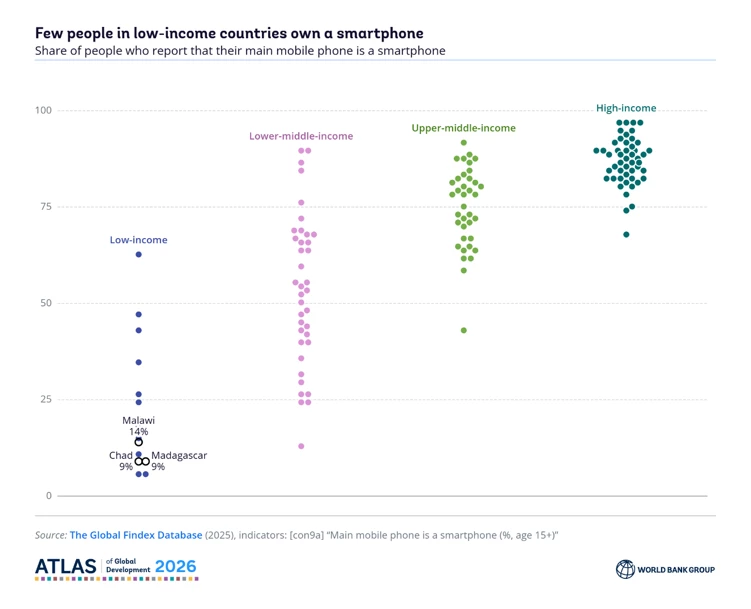
For many people and households, the challenge is not whether a network exists, but whether they can afford to use it. The cost of smartphones, computers, and data plans remains a major barrier. Four times as many people have smartphones in high-income countries compared to low-income countries.
But affordability is only part of the story. Many people also lack the skills to navigate online information, evaluate digital content, or safely use digital services. Without these skills, access does not translate into meaningful use.
Closing the digital divide will require more than expanding networks. It calls for a broader approach, combining infrastructure with affordable devices, lower data costs, and stronger digital skills.
Source : World Bank