

At the time when the Government of South Africa approached the World Bank’s Disaster Risk Financing (DRF) Program about looking beyond natural disasters to social risks such as social violence, which costs South Africa $45.6 billion (13% of GDP) annually, we had already begun exploring this challenge. We were grappling with the complex, dynamic way in which social risks interact with public health emergencies, trade, conflict, extreme weather, and people’s perceptions of them in different places—a mix commonly referred to as polycrises.
With financial support from the Risk Finance Umbrella (RFU) trust fund and the Global Shield Financing Facility, we explored the power of AI to measure, predict, and explain social risks for better preparedness and development impact. Our hope was that if AI models could accurately predict changes in social phenomena, and identify their drivers, we could more effectively and efficiently adjust the nature, scale, location, and timing of development activities before crises occur.
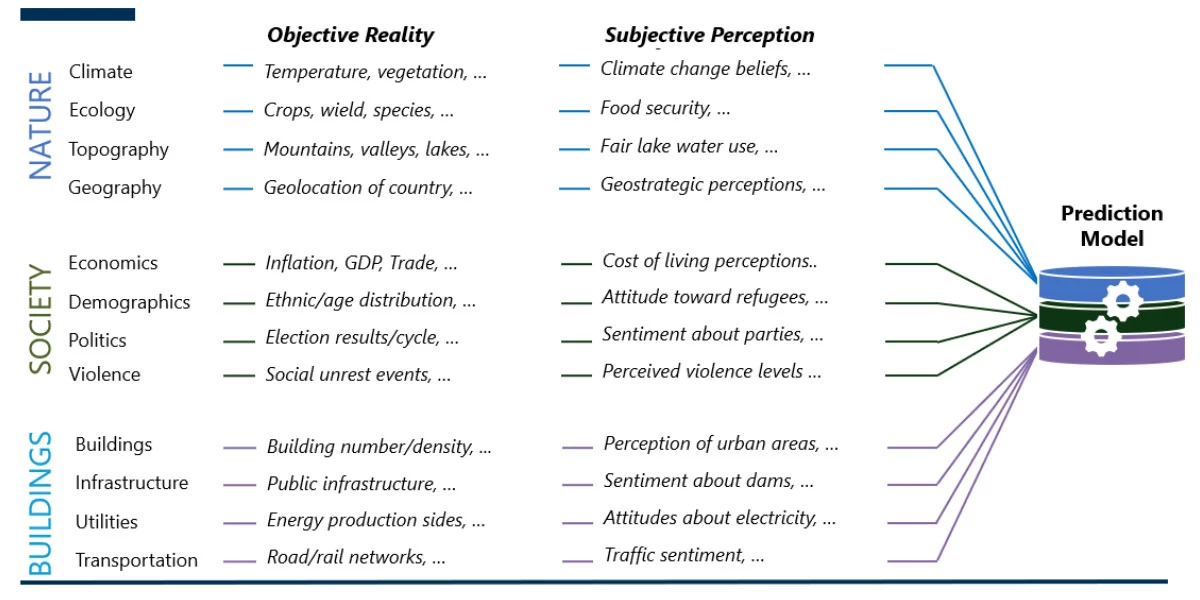
We knew that predicting human behavior requires context-specific consideration of the complex dynamic relationship between millions of dimensions of reality and perceptions of them (Figure 1). Our challenge was about identifying the right phenomena and finding appropriate data for measuring them, i.e., datasets with sufficient frequency and history to allow a machine learning model to observe enough episodes of change. For some phenomena, like variations in population sizes or crime levels, our data science team had to apply AI to newspaper reporting of crime and to satellite imagery of built structures to produce appropriate data for ingestion into our models.
Figure 1: Social science-informed factors ingested into the model
Source: World Bank
Our social science team identified dimensions of the natural, built, and social world, as well as online language about them, informing data collection for three proofs of concept models predicting violence in the Democratic Republic of Congo, changes in the population of the Horn of Africa, and variations in crime levels in a Small Developing Island State. Today, our AI models studying the drivers of social risks are already informing the design and implementation of World Bank policies and operations in Africa (and elsewhere), as well as subsequent analysis.
In the Democratic Republic of Congo
Focusing on three Eastern DRC provinces historically plagued by conflict—i.e., North Kivu, South Kivu, and Ituri—our first model forecast changes in the number of conflict events, and identified, among the thousands of model variables, the phenomena with the highest association to change. This included sentiment about sensitive topics such as land, mining, identity and governance, the size of official government reserves, the price of sugar, and the volume of copper exports.
The model is informing country analytics, including the World Bank’s Risk and Resilience Assessment, alongside the nature, scale, location, sequencing, and timing of World Bank-supported activities, including the Stabilization and Recovery in Eastern DRC project (STAR Est) that envisages a risk financing mechanism to respond to observed or predicted conflict levels.
In the Horn of Africa
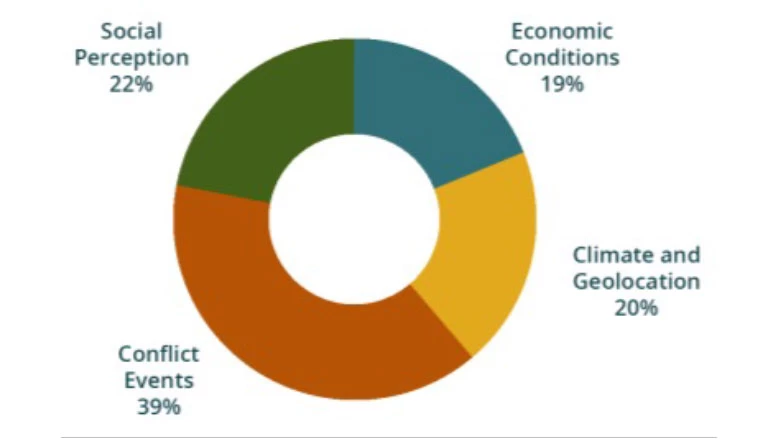
In the data-scarce Horn of Africa borderlands, where Ethiopia, Kenya, and Somalia meet, our team produced five years of monthly data on built structures in 56 towns and cities, using satellite imagery as a proxy for population change. A second model forecast changes in this proxy data: Figure 2 shows the significance of conflict event, economic, and environmental factors, as well as social perceptions of them, as influences on population changes. This data informed the design of the DRIVE (De-risking, Inclusion and Value Enhancement of Pastoral Economies in the Horn of Africa) project which is now exploring model adaptation to forecast livestock supply chain elements affecting agro-pastoralists’ vulnerability. The model is also informing the design of a displacement risk forecasting model for Phase II of the Ethiopia Development Response to Displacement Impacts Project.
Figure 2. Association of model-identified factors with changes in population size in the Horn of Africa borderlands
In a Small Developing Island State
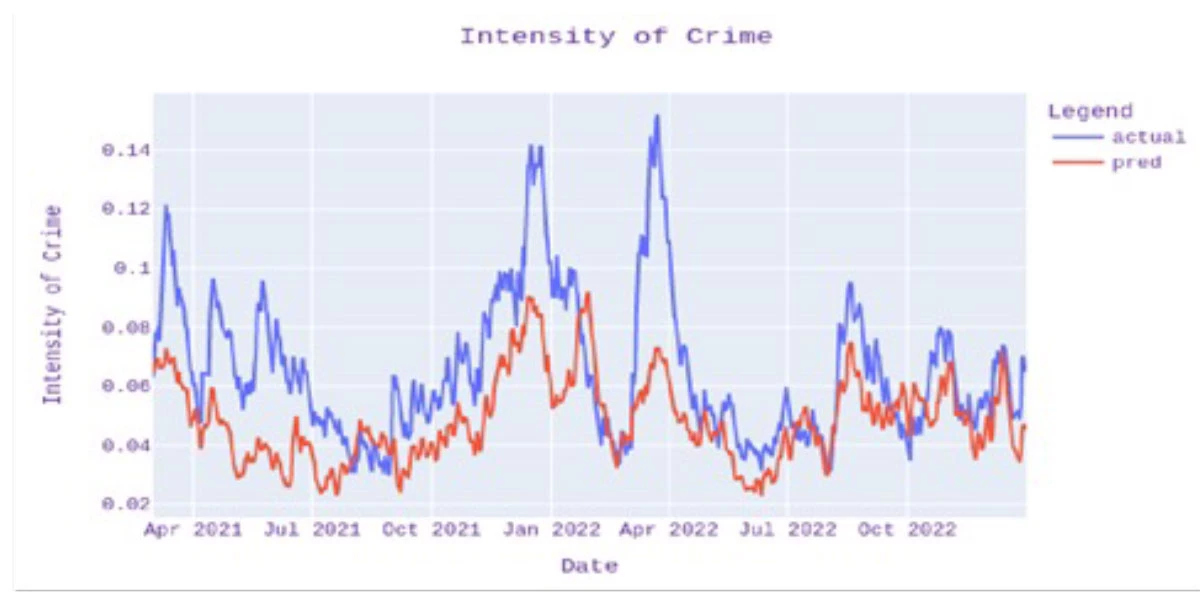
We then turned our attention to forecasting and explaining the number of days until the next social unrest event and change in crime levels in a Small Developing Island State. Social science experts identified crime levels as a likely driver of unrest; however, we were surprised that crime data with sufficient frequency and history was unavailable. This led us to use an agentic large language model (LLM) to produce this data from online news reporting. We then developed a predictive model forecasting daily changes in this crime data with 87.1% accuracy (Figure 3). We then analyzed the model to identify the factors most associated with change. With this model we were able to produce, forecast, and identify associated factors, which enabled us to measure crime to inform The World Bank’s Country Policy and Institutional Index’s crime and violence metric for portfolio development.
Figure 3: The predictive model’s performance against actual levels of reported crime
Source: World Bank
The Social Policy and the Fragility, Conflict and Violence (FCV) practices have already taken this modeling forward to support the world’s first displacement risk financing mechanism enabling the Government of Uganda to scale public service capacity in advance of refugees’ arrival instead of in response.
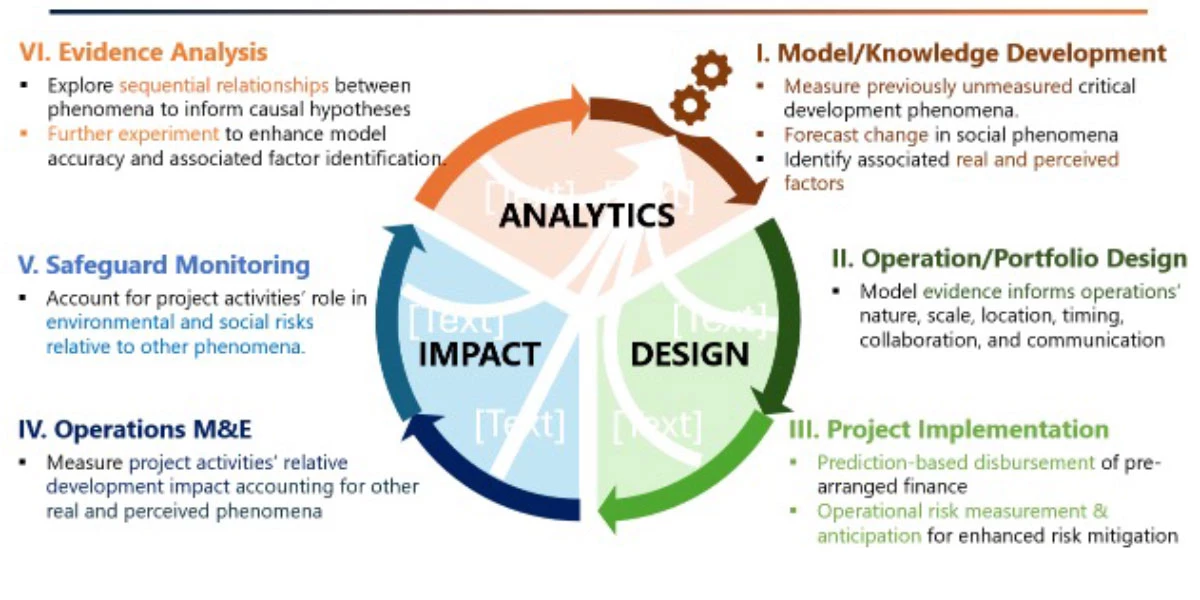
These innovative models are showing the power of AI to transform the way the World Bank measures, understands, and predicts social risks for better development outcomes across a range of applications, as illustrated in Figure 4. Moving forward, we plan to share more details on the models as the operational learning is captured.
Figure 4: Policy, operations, and Knowledge utility of predictive and explanatory AI models
Source : World Bank