

The White House Faith Office is expanding federal support for religious organisations. Can government policy change how religious citizens are, and what does blurring the line between church and state do to attitudes and polarisation? Exploiting the staggered rollout of ‘faith-based initiatives’ across US states from 1996 to 2009, this column shows that church attendance rose sharply among Protestants, new faith-based organisations multiplied, and social views hardened against abortion and homosexuality, while the rest of the population continued to secularise.
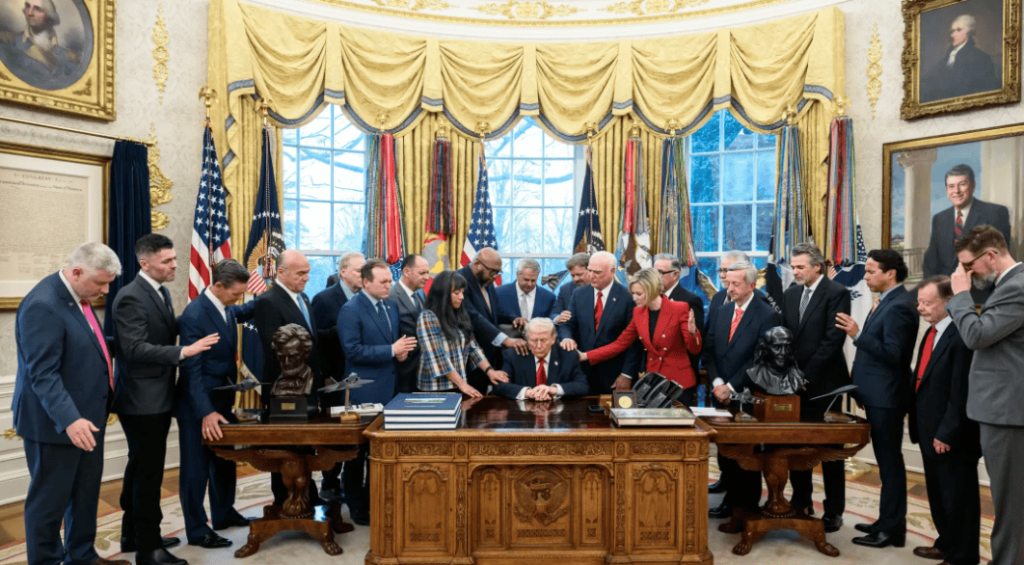
Around the world, governments are pulling religion closer to the state, from Türkiye’s generously funded religious directorate to Viktor Orbán’s church-run schools in Hungary (Duvar English 2024, Republikon Institute and Huvos 2022). One explicit attempt comes from Washington: on 26 June 2026, President Trump’s Religious Liberty Commission presented its report in the Oval Office. Americans, the 224-page document urges, should view religion as an “essential support” and remember “the Creator who made us and bestows our rights”. It proposes expanding public funding for faith-based organisations, allowing political activity by tax-exempt religious groups, and setting broader exemptions for conscientious objections to policies ranging from vaccine mandates to classroom lessons (Boorstein 2026, Smith 2026). “We saved religion, it was going down”, the President said the same day (Smith 2026). Whatever one makes of the claim, it is an empirical one: can government policy change how religious citizens are – and what does blurring the line between church and state do to attitudes and polarisation?
Existing evidence suggests that policies move both religiosity and the values that come with it. When US states repealed their ‘blue laws’ – local laws that restrict certain activities on specified days – and shops opened on Sundays, church attendance fell and drinking and drug use rose (Gruber and Hungerman 2008, Giles et al. 2026). When West German states abolished compulsory religious education, students grew up less religious, with more modern gender views and altered working lives decades later (Arold et al. 2022, 2025). Not every reform reaches that deep: expanded evolution teaching shifted beliefs about evolution but left religiosity untouched (Arold 2024). And policy can even backfire: France’s 2004 headscarf ban pushed young Muslim women out of school and strengthened their religious identity (Abdelgadir and Fouka 2020).
Across all these experiments, government was pushing religion back, never deliberately promoting it. Cross-country patterns suggest that state support of religion goes with higher religiosity (Barro and McCleary 2019, McCleary and Barro 2006). Yet, causal evidence on what happens when government tilts the playing field towards religion is missing.
In a recent paper (Bentzen et al. 2026), we provide such evidence by studying US faith-based initiatives, the direct descendant of which – the White House Faith Office – was established by Trump in February 2025 (Banks 2026).
A quiet revolution
The faith-based initiatives began with the Charitable Choice provision of the 1996 welfare reform. Their stated purpose was to ‘level the playing field’: religious non-profits could now deliver government-funded social services (such as job training, food aid, and addiction treatment) without secularising their operations, and states created offices and ‘faith-based liaisons’ to connect religious organisations with government. An example is Texas’s Teen Challenge bill of 1997, which exempted Christian scripture-based drug rehabilitation from standard state-licensing requirements (Sager 2010).
Between 1996 and 2009, the period for which we have data, US states adopted faith-based initiatives through 332 executive orders and laws, at different times in different states. The movement was strikingly bipartisan: by 2008, 35 governors (19 Democrats and 16 Republicans) had faith-based offices or liaisons. It was also quiet. The policies were advanced by a small circle of evangelical Protestant lawyers, scholars, and politicians. As an adviser said about a 1997 bill, “it was done very quietly, because we didn’t want to draw undue attention to it or spark a bitter church-state separation debate” (Sager 2010). The White House’s 2008 status report was titled “The Quiet Revolution”.
The direct funding was modest (mini-grants of at most $50,000, for instance), but the machinery was large: $14 billion in federal grants flowed to non-profits in 2006 alone, and the liaisons held weekly calls across states, arranged clergy meetings with governors, and steered religious groups towards grant opportunities.
Measuring what followed
The staggered, top-down rollout allows us to estimate causal effects. We combine the timing of each state’s adoption with survey data on 44,758 US residents from the General Social Survey (1987–2018), and compare how religiosity evolved in adopting states relative to those that had not yet adopted the initiatives, using stacked difference-in-differences methods.
Our most demanding test is a triple difference: we compare Protestants with their non-Protestant neighbours in the same state at the same time. Anything that hit a whole state – a recession or local politics – affects both groups and cancels out. We also compare neighbouring counties on opposite sides of a state border. Before the initiatives, adopting and non-adopting states were trending identically; the policies were not a response to rising religiosity in the population. The initiators’ religiosity did not reflect their electorates’, and many religious organisations initially resisted government money for fear of secularisation.
Religion grew for half the country
After a state adopted the initiatives, church attendance among Protestants rose by 8.6 percentage points relative to non-Protestants (Figure 1). That is a fifth of the average state-level attendance rate, and more than five times the average national decline over the period, enough to reverse secularisation locally. It also equals roughly 70% of the attendance gap between men and women, one of the most robust regularities in the sociology of religion. Attendance rose within a year of adoption, peaked after two to three years, and persisted. Other dimensions of religiosity moved too: strength of religious affiliation, belief that the Bible is the literal word of God, and prayer frequency increased.
Figure 1 Church attendance of Protestants and non-Protestants before and after a state adopts a faith-based initiative


Notes: The figure shows event-study estimates of church attendance for Protestants and non-Protestants, relative to the year before a state’s first faith-based initiative.
Source: Bentzen et al. (2026).
To gauge the magnitude, we borrow the persuasion-rate framework of DellaVigna and Gentzkow (2010). We find that 9% of Americans who were not regular churchgoers started attending monthly or more. That places the faith-based initiatives in the upper half of documented persuasion effects in economics, on a par with fundraising campaigns (List and Lucking-Reiley 2002).
This worked as the initiators had planned. Using data on 450,072 non-profit organisations, we find that the initiatives raised the entry of new faith-based non-profits (Figure 2). Most of the new organisations were Christian ministries, missions, and churches (Figure 3), and their registered missions spell out their intent: “evangelism and sharing the gospel with our community” (We Will Go), making “abortion unnecessary and undesirable in our region” (First Choice Center for Women), and “development of male based curriculum for leadership in the home” (Oaks of Righteousness). A back-of-the-envelope calculation suggests the entry of more than 2,000 faith-based organisations, potentially reaching 4.9 million people a year, or 3.5% of American Protestants. Effects are driven by the laws that build church-state infrastructure (liaisons, deregulation), not by welfare delivery nor by the poor: if anything, higher-income Protestants responded the most to the initiatives. This was not soup-kitchen conversion; it was a shift in the religious marketplace (Iannaccone 1998, Iyer 2016).
Figure 2 The share of faith-based organisations before and after a state adopts a faith-based initiative


Notes: The figure shows event-study estimates of the probability that a non-profit organisation is faith-based, relative to the year before a state’s first faith-based initiative.
Source: Bentzen et al. (2026).
Figure 3 The most frequent religious words in the names of US non-profit organisations


Notes: Word size reflects the frequency of religious words in the names of non-profit organisations.
Source: Bentzen et al. (2026).
Beliefs, laws, and a widening divide
Social views followed, more slowly. Four to seven years after adoption, Protestants had become significantly more opposed to homosexuality and abortion – the issues the evangelical initiators cared most about – and more likely to call themselves conservative (by 5.8 percentage points, a third of the average). These shifts left traces beyond opinion surveys. Treated states became more likely to write gay-marriage bans into their constitutions (a total of 31 states did so between 1998 and 2015). Gender gaps in wages and college education widened, even as self-reported views on gender became more progressive, perhaps because religious respondents are more inclined to give the virtuous-sounding answer.
Everyone else was unmoved. Non-Protestants’ attendance, beliefs, and views continued to secularise, and within Protestantism, the rise was concentrated among evangelicals, the initiators’ own tradition, and Black Protestants, the initiatives’ earliest embracers. In a country whose polarisation is usually told as a story of parties, media, and economic shocks (Iyengar et al. 2019, Levy 2021, Autor et al. 2020, Boxell et al. 2021), our results document polarisation along religious lines – driven not by partisan sorting but by a policy that resonated with one group and passed the other by, just as group identity theories predict (Bonomi et al. 2021, Tabellini and Gennaioli 2019) and as long suspected in accounts of the religious divide in the US (Putnam and Campbell 2012). Nor is this unique to the US: in Brazil, Pentecostal expansion raised the vote share of evangelical and far-right candidates (Solá 2025).
The faith-based initiatives were part of a broader strengthening of religion in government in the US, so we interpret our estimates as the effect of that bundle. Further, because we exploit only state-level variation while much of the policy was federal, our estimates are, if anything, conservative.
Lessons for the rerun
So, can government policy save a religion that is ‘going down’? The US’s past says yes, for a while and for some: where states embraced the faith-based initiatives, Protestant religiosity stopped falling and rose instead. But the revival of religiosity did not come alone. Views hardened against homosexuality and abortion, gay-marriage bans entered state constitutions, and gender gaps in wages and education widened. And because the policies moved only one group while everyone else continued along their path, the two halves of the country drifted further apart.
The current US administration is now rerunning the experiment, and it is not alone. Wherever governments blur the boundary between church and state, the stakes are the same: such policies likely change what citizens believe, selectively, and can widen the religious and social divides they leave behind.
Source : VOXeu