

The East Asia and Pacific (EAP) region has achieved one of the most remarkable economic transformations in history. In just a few decades, hundreds of millions of people have been lifted out of poverty, living standards have surged, and the region has become a global benchmark for what development looks like when it works. But success raises its own questions, and the most urgent one is this: having come so far, so fast, what does it take to keep going?
A new World Bank paper examines the region’s progress in building a larger and more economically secure middle class, and the findings are at once encouraging and sobering. Today, roughly one in three people in the EAP region belongs to the middle class, with economic security to withstand shocks without sliding back into poverty. The region also leads the world in the pace of growth in the middle class over the last decade. Much of this has been driven by China, where the middle class grew from 11 percent of the population in 2010 to around 40 percent in 2021. But across the rest of the region, momentum has slowed. Many who escaped poverty are struggling to gain a foothold in the middle class. While there has also been strong progress in rural areas, EAP’s cities remain the most powerful engines of upward mobility—urban residents are twice as likely as rural ones to belong to the middle class. Growing a vibrant and resilient middle class, the paper argues, is a distinct and harder challenge, but one the region has the tools, the track record, and the opportunity to meet, if it acts with purpose.
Jobs have been key, but the ground is shifting
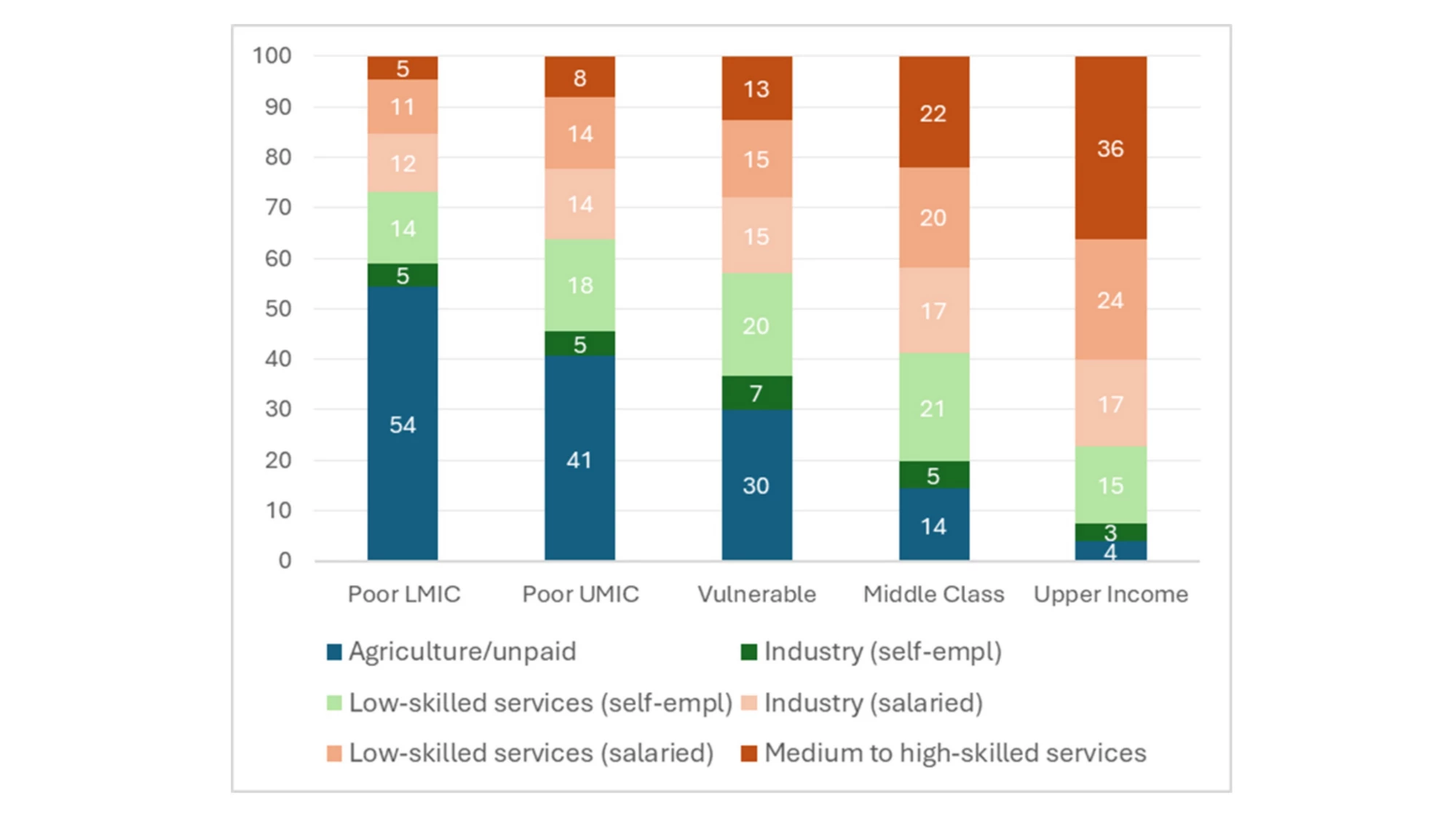
Jobs have been the single most powerful driver of middle-class expansion. Around 77 percent of those in upper-income groups and 59 percent of those in the middle class hold salaried jobs, making a steady paycheck still the most dependable ladder up. The poor and vulnerable, by contrast, remain concentrated in agriculture, unpaid work, and self-employment—sectors that rarely offer the security needed to cross into the middle class and stay there.
What is happening in the labor market matters enormously for middle-class prospects. A recent World Bank report finds that the region’s employment rates are high by global standards, but high employment alone does not tell the full story. Labor productivity remains below the global average in most economies outside China and Malaysia, and its pace of growth is slowing. Workers leaving agriculture are landing primarily in low-productivity services, not the high-productivity manufacturing that historically powered middle-class expansion. Informal employment remains widespread. The region is generating jobs, just not enough of the right kind to reliably deliver middle-class livelihoods.
This productivity slowdown is unfolding alongside a profound reconfiguration of work itself. Automation, AI, and digital platforms are reshaping the opportunity landscape, and not evenly. The World Bank’s Future Jobs report finds that robot adoption across five major EAP economies created around 2 million jobs for skilled formal workers between 2018 and 2022, while displacing 1.4 million low-skilled workers in routine manual roles. The net figure of 600,000 jobs sounds positive until you look at who is on each side of the ledger. The jobs being created require education and digital skills. The jobs being destroyed are exactly the ones that have historically served as the first rung into the formal economy for workers without advanced qualifications.
AI poses a different and harder challenge altogether. With the region’s large services workforce, its exposure to this rapidly evolving technology is vast, and the disruption is still unfolding. Digital platforms have opened real doors: e-commerce has expanded labor market access for women, and gig work has drawn in younger workers, primarily men. But opportunity and security are not the same thing. Platform work, even when the pay is comparable to other forms of informal work, rarely comes with health coverage, pensions, or job security. And it is precisely these very protections that separate precarious gig work from genuine economic security.
Building on what works
Meeting this challenge calls for action on three fronts simultaneously. The first is investing in human capacity: education, health, and training that complement rather than compete with new technologies. The second is expanding economic opportunity through infrastructure, a stronger business environment, and private capital. The two must advance in lockstep. Skilled workers will find few quality jobs in an economy without the dynamism to create them. And a dynamic private sector operating in a shallow talent pool cannot reach its productive potential. A third imperative cuts across both: social protection must reach beyond the formal economy. Informal workers, who are the majority of the region’s workforce, need access to portable benefits that actually deliver economic security, not just the promise of it.
The stakes extend well beyond individual livelihoods. In the EAP region, as elsewhere, the middle class is also the consuming class, which is the engine of domestic demand that sustains businesses, drives growth, and powers economies that cannot depend on exports alone. But middle-class households do more than consume. They demand better public services and contribute more to financing them, strengthening the social contract between citizens and governments. A growing middle class, in other words, does not just reflect development success; it helps fuel and sustain it.
The EAP region’s poverty reduction story is one of the great achievements of our time. The middle-class story is still being written. The region has every reason and every tool to make it just as remarkable.
Source : World Bank