


Throughout the 2000s and early 2010s, Romania was known more as an IT outsourcing destination than a startup hub. Its talent base was strong, but the broader entrepreneurial ecosystem remained nascent, with venture capital activity lagging regional peers well into 2015. Over the following decade, the landscape changed dramatically: cumulative venture capital (VC) investment rose from less than $1 million between 2011 and 2015 to an annual average of $84 million between 2021 and 2024.
While much has been written about the growth, innovation, and job creation driven by Romania’s digital entrepreneurial ecosystem, less has been written about how effectively such ecosystem developed and took shape. Today, Romania hosts 13 active VC funds – of which 5 are fully Romania-based – 3 are considered unicorns, and where VC investment volumes are nearly 100 times larger than a decade ago. How did it get there?
Purposeful public and DFI intervention
EU-funded programs played a pivotal role in shaping Romania’s private capital landscape. The JEREMIE program (2007–2013) was the first holding fund created to support Romanian fund managers achieve their fundraising targets. This approach, continued through subsequent equity instruments, allowed early ecosystem builders to test the VC and private equity (PE) model in the country, eventually leading to the emergence of locally rooted institutional fund managers with long-term presence and operational continuity.
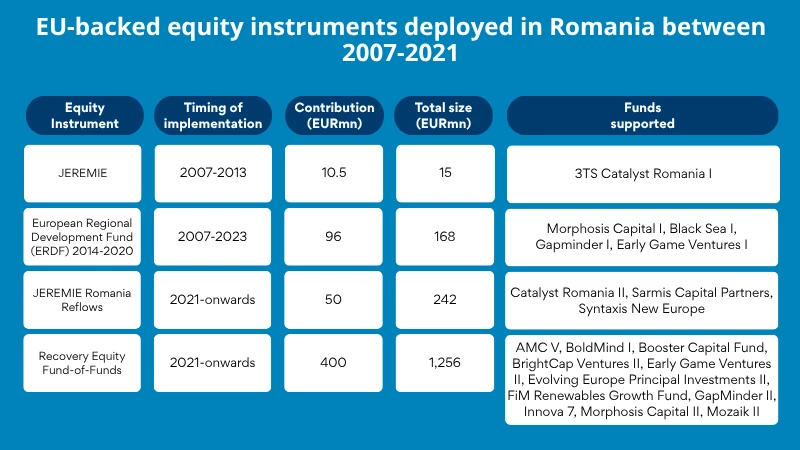
First-generation funds need follow-on capital to prove their model, and development finance institutions (DFIs) play a key supportive role. DFIs, the EU, and local government programs accounted for 53 percent of the capital committed to PE and VC fundraising activities between 2018 and 2024, providing not only funding but also the credibility to attract co-investors. One example of this is IFC’s recent EUR 10 million commitment to GapMinder Fund II which signals continued confidence in the ecosystem’s maturation.
A trailblazer that spurred ecosystem growth
The rise of UiPath was pivotal in establishing Romania as a destination for international investors. Founded in 2005 as a small IT consulting firm, it pivoted in 2012 toward robotic process automation, a technology category that at the time was in its infancy worldwide. IFC’s investment of $25 million in BEK Ventures, an early-stage VC firm backing tech founders from Türkiye and Central and Eastern Europe, helped the fund lead UiPath’s seed round in 2015 – a bet that would prove transformative. By 2018, the company had become Romania’s first unicorn, backed by Sequoia, Accel, and other leading venture capital investors. Its April 2021 IPO on the New York Stock Exchange valued the company at roughly $36 billion, one of the most successful software listings of its era.
The downstream effects of its success were significant. Annual VC investment in Romania surged from an average of $11 million between 2016–2020 to $84 million between 2021–2024 (see Figure 1), while new business registrations nearly doubled, outpacing regional peers. Startups like FintechOS, Druid AI, and MultiversX benefited from these catalytic effects, expanding the ecosystem to an estimated EUR19 billion in enterprise value.
Human capital and the ITC economy as a necessary foundation
Romania’s success wouldn’t have been possible without its deep reserves of technical talent. The country ranks among the EU’s top three for the share of STEM graduates, and compounded with government investment into IT infrastructure, this translated into economic weight: by 2021, the Information and Communications Technology (ICT) sector accounted for 4.5% of GDP – more than double its 2011 share – while ICT services made up over 60% of total service exports.
The outsourcing economy of the 2000s served as an important training ground where engineers developed real-world product and delivery skills, with some eventually becoming founders themselves.
Diaspora networks provide a bridge between capital and talent
The angel and accelerator layer spurred by the Romanian diaspora played another critical role in supporting startup growth at the earliest stages. TechAngels, founded by Andrei Pitiș, a Romanian entrepreneur with experience in Silicon Valley, has deployed over EUR46 million into 270+ startups; SeedBlink, founded by four Romanian senior executives with experience in technology, finance and entrepreneurship, became Eastern Europe’s largest equity crowdfunding platform; and Transylvania Angels Network, which attracts Romanian entrepreneurs based in Singapore, UK and the US, has facilitated over EUR3.5 million in 35 startups. While these networks cannot match the funding scale of public institutions or private institutional investors, they are key in transferring essential product, delivery, and managerial skills, filling persistent gaps in the local ecosystem.
Romania’s transformation is the product of coordinated public support enhanced with strategic DFI investment, a catalytic success story, availability of talent, and a diaspora willing to invest back home. For policymakers, Romania’s experience suggests that ecosystems may require multiple reinforcing layers that don’t always emerge through market forces alone, and that purposeful public intervention can play a critical role in aligning capital, capability and ambition.
Source : World Bank