
Recently, the PIP Innovation Hub was added to the Poverty and Inequality Platform (PIP) as a way to showcase experimental work on poverty and inequality measurement. One of the Deep Dive approaches presented in the Innovation Hub as an alternative to the World Bank’s official estimates in PIP addresses two well-known issues prevalent in household surveys. First, there is a disparity between the level of living standards implied by national accounts and survey data. Second, household surveys struggle to capture responses from the richest households. The Deep Dive updates earlier work by Prydz, Jolliffe, and Serajuddin (2022), which documents the gap between surveys and national accounts, and applies the methodology by Chandy and Seidel (2017a, 2017b) to account for undercounting of top incomes. In this approach, part of the gap is allocated to the top of the distribution to address the problem of the “missing rich” (similar to an earlier effort by Lakner and Milanovic, 2016).
The gap between surveys and national accounts
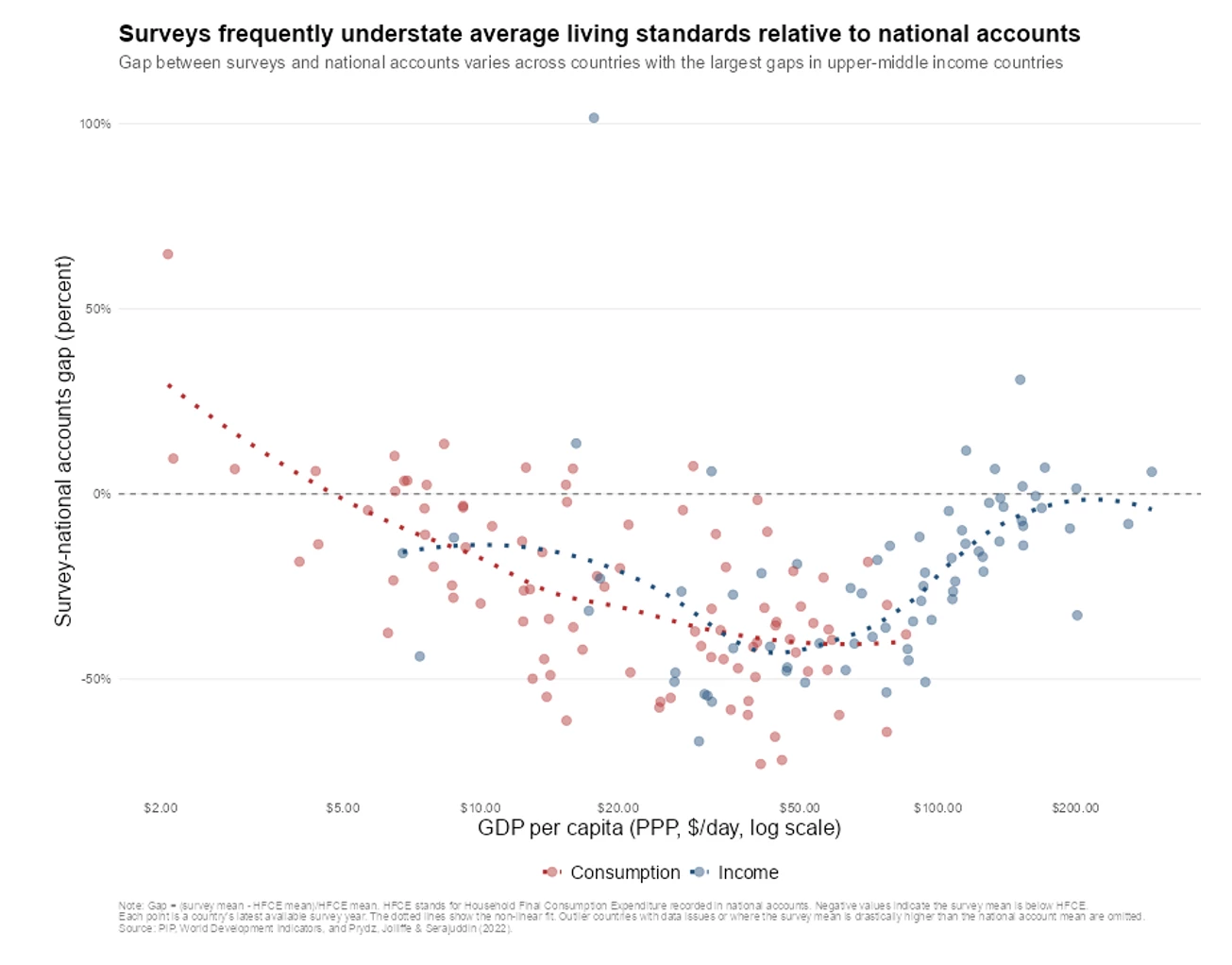
Per capita consumption and income reported in national accounts is typically higher than what is reported in household surveys. For instance, Ecuador reports per capita consumption at $24 per day in 2023 in national accounts, while survey data showed $18 in the same year (both expressed in 2021 PPPs), which means that the survey mean is around 26 percent smaller. These kinds of discrepancies have sparked debates on poverty and growth, such as “The Great Indian Poverty Debate” (Deaton & Kozel, 2005; Sandefur, 2022). Analysis of over 2,000 surveys since 1990 reveals that survey means are, on average, 26% lower than national account consumption (HFCE), and 55% lower than GDP per capita. The gap varies systematically with a country’s level of development: Figure 1 illustrates that the gap is smaller (and even sometimes positive) in low-income countries, grows as countries get richer, and narrows again for high-income countries.
Allocating the gap to the richest households
One potential explanation for the observed gap between surveys and national accounts is that surveys fail to fully capture the consumption and incomes of the richest households who are thus “missing” from surveys. For example, the rich are less likely to participate in surveys because they reside in gated communities, or their observations are discarded as outliers. If the richest individuals are missing from the survey distributions, adjustment approaches to include them, whilst minimal on poverty rates, could have large implications on the level of inequality.
Chandy and Seidel’s method addresses these two issues by attributing half of the gap between the survey mean and the national account mean to the rich. Specifically, they extend the survey distribution by fitting a Pareto distribution using information from the top decile of the survey distribution. Whilst how much of the survey-national account gap to attribute to the “missing rich” is somewhat arbitrary, Chandy and Seidel (2017a) conclude that roughly half of the gap is explained by differences in definitions between national accounts and surveys. Generally, national account aggregates are much broader in scope, meaning that items such as financial services to households are frequently excluded from household surveys but form part of the national account aggregate (see the Atkinson report for a summary of these definitional differences). Given the uncertainties and differences that cause the gap, the Innovation Hub dashboard reports Gini estimates by varying the share of the survey-national accounts gap attributed to the top in 5 percentage point steps.
Figure 2 presents the differences in the Gini depending on whether 25%, 50%, 75%, or 100% of the survey-national account gap is attributed to the “missing rich”. The average increase in the Gini by attributing 25% and 50% of the survey-HFCE gap are 13% and 23% respectively, whilst attributing the entire gap to the very rich increases the Gini by 38%.
The Gini adjustments are almost twice as large for consumption-based surveys (typically conducted in poorer countries) compared to income-based surveys (typically conducted in richer countries). In addition, Gini indices from consumption surveys are generally lower than those from income surveys. Combined, the adjustment could impact country rankings. For instance, using 50% of the survey-national accounts gap, the Gini increases from 36 to 48 on average for consumption surveys compared with 37 to 44 for income surveys.
Some final words
A key consideration when interpreting top-adjusted Gini estimates is the uncertainty inherent in the methodology. As the results presented in this blog have shown, the Gini results are highly sensitive to specific assumptions: the decision to attribute, for example, 50% of the HFCE-survey gap to the “missing rich” is ultimately arbitrary. This uncertainty not only affects inequality measurement but also carries broader implications for other indicators. For instance, the World Bank’s threshold for “high inequality” set at a Gini of 40, may need to be revisited in light of upward adjustments to the Gini.
The results also highlight that more work on the gap between national accounts and surveys is needed, and whether and how it relates to underestimation of inequality in surveys. It is clear that surveys tend to underestimate the top tail, but the extent to which this happens in all countries is unclear. At the same time, it is also evident that national accounts do not directly measure households’ standards of living. Therefore, to move this methodological work forward, the key lies in combining the insights from these various sources of information.
Source : World Bank